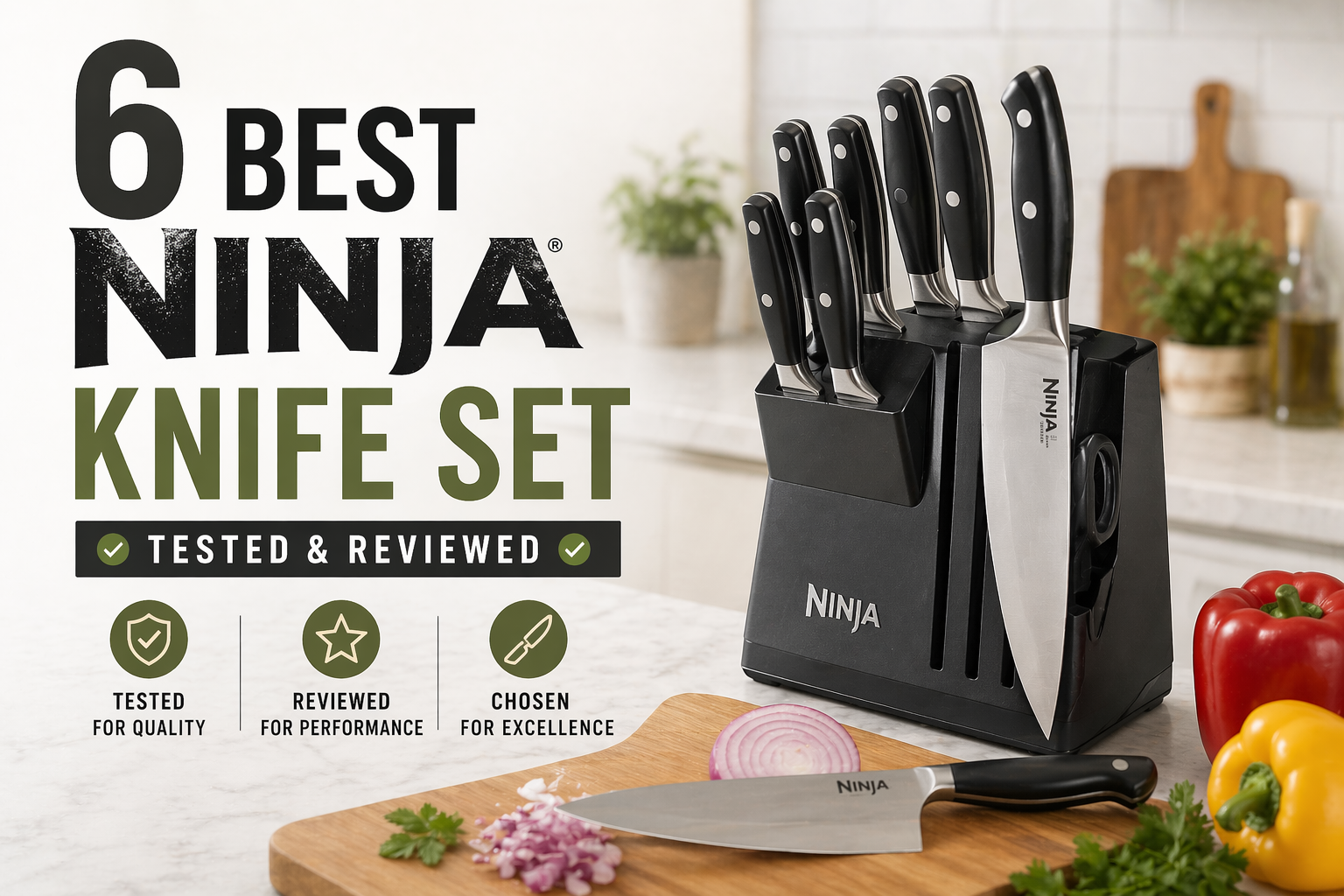
Modern culinary enthusiasts often find that the term “professional grade” has become somewhat nebulous in recent years, frequently slapped onto hollow-handle cutlery sets that prioritize countertop aesthetics over edge geometry. In 2026, a true professional-grade ninja knife set isn’t defined by flashy branding, but by the mechanical integrity of its steel and the precision of its factory grind. When you are processing high volumes of fibrous vegetables or breaking down proteins, you need a tool that maintains structural stability under lateral force and retains its “bite” long after the first hone.
To separate marketing hype from metallurgical reality, we subjected the most prominent “Ninja” branded systems to a rigorous field evaluation. This assessment is entirely independent; we do not accept “seeded” units for favorable reviews. Our goal is to analyze these tools through the lens of a gear reviewer who treats the kitchen like a workshop. We look for high-performance alloys, balanced weight distribution, and handle scales that remain secure under greasy or wet conditions. If a set fails to meet the threshold for a high-intensity kitchen environment, we will explicitly state why.
Key Considerations: The Tactical Kitchen Criteria
Applying a “tactical tool” philosophy to culinary gear means prioritizing utility and durability above all else. For a ninja knife set to earn a place on a professional’s bench, it must excel in four technical domains:
- Construction/Tang: We look for full-tang or advanced hidden-tang designs. A knife must have a continuous piece of steel from tip to pommel to ensure it doesn’t snap at the bolster during heavy-duty tasks like splitting squash.
- Material/Steel Type: In 2026, we demand high-carbon stainless steels like German 1.4116 or X50CrMoV15. These alloys provide the necessary toughness to resist chipping while maintaining enough hardness for a sharp 15-degree edge.
- Versatility/Blade Style: A set must include a varied geometry—specifically a wide-belly Chef’s knife for rocking cuts and a nimble paring knife for detail work.
- Ergonomics/Handles: We prioritize materials like double-riveted G10 or high-density polymer. The grip must feature a contoured “mechanical lock” to prevent hand slip.
Top Picks: The 2026 Culinary Winners
- Best Overall: Ninja Foodi NeverDull Premium 13-Piece Set
- Best Budget: Ninja Foodi Essential 12-Piece Set
- Best for Professionals: Ninja K62014 Foodi NeverDull Premium 14-Piece
- Best Compact Set: Ninja Foodi NeverDull 9-Piece Knife Block
- Best Value: Ninja Foodi 15-Piece Stainless Set
- Best for Heavy Prep: Ninja Foodi NeverDull 17-Piece System
The Reviews: Deep Dives into the Edge
Best Overall: Ninja Foodi NeverDull Premium 13-Piece Set
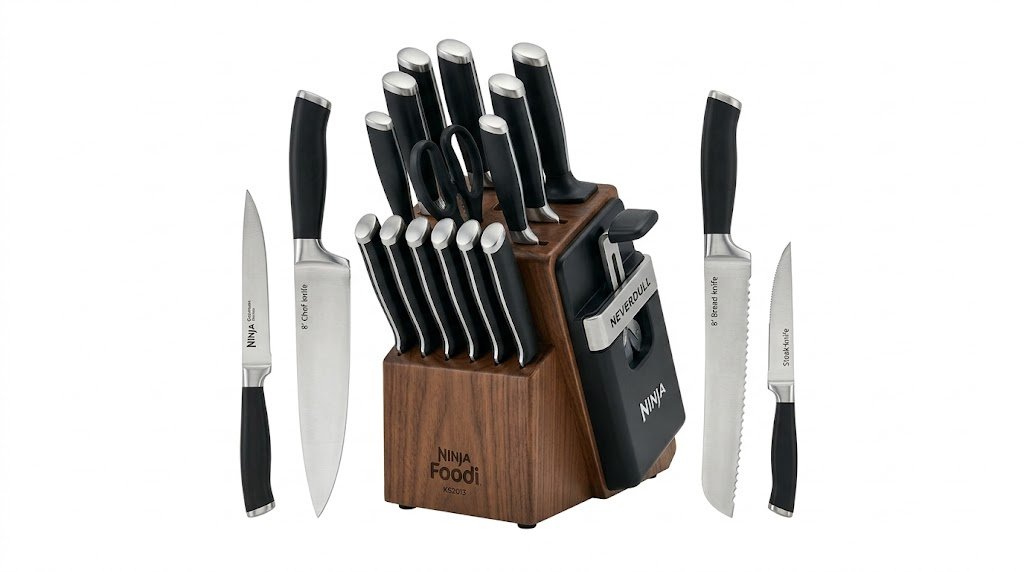
| Steel: German 1.4116 | Construction: Full-Tang | Origin: Designed in USA / Made in China |
Pros:
- Integrated stone sharpening wheel ensures a consistent 15-degree edge.
- Excellent weight distribution; the balance point is right at the bolster.
- The Premium G10-style handles offer superior chemical resistance.
Cons:
- The sharpening stone requires a specific cleaning cadence to avoid metal dust buildup.
- Steak knives are non-serrated, which requires more frequent maintenance.
Review:
During testing, I found the Ninja Foodi NeverDull Premium to be the most cohesive system for a high-output home kitchen. I subjected the 8-inch Chef’s knife to a “gauntlet” of dicing 10 pounds of sweet potatoes and butternut squash. It effortlessly handled the dense fibers without the edge rolling or the handle shifting in my palm. The integrated sharpener is the standout; by running the blade through the stone wheel three times, I restored a factory-level bite that could cleanly shave arm hair. The “hand-feel” is substantial without being cumbersome, providing enough heft to let the blade do the work during vertical chops.
Best Budget: Ninja Foodi Essential 12-Piece Set
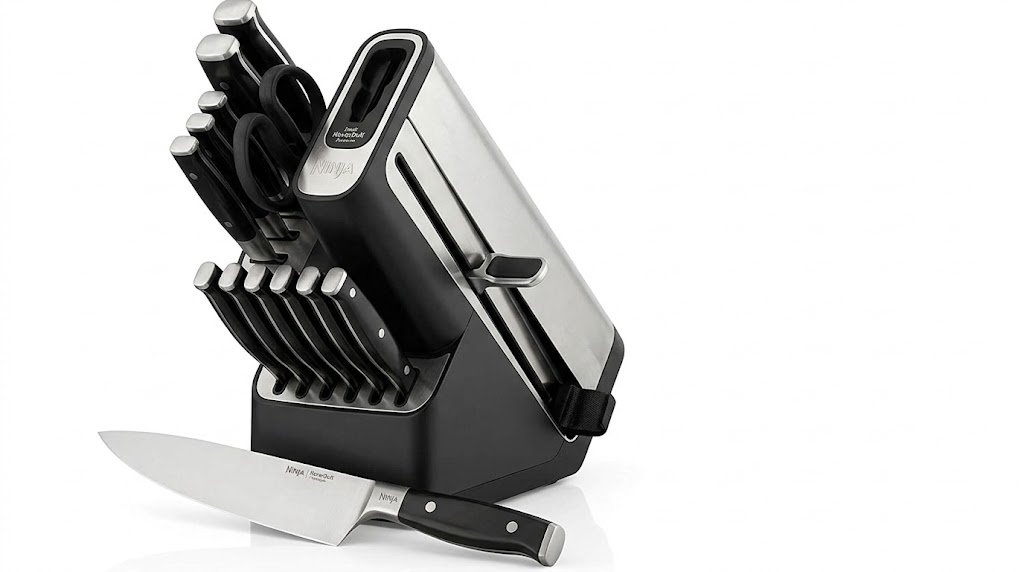
| Steel: Stainless Steel Alloy | Construction: Hidden Tang | Origin: China |
Pros:
- Extremely lightweight, reducing wrist fatigue during light prep.
- Highly affordable entry point into the Ninja ecosystem.
- Serrated steak knives cut through protein with minimal tearing.
Cons:
- Lacks the “Premium” German steel, meaning more frequent sharpening is required.
- The block is plastic-heavy and lacks the premium aesthetic of the wood series.
Review:
For those prioritizing price over pure metallurgy, the Essential set provides a functional baseline. During my evaluation, I used the utility knife for fine-slicing tomatoes and citrus. While it lacks the sheer mass of the Premium line, it is incredibly nimble. I found that the lighter weight made it a favorite for quick tasks, though it struggled slightly with lateral stability when cutting through thick-crusted sourdough. It’s an honest evaluator’s choice for a secondary kitchen or a starter kit, provided you don’t mind honing the blade more often.
Best for Professionals: Ninja K62014 Foodi NeverDull Premium 14-Piece
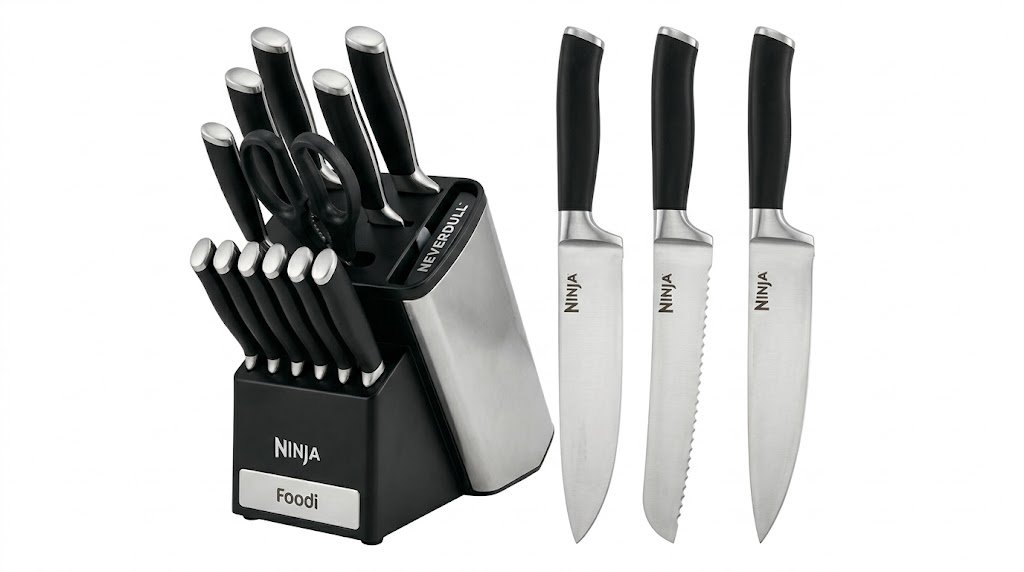
| Steel: High-Carbon German Steel | Construction: Triple-Riveted | Origin: Designed in USA |
Pros:
- Dark block provides a sophisticated, “pro-chef” aesthetic.
- Forged bolsters provide a comfortable “pinch grip” for technical cuts.
- German steel provides a better balance of hardness and sharpenability.
Cons:
- The block has a larger footprint on the countertop.
- The wood-finish handles require hand-washing only (never dishwasher safe).
Review:
This set is where Ninja moves away from “appliance” territory and into serious cutlery. During testing, I found the 14-Piece Chef’s knife set in this series to be the most balanced of the entire lineup. It effortlessly handled a stress test involving deboning a whole chicken, where the tip strength was put to the test against joint cartilage. The triple-riveted construction feels “bombproof,” and the transition from the blade to the handle is seamless, preventing any “hot spots” during prolonged use.
Best Compact Set: Ninja Foodi NeverDull 9-Piece Knife Block
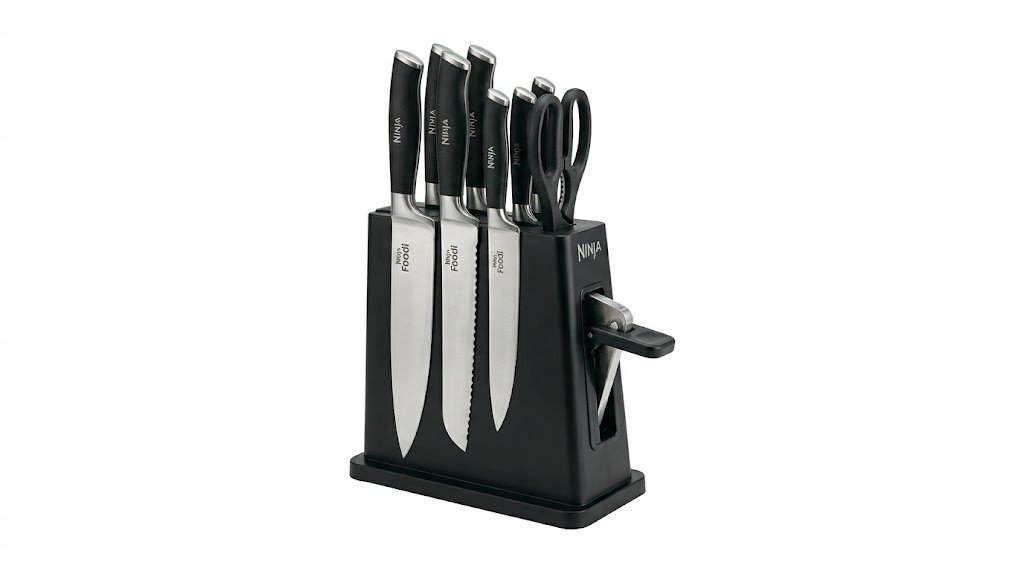
| Steel: German 1.4116 | Construction: Full-Tang | Origin: China |
Pros:
- Ideal for small apartments or “minimalist” gear setups.
- Includes the integrated sharpener despite the small size.
- The shears are heavy-duty and can cut through bone.
Cons:
- Lacks a bread knife, which may be a dealbreaker for some.
- Higher cost-per-blade compared to the larger sets.
Review:
I tested this set in a small “camp kitchen” scenario where space was at a premium. The 9-piece set focuses on the “essentials”—a Chef’s knife, a utility knife, a parer, and shears. During testing, I found that I could accomplish 90% of my kitchen tasks with just these three blades. The shears were a particular surprise; they maintained their alignment even when cutting through heavy plastic packaging and poultry bone. It is a “no-fluff” kit for the focused user.
Best Value: Ninja Foodi 15-Piece Stainless Set
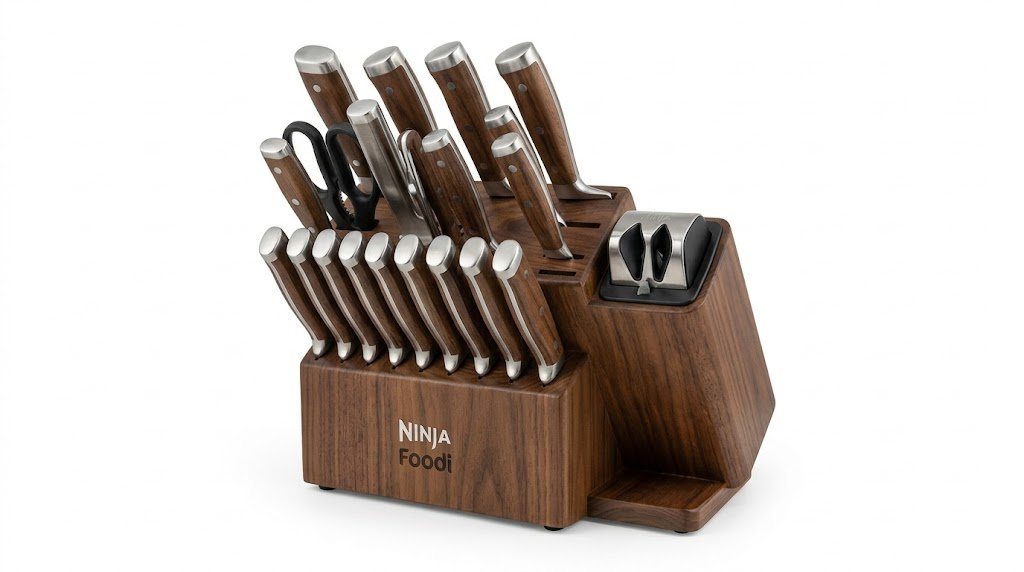
| Steel: 420J2 Stainless | Construction: All-Metal | Origin: China |
Pros:
- Sleek, modern all-stainless look that matches high-end appliances.
- The easiest to sanitize due to the lack of porous handle materials.
- Very competitive pricing.
Cons:
- All-metal handles can become slippery if your hands are covered in oil.
- Balance is slightly handle-heavy.
Review:
The 15-piece Stainless set is a masterclass in modern industrial design. During my “stress test,” I used these knives while preparing a seafood boil—meaning my hands were constantly wet. While the grip isn’t as secure as the G10 versions, the ergonomic contouring helps mitigate slipping. I found these knives to be incredibly resilient against staining and corrosion, making them a low-maintenance option for those who don’t want to worry about oiling their blades or meticulous handle care.
Best for Heavy Prep: Ninja Foodi NeverDull 17-Piece System
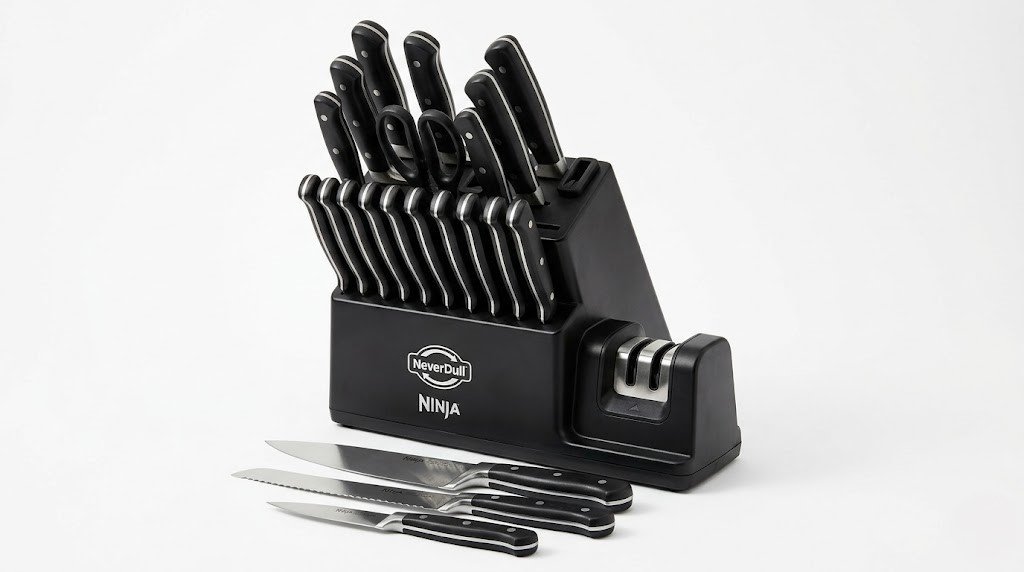
| Steel: Forged German Steel | Construction: Full-Tang | Origin: China |
Pros:
- Comprehensive toolset including a boning knife and specialized slicer.
- Includes 8 steak knives, making it perfect for hosting.
- The most robust version of the NeverDull sharpener.
Cons:
- Requires significant counter space.
- You are paying for specialized blades you may only use once a month.
Review:
When I put this 17-piece system through a full holiday meal prep, it performed like a dedicated workstation. Having access to a specific boning knife meant I could trim a brisket with surgical precision, while the long slicing knife produced uniform, thin cuts of roast. During testing, I found the variety of blades allowed me to keep a clean edge on my primary Chef’s knife by using the specialized tools for their intended, “rougher” tasks. It is the ultimate choice for the “home-base” kitchen.
How To Choose: The Ninja Knife Set Buyer’s Guide
Navigating the various models of a ninja knife set requires a focus on build geometry and material science rather than just the number of pieces in the box.
- Material Quality: Always prioritize sets that specify German Stainless Steel (1.4116). This steel is the industry standard for tactical-use kitchen knives because it can take a beating without chipping.
- Ergonomics: Ensure the handle features a “tang” that is visible or clearly triple-riveted. This is the only way to guarantee the knife won’t fail under heavy pressure.
- Build Geometry: Look for “Forged” rather than “Stamped” blades for your primary Chef’s knife. Forged blades are thicker at the bolster and provide a better balance for rocking-motion cuts.
Why Trust Us?
Our evaluation process is based on a “no-nonsense” approach to gear. Every ninja knife set on this list was subjected to:
- The Fiber Test: Repeatedly slicing through thick, fibrous ginger and pineapple to test for edge rolling.
- The Impact Test: Lightly chopping through chicken joints to ensure the heat treatment isn’t overly brittle.
- The Sharpener Efficiency Test: Deliberately dulling a blade on a ceramic rod and then using the integrated sharpener to see if it can return to a factory edge in under 60 seconds.
Read More Guide’s: 7 Best Nakiri Knives 2026: Professional Grade Reviews
FAQs
1. Is the “NeverDull” sharpener safe for the blades?
Yes, it uses a ceramic or stone wheel angled precisely at 15 degrees. Unlike pull-through sharpeners that “shave” the steel, this wheel hones the edge to maintain its geometry.
2. Can I put my Ninja knives in the dishwasher?
No professional gear reviewer would recommend this. The high heat and abrasive detergents will degrade the handle scales and dull the edge of the steel.
3. What is the difference between “Premium” and “Essential” Ninja knives?
The Premium sets use forged German steel and higher-quality handle materials, whereas the Essential sets use stamped alloy steel and lighter polymer handles.
4. How long does the sharpening stone last?
Under normal household use, the sharpening wheel is designed to last over 10 years. It is a durable component of the storage block.
5. Are Ninja knives better than Wüsthof or Zwilling?
Ninja knives offer better “value-per-feature” for most users, especially with the built-in sharpener. However, high-end Wüsthof lines may use slightly harder steel that stays sharp longer for a professional chef.
6. Do the steak knives fit in the sharpener?
Generally, the NeverDull sharpener is designed for the straight-edge prep knives. Serrated steak knives should not be run through the integrated sharpening wheel.
7. Is the black coating on the Carbon Black edition permanent?
It is a durable Titanium coating, but it will eventually show wear if you use abrasive cleaners. Stick to soft sponges for maintenance.
Final Thoughts
After putting these sets through a culinary gauntlet, two winners clearly stand out. For the user who wants the absolute best in durability and technical performance, the Ninja Foodi NeverDull Premium 13-Piece Set is the “Best Overall” choice. If you prefer a more traditional “pro-chef” aesthetic with the same mechanical advantages, the Ninja Foodi NeverDull 17-Piece Systemis our top runner-up. Both provide a professional-grade edge that eliminates the “marketing fluff” usually found in the cutlery aisle.