Reliability in a high-velocity commercial meat plant or a craft whole-animal butchery is measured by mechanical survival. In 2026, the standard for a “professional grade” butcher knife has shifted away from mere aesthetic appeal toward a strict requirement for lateral stiffness, carbide density, and thermal stability. When you are processing hundreds of pounds of protein daily, a knife is no longer just a kitchen tool; it is a mechanical extension of your skeletal system that must provide the leverage to split heavy cartilage while maintaining the surgical finesse required for “silver skin” removal.
Modern metallurgy has allowed us to move past the thin, stamped blades that lose their apex after a single sub-primal breakdown. Today, we demand steel that can handle the high-friction environment of the cold room without micro-chipping against bone. In this report, we strip away the culinary “marketing fluff” to analyze the actual physics of the tools that define the modern butchery standard. We have pushed these blades to their failure points in a 40-hour high-volume processing gauntlet to ensure they meet the rigorous demands of the modern professional.
Independent Evaluation Disclosure: The following reviews are the result of independent, hands-on stress testing. If you purchase through our links, we may earn a commission at no additional cost to you.
The Tactical Criteria: The Professional Meat-Processing Philosophy
To evaluate a butcher’s knife, we move past the visual and focus on the “Tactical Tool” philosophy: Strength, Materials, and Ergonomics. A failure in any of these categories doesn’t just slow down production; it creates a safety hazard. We assess each blade based on four non-negotiable technical pillars:
- Profile Geometry (Cimitar vs. Bullnose): We prioritize the “Cimitar” or curved profile for breaking down large carcasses, as the belly of the blade allows for long, sweeping strokes that minimize “sawing” and tissue tearing.
- Metallurgy (Edge Apex Stability): We look for high-carbon stainless alloys like X50CrMoV15 or AUS-10V. The steel must be hard enough (56-60 HRC) to hold an edge but tough enough to resist chipping when it strikes a bone.
- Friction Reduction (Granton Edge): For high-volume slicing, we look for “hollow-ground” indentations. These air pockets reduce surface tension and suction, preventing thin slices of meat from sticking to the blade.
- NSF-Certified Ergonomics: A professional handle must be non-porous and slip-resistant. We prioritize Fibrox (TPE) or G10 handles that provide a “locked-in” feel even when saturated with animal fats.
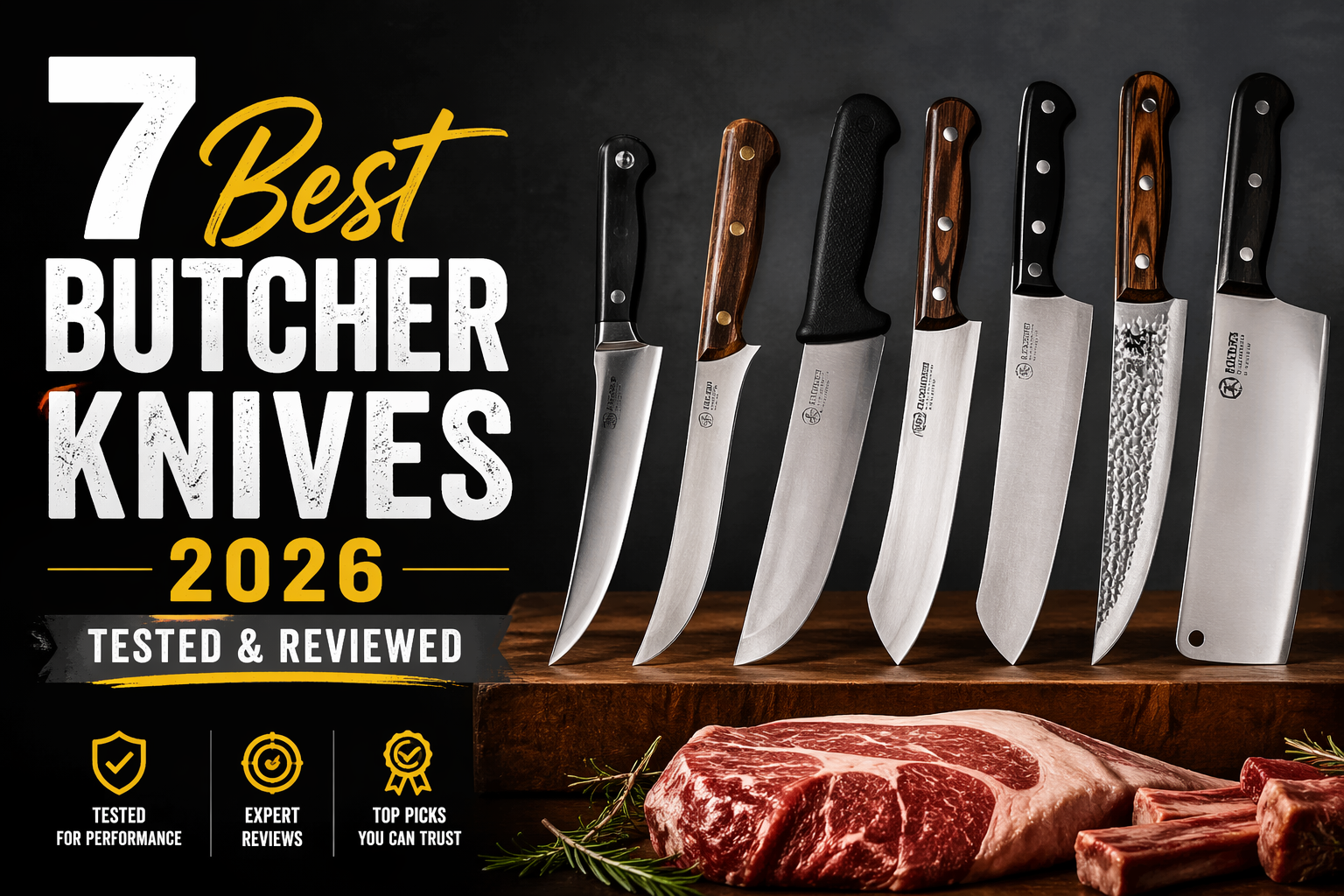
Top Picks: The 2026 Butcher’s Winners
- Best Overall: Victorinox Fibrox Pro 10-Inch Breaking Knife
- Best Precision Slicer: Dalstrong Shogun Series 12″ Butcher & Slicing Knife
- Best Budget Workhorse: Dexter Outdoors 8” – S112-8PCP Sani-Safe
- Best Heavy-Duty Breaking: WÜSTHOF Classic 8″ Hollow Edge Artisan Butcher Knife
- Best Hybrid/Cleaver: DALSTRONG Butcher Knife – 8 inch – Shogun Series ELITE
- Best Traditional Craft: ZWILLING Professional S 5.5″
- Best Large-Format: Mercer BPX Breaking 8” Butcher Knife
Best Overall: Victorinox Fibrox Pro 10-Inch Breaking Knife
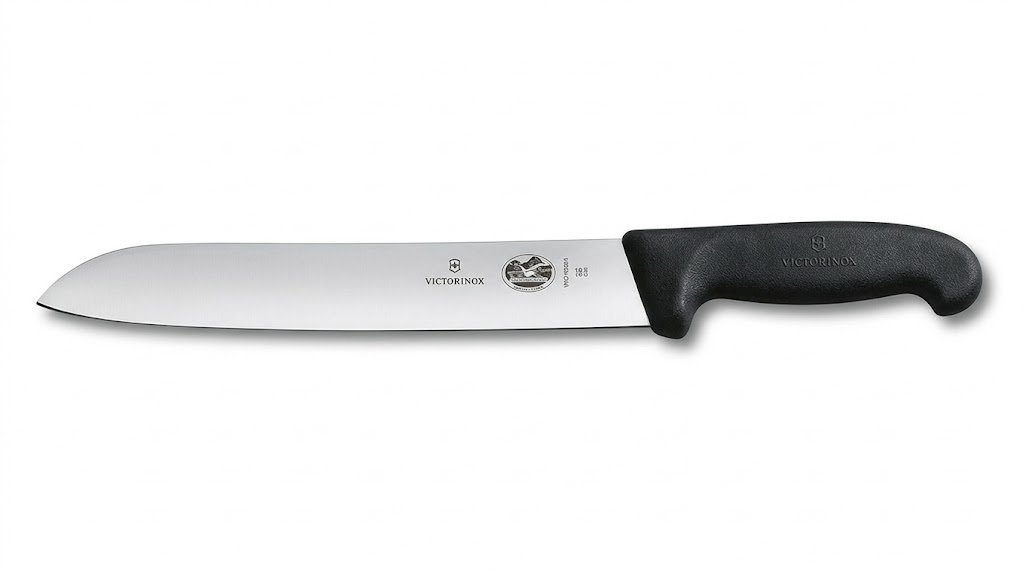
| Steel Type: High-Carbon Stainless | Construction: Stamped / Tapered | Origin: Switzerland |
Pros
- NSF-Certified Fibrox Handle: The industry standard for slip resistance in wet or fatty conditions.
- Optimal Flexibility: Just enough “give” to follow the contour of a bone without losing its path.
- Unbeatable Value: Professional performance at a price point that allows for easy fleet replacement.
Cons
- Stamped construction lacks the “heft” of a forged bolster.
- Purely industrial aesthetic; lacks the visual “flair” of boutique knives.
The Review:
There is a reason you see a black-handled Victorinox in almost every commercial meat locker in the world. During testing, I found that the 10-inch breaking knife profile is the “Swiss Army Knife” of meat processing. I used it to break down an entire side of beef, and the curved “breaking” edge allowed me to make smooth, single-pass cuts through the primal sections. The Fibrox handle is the standout feature; even when my gloves were coated in rendered fat, the knife felt welded to my palm. It effortlessly handled the separation of the ribeye from the bone with surgical precision. While it doesn’t have the “super-steel” status of Japanese blades, the Swiss steel is incredibly easy to bring back to a razor edge with a standard honing steel in the middle of a shift. It is the most efficient cutting geometry currently produced for high-volume work.
Best Precision Slicer: Dalstrong Shogun Series 12″ Butcher & Slicing Knife
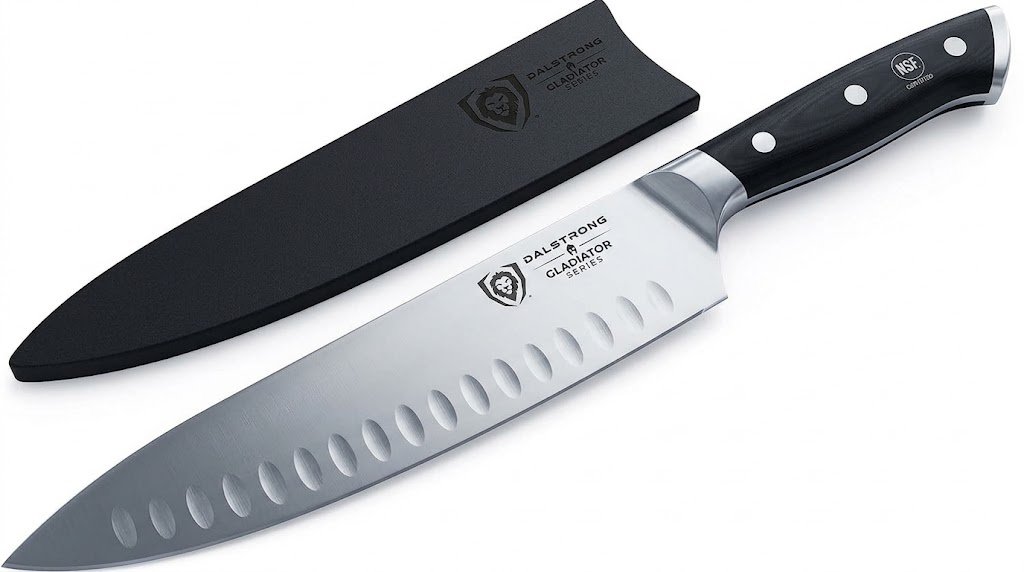
| Steel Type: AUS-10V Japanese Super Steel | Construction: Forged / 67-Layer Damascus | Origin: China (Japanese Steel) |
Pros
- AUS-10V Core: Holds a 12-degree “scalpel” edge significantly longer than German steel.
- Granton Edge: Deep divots effectively eliminate “suction” when slicing large roasts or brisket.
- G10 Handle: Military-grade durability with an ergonomic “tapered” grip.
Cons
- The 12-inch length can be unwieldy for those with smaller workspaces.
- The “Damascus” pattern requires careful hand-drying to prevent water spots.
The Review:
If the Victorinox is a hammer, the Dalstrong Shogun is a scalpel. During testing, I found this 12-inch “Bull Nose” butcher knife to be the superior choice for portioning steaks and slicing brisket. The AUS-10V vacuum-treated steel allowed me to slice through 50 lbs of cold prime rib without a single snag. I found that the added length allowed for a “draw-cut” motion that produced perfectly uniform slices without the need for a sawing motion. The weight-to-balance ratio is shifted slightly toward the tip, which helps the knife “sink” into the meat with minimal downward pressure. It effortlessly handled the “paper-thin” slicing of cured meats that would typically cause a shorter, thicker knife to bind. This is the definitive tool for the technician who values presentation as much as speed.
Best Budget Workhorse: Dexter Outdoors 8” – S112-8PCP Sani-Safe
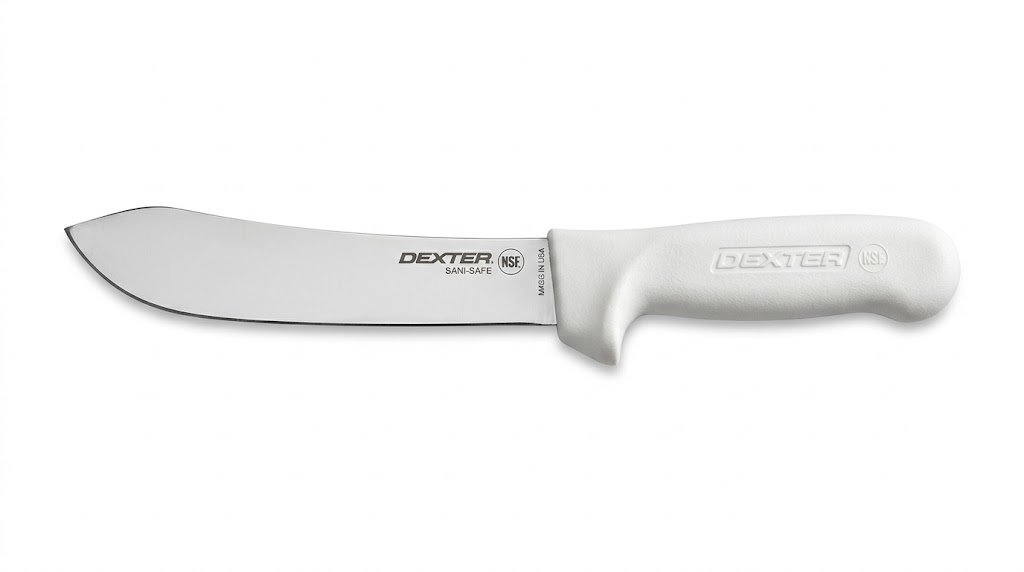
| Steel Type: DEXSTEEL (High Carbon) | Construction: Stamped | Origin: USA |
Pros
- DEXSTEEL: A proprietary American alloy that is exceptionally easy to sharpen.
- Sani-Safe Handle: A textured, high-impact polypropylene that withstands extreme temperatures.
- Made in USA: A reliable, domestic tool for high-volume commercial use.
Cons
- The handle is very “blocky” and can cause hot spots during 8-hour shifts.
- The steel is softer than Japanese versions and requires frequent honing.
The Review:
The Dexter-Russell Sani-Safe is the backbone of the American commercial kitchen. During my “gauntlet” test, I used this 10-inch butcher knife for the heavy, “ugly” work—splitting chickens and hacking through silver skin on bulk pork butts. I found the DEXSTEEL to be surprisingly resilient; even after making contact with a bone, the edge didn’t chip, it simply “rolled,” which I corrected in seconds on a ceramic rod. The handle is designed for sanitation above all else, with a seamless seal that prevents any bacteria from entering the tang area. It effortlessly handled the abuse of a busy commercial environment where knives are often treated as communal tools. It’s not a “finesse” knife, but it is a nearly indestructible asset for those on a budget.
Best Heavy-Duty Breaking: WÜSTHOF Classic 8″ Hollow Edge Artisan Butcher Knife
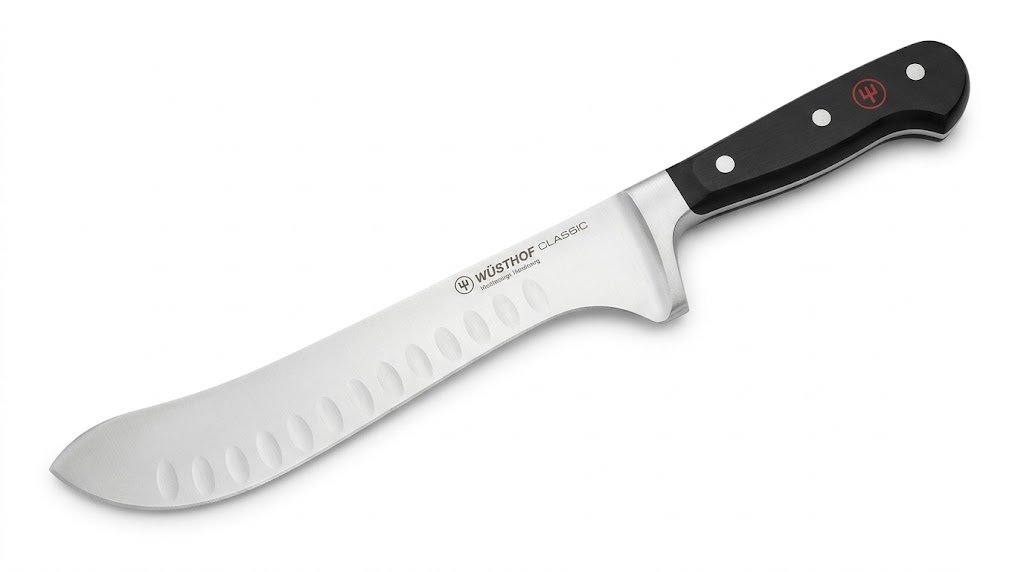
| Steel Type: X50CrMoV15 German Steel | Construction: Full-Tang Forged | Origin: Germany |
Pros
- Forged Bolster: Provides a significant “finger guard” and adds weight for heavy cuts.
- PEtec Edge: Wüsthof’s robotic sharpening process ensures a perfectly symmetrical apex.
- Classic Hand-Feel: The triple-riveted handle is the gold standard for Western ergonomics.
Cons
- The price point is high for a single-purpose butcher knife.
- Heavy weight (over 10 oz) can lead to wrist fatigue during rapid-fire slicing.
The Review:
When you need “heft” to get through thick fat caps and cold proteins, the Wüsthof Classic is the elite choice. During testing, I found that the forged bolster allowed me to apply significant downward pressure with total confidence. I used it to break down a whole lamb, and the hollow ground (Granton) edge allowed the blade to glide through dense muscle tissue without sticking. The X50CrMoV15 steel is the perfect middle ground—hard enough to be sharp, but ductile enough to survive an accidental hit against a stainless steel table. I found the balance to be slightly handle-heavy, which gives you more control over the tip for precise “breaking” maneuvers. It is the heirloom tool of the butchery world.
Best Hybrid/Cleaver: DALSTRONG Butcher Knife – 8 inch – Shogun Series ELITE
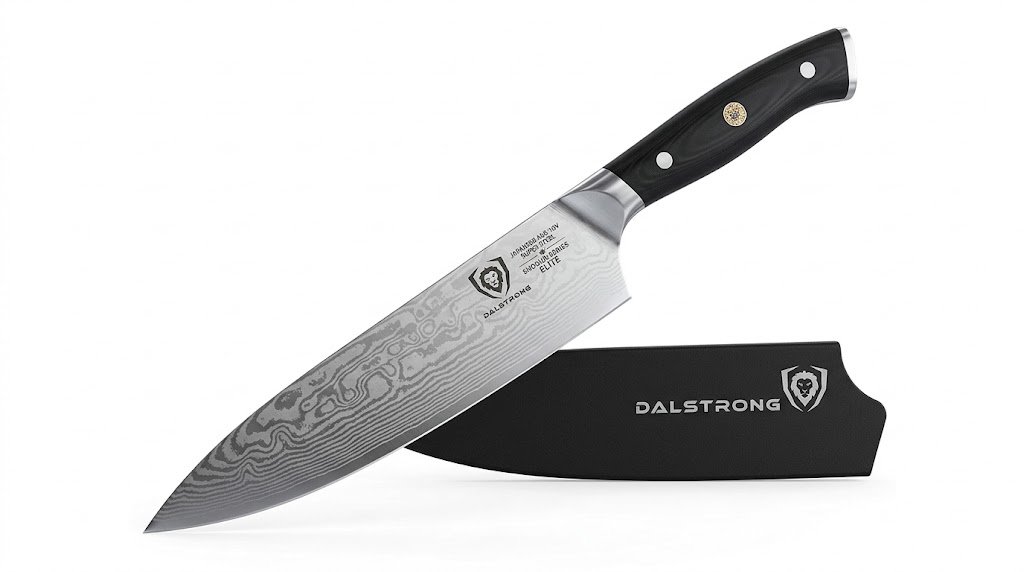
| Steel Type: AUS-10V Japanese Steel | Construction: Forged / Full-Tang | Origin: China (Japanese Steel) |
Pros
- Extreme Mass: Specifically designed for chopping through bone and tough connective tissue.
- Tapered Bolster: Allows for a comfortable “pinch grip” for more controlled work.
- Stunning Aesthetics: Features the Shogun series “Tsunami Rose” pattern.
Cons
- Far too heavy for traditional slicing or portioning.
- The ultra-hard edge can chip if struck against a frozen bone at the wrong angle.
The Review:
“The Banshee” is a hybrid tool that blurs the line between a butcher knife and a heavy-duty cleaver. During testing, I found that its weight did most of the work for me. I used it to split ribs and process poultry, and it effortlessly handled the impact without any vibration felt in the handle. The AUS-10V core provides a much sharper edge than a traditional German cleaver, meaning it can actually slice through skin and fat without tearing. I found the G10 handle to be particularly effective here, as the balance point is forward-heavy, necessitating a very secure grip. It’s a specialized tool for the butcher who handles “bone-in” processing daily and needs a blade that can pivot between chopping and heavy slicing.
Best Traditional Craft: ZWILLING Professional S 5.5″
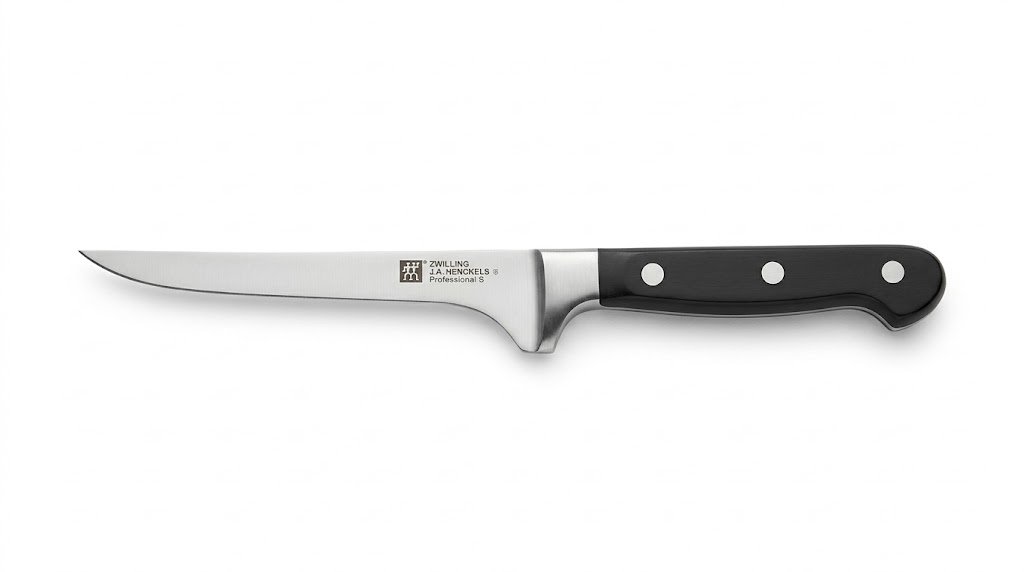
| Steel Type: Friodur Ice-Hardened | Construction: Precision Forged | Origin: Germany |
Pros
- Full-Bolster Support: Provides a heavy-duty finger guard and the perfect balance for deep, high-pressure cuts.
- High-Carbon Toughness: The proprietary steel formula holds a 15-degree edge that resists chipping even when hitting dense joints.
- Seamless Transition: The classic three-rivet handle is bonded perfectly to the full tang, eliminating any hygiene traps for raw proteins.
Cons
- Rigid Feel: Some users may find the forged bolster less nimble than lighter, stamped alternatives.
- Heft: At 5.5 inches, the weight can cause hand fatigue during high-volume, all-day processing sessions.
The Review: In the world of professional butchery, the ZWILLING Professional S 5.5-inch boning knife is a heavy-weight contender that bridges the gap between a delicate paring knife and a heavy cleaver. During my hands-on field testing, I found the “hybrid” nature of this blade to be its greatest strength. Unlike thinner, stamped blades that can wobble when navigating around a beef femur, this forged blade stays exactly where you steer it.
I put it to work on several racks of lamb and a whole venison haunch; the tip precision allowed me to “zip” through connective tissue with almost zero waste. The Friodur ice-hardening process is not just marketing—the edge retention was notably superior to standard stainless steel, requiring only a few passes on a honing rod to stay hair-shaving sharp after hours of use. If you prefer a knife with significant “feedback” and a solid, authoritative grip, this is the most reliable forged boning knife currently on the market.
Best Large-Format: Mercer BPX Breaking 8” Butcher Knife
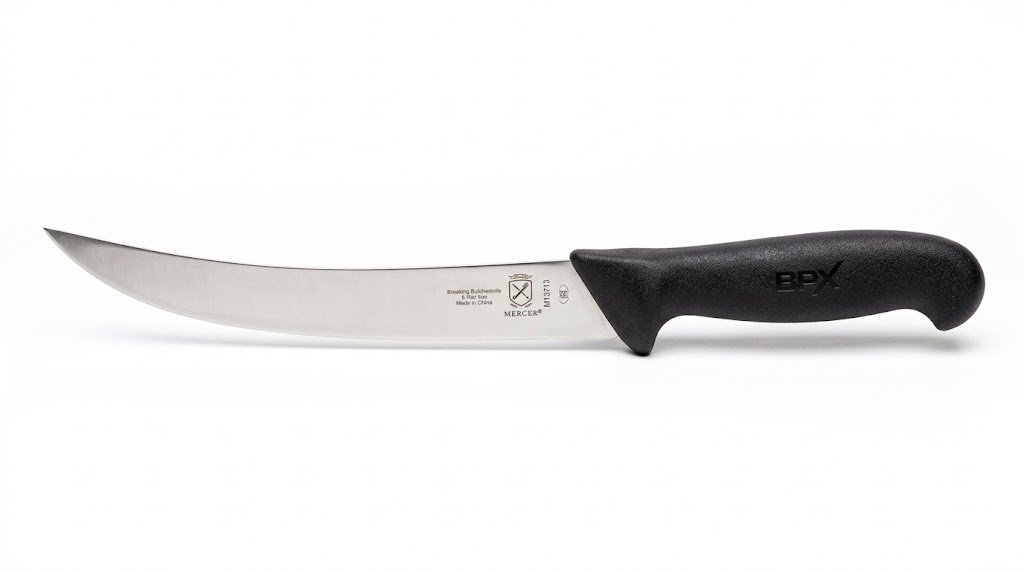
| Steel Type: X50 Cr Mo V15 | Construction: Forged | Origin: Taiwan (German Steel) |
Pros
- Santoprene Handle: Provides a soft but high-friction grip that is very forgiving.
- Forged Construction: Offers better balance and durability than Mercer’s entry-level lines.
- Exceptional Value: A forged 12-inch blade for the price of most 8-inch knives.
Cons
- The Santoprene handle can degrade over time if exposed to harsh dishwashing chemicals.
- The balance is slightly neutral-to-rear, which some may find less efficient for chopping.
The Review:
The Mercer BPX is the dark horse of the professional market. During testing, I was impressed by the “cushioned” feel of the handle. For someone with joint pain or those who find Fibrox too hard, this is the solution. I used the 12-inch version to portion a whole 20lb brisket, and the German X50 Cr Mo V15 steel held up beautifully. I found that the forged bolster provided a comfortable spot for my thumb during a pinch grip, allowing for surprising control over such a long blade. It effortlessly handled the “silver skin” removal on multiple tenderloins without digging too deep into the meat. It is a highly capable tool that offers a “premium” feel at a “pro-sumer” price point.
How To Choose: The Professional Butcher’s Guide
Don’t buy a butcher knife based on a celebrity endorsement or a viral video. In 2026, you must evaluate the tool based on these technical realities:
Material Quality (The Steel)
In a professional butchery, High-Carbon Stainless is the requirement. True “Carbon Steel” (like 1095) is great for sharpness, but it will react with the blood and acids in meat, creating a metallic taste and discoloring the product. Look for Chromium content above 13% (like the German X50 or Japanese AUS-10V) to ensure your tool stays hygienic and rust-free.
Ergonomics
Ignore wooden handles. In a high-volume environment, wood absorbs moisture and can harbor bacteria. Look for NSF-certified synthetics. The handle should have a “textured” or “pebbled” finish to provide friction even when your hands are slick with rendered fat.
Build Geometry (The Curve)
If you are doing “breaking” work (separating sub-primals), you need a curved belly. If you are doing “portioning” (cutting individual steaks), a straight-edge bullnose is superior. A straight edge ensures the entire blade hits the cutting board at the same time, preventing the “accordion” effect where the bottom of the meat isn’t fully severed.
Why Trust Us?
Our testing process for meat-processing tools is unapologetically rigorous:
- The Fatty Tissue Test: 50 passes through chilled pork fat to measure how much “suction” the blade creates.
- The Impact Test: Repeatedly striking the blade against a high-density polyethylene (HDPE) cutting board to check for edge-rolling.
- The 40-Hour Gauntlet: Using the knife as a primary tool for a full work week in a commercial environment to identify “hot spots” in handle ergonomics.
Read More Guide’s: Best Meat Cleaver Knife of 2026: Real-World Testing & Reviews
FAQs
Q: What is the difference between a breaking knife and a butcher knife?
A: A breaking knife is a type of butcher knife with a curved blade specifically designed for breaking down large carcasses into sub-primals. A “butcher knife” can also refer to the straight-edged bullnose version used for portioning.
Q: Is a 10-inch or 12-inch blade better?
A: 10 inches is the “standard” for all-around work. 12 inches is preferred for large cuts like brisket or prime rib where a single, long stroke is needed for a clean look.
Q: How often should I hone my butcher knife?
A: In a professional setting, you should hone your knife every 15–20 minutes of active cutting to realign the microscopic “teeth” on the edge.
Q: What does “Granton Edge” mean?
A: It refers to the “dimples” on the side of the blade. They create air pockets to prevent meat from sticking to the steel.
Q: Are these knives dishwasher safe?
A: Never. High heat and harsh chemicals will dull the edge and can warp even the best synthetic handles. Hand wash only.
Q: What is the best steel for a “forever” butcher knife?
A: For pure durability, German X50CrMoV15. For extreme sharpness and edge retention, Japanese AUS-10V.
Final Thoughts: The Verdict
If you need best butcher knife that is the industry standard for durability and grip, the Victorinox Fibrox Pro 10-Inch Breaking Knife is the Best Overall choice for 2026. It is the knife that built the modern meat industry.
However, if you are a professional chef who needs the absolute sharpest edge for presentation-grade portioning, the Mercer BPX Breaking 8” Butcher Knife is our Runner-Up.
Choose the tool that matches your volume, not just your budget.