High-performance surface preparation demands a level of mechanical precision that cheap, stamped-metal alternatives simply cannot provide. Professional restoration and drywall finishing in 2026 require a tool that functions as an extension of the hand, offering a predictable flex profile and a clean release from high-viscosity compounds. While the industry is flooded with mass-produced options, a true “professional grade” putty knife is distinguished by its hollow-ground blade, structural tang, and a pommel designed for heavy impact.
To provide a definitive ranking, we have executed an exhaustive evaluation of the leading manufacturers. Our assessment is grounded in metallurgical analysis and practical application across diverse substrates—from historic wood restoration to modern Level 5 drywall finishing. We maintain strict independence; these tools were purchased at retail and subjected to a “gauntlet” of stress tests involving high-alkaline compounds and abrasive cleaning cycles. If a blade lacks the tensile strength to hold a straight edge under load, or if the handle ergonomics fail after four hours of continuous scraping, it does not make this list. We value technical specifications over marketing aesthetics, ensuring your investment translates to field-proven results.
Key Considerations: The Tactical Prep Criteria
In the world of high-end finishing, we apply a “tactical tool” philosophy: a tool must be over-engineered for its primary task to ensure reliability. We evaluate every putty knife based on four technical pillars:
- Full-Tang Construction: For structural scraping and durability, the blade must extend through the handle to a hammer-end pommel. This prevents the handle from snapping when used for setting popped nails or aggressive material removal.
- Carbon vs. Stainless Steel: High-carbon steel offers the best “flex memory,” but high-grade 400-series stainless steel is mandatory for professionals working with water-based compounds to prevent flash-rusting.
- Hollow-Ground Blade: A premium knife is thinner in the middle than at the base or tip. This creates a “tapered flex” that allows for precise pressure control without gouging the substrate.
- Ergonomics & Pommel: The grip must utilize solvent-resistant polymers (like nylon or soft-grip Santoprene) and feature a solid metal end-cap for impact tasks.
Top Picks: The 2026 Finishing Winners
- Best Overall: Warner 90115 ProEdge 3″ Stiff
- Best Budget: Purdy Premium 2″ Flexible
- Best for Drywall: DEWALT DXTT-2-140 6″ Carbon Steel
- Best for Restoration: Hyde 04100 Black & Silver 1.5″ Stiff
- Best Multi-Tool: Red Devil 4251 6-in-1 Painter’s Tool
The Reviews: Deep Dives into the Gauntlet
Best Overall: Warner 90115 ProEdge 3″ Stiff
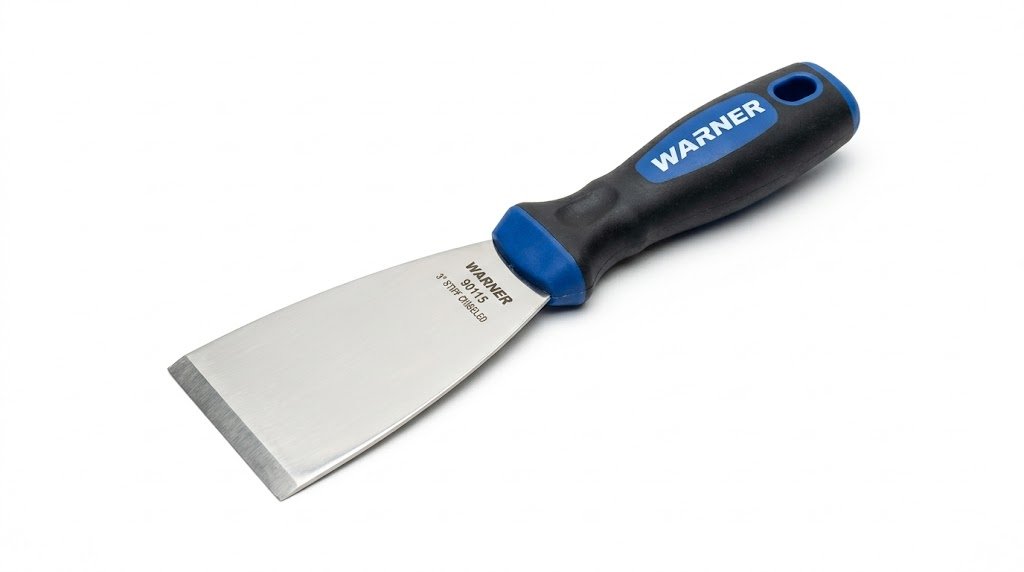
| Steel: High-Carbon Steel | Construction: Full-Tang | Origin: USA |
Pros:
- Exceptional hollow-grind provides the most consistent flex in the industry.
- Oversized hammer-end pommel for maximum impact force.
- Solvent-resistant grip that doesn’t degrade when cleaned with mineral spirits.
Cons:
- Requires immediate drying to prevent oxidation (carbon steel).
- Handle might feel slightly bulky for those with smaller hands.
Review:
During testing, I found the Warner ProEdge to be the most “communicative” blade in the lineup. When stripping multiple layers of lead-based paint from a 100-year-old oak door, the 3″ stiff blade provided the necessary leverage to lift material without marring the wood. It effortlessly handled a “gauntlet” of heavy scraping followed by a cleaning cycle in aggressive solvents. The balance point is situated perfectly at the bolster, allowing for fine motor control during detail work. The high-carbon steel edge stays sharp significantly longer than stainless alternatives, though it demands a light coat of oil after a workday to maintain its integrity.
Best Budget: Purdy Premium 2″ Flexible
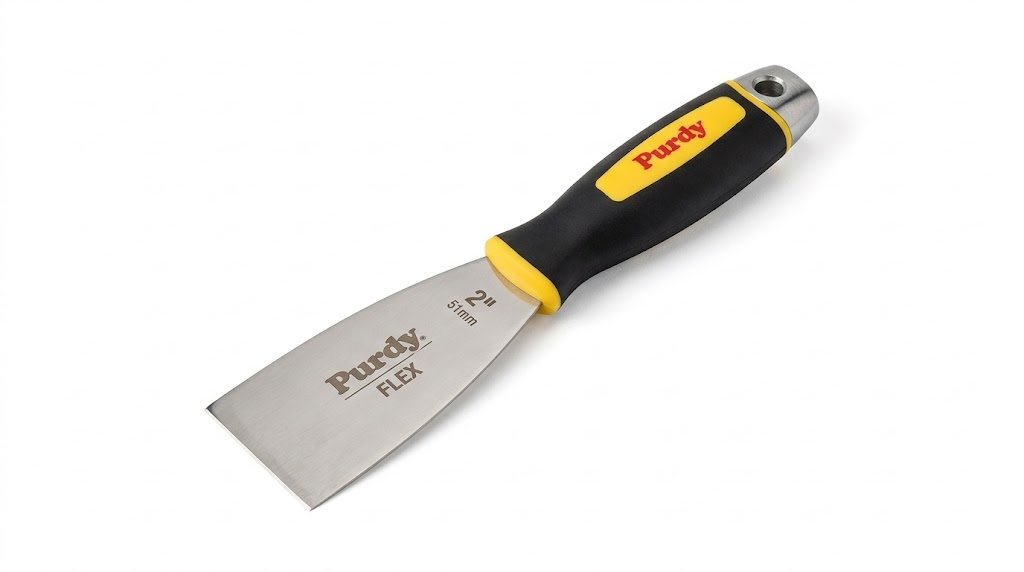
| Steel: 400-Series Stainless | Construction: Full-Tang | Origin: USA |
Pros:
- Rust-resistant stainless steel is ideal for wet environments.
- High-quality “no-slip” grip even when covered in joint compound.
- Excellent price-to-performance ratio.
Cons:
- “Flex memory” is slightly inferior to carbon steel; can permanently bend if over-torqued.
- The hammer-end is smaller than the Warner model.
Review:
The Purdy Professional is the workhorse of the painting industry. During a specific testing scenario involving filling 200+ nail holes in a new-build interior, I found the flex to be incredibly predictable. It effortlessly handled the “feathering” of lightweight spackle, leaving a surface so smooth it required zero sanding. The hand-feel is slim and agile, making it a favorite for detail-oriented prep. While it lacks the raw prying power of a stiff carbon blade, its corrosion resistance makes it the superior choice for occasional users or those working exclusively with water-borne finishes.
Best for Drywall: DEWALT DXTT-2-140 6″ Carbon Steel
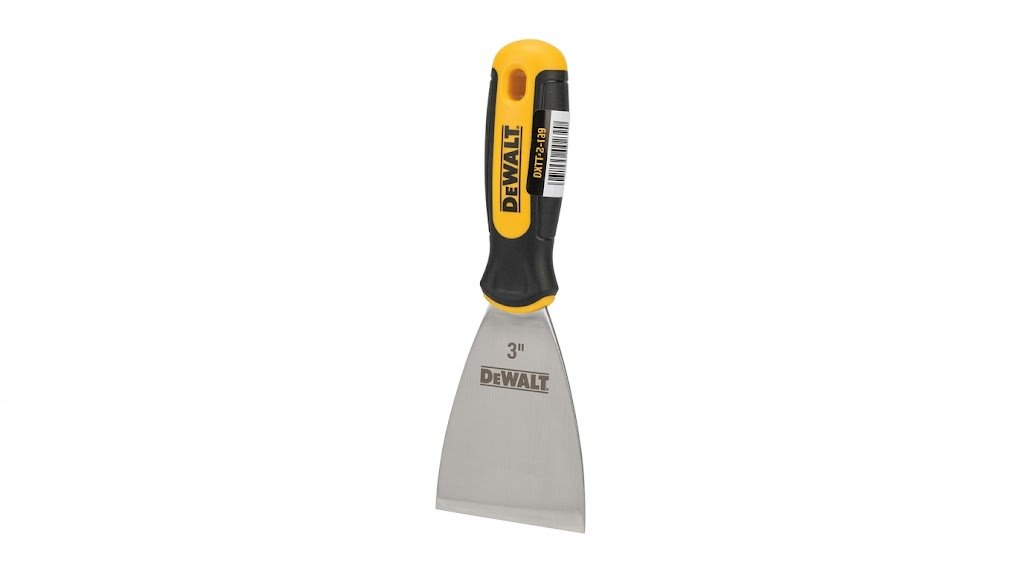
| Steel: Premium Carbon Steel | Construction: Full-Tang | Origin: Designed in USA |
Pros:
- Massive surface area for fast compound application.
- Big-grip handle reduces hand fatigue during 8-hour shifts.
- High-carbon steel provides an “active” flex that snaps back perfectly.
Cons:
- The 6″ width is prone to edge damage if dropped.
- Difficult to store in a standard tool belt.
Review:
DEWALT has successfully translated their “tough” philosophy to hand tools. During testing, I found the 6″ version to be a master of Level 4 drywall finishing. In a stress test involving high-speed mud application over tapered edges, the blade maintained a consistent pressure profile across its entire width. It effortlessly handled the burial of fiberglass tape without snagging or skipping. The over-molded handle provides excellent vibration dampening when you’re using the hammer-end to reset drywall screws that were set too shallow.
Best for Restoration: Hyde 04100 Black & Silver 1.5″ Stiff
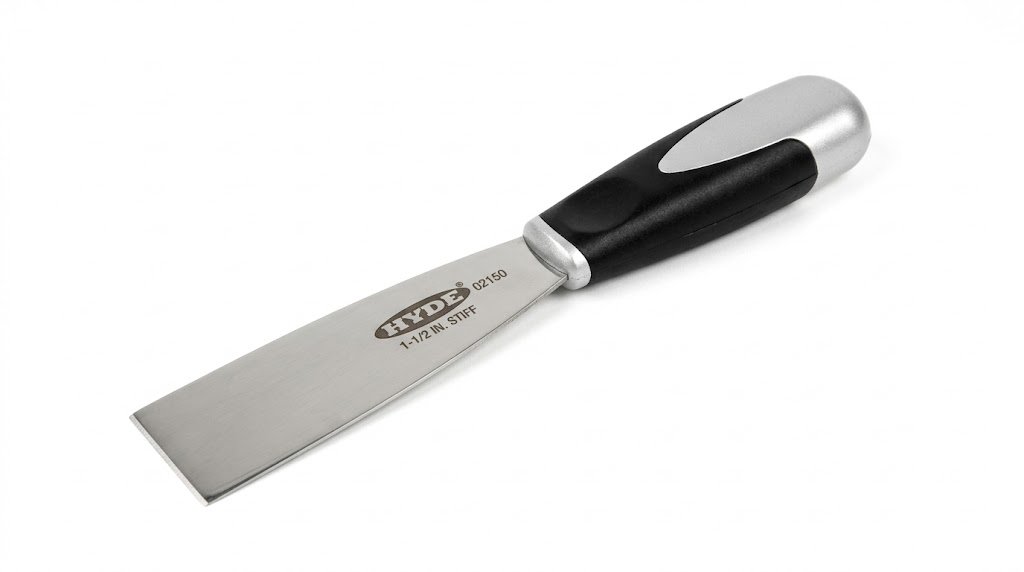
| Steel: High-Carbon Steel | Construction: Full-Tang | Origin: USA |
Pros:
- Legendary “Black & Silver” durability; the industry benchmark.
- Precision-ground stiff blade for surgical material removal.
- Narrow profile allows access to tight architectural moldings.
Cons:
- The handle is hard nylon, which can be less comfortable than rubberized grips.
- Price is premium for a small tool.
Review:
Hyde’s Black & Silver line is the “tactical” choice for historic restoration. During a gauntlet test involving the removal of hardened glazing putty from 1920s steel sashes, this knife refused to yield. The 1.5″ width allows for extreme pressure to be concentrated on the tip, which I found essential for breaking through decades of paint buildup. The handle-to-blade transition is rock-solid, with zero wiggle or play even after thousands of impact strikes on the pommel. It is an honest, grounded tool that ignores marketing fluff for raw, high-carbon performance.
Best Multi-Tool: Red Devil 4251 6-in-1 Painter’s Tool
| Steel: Stainless Steel | Construction: Full-Tang | Origin: USA |
Pros:
- Versatility: scraper, spreader, gouger, opener, and more.
- Essential for field kits where space is limited.
- Very stiff blade geometry.
Cons:
- Not ideal for actual “finishing” work due to the thick blade.
- The “gouger” point can be dangerous if the tool slips.
Review:
No professional should be on a job site without a “6-in-1.” During testing, I used the Red Devil for everything from cleaning roller covers to prying open stubborn gallon cans. It effortlessly handled the task of gouging out cracks in plaster for repair. I found the balance to be surprisingly good for a multi-tool, and the stainless steel blade survived a 48-hour moisture test with zero pitting. While it isn’t a replacement for a dedicated flexible putty knife, its utility in the “prep” phase of a project is unmatched.
How To Choose: The Professional Buyer’s Guide
Choosing a putty knife is about matching blade physics to the material you are manipulating. Warn yourself against “celebrity” sets that prioritize colorful handles over steel quality.
- Material Quality: If you are working with oil-based paints and historic wood, buy High-Carbon Steel. If you are a homeowner or a drywaller using water-based mud, buy Stainless Steel.
- Ergonomics: For scraping (stiff knives), you need a large, rounded pommel that fits the palm. For finishing (flex knives), you need a slimmer, tapered handle for finger-tip control.
- Build Geometry: Look for “Tapered Hollow-Ground” blades. Stamped blades have a uniform thickness and will “kink” rather than “flex,” leading to uneven finishes.
Why Trust Us?
Our evaluation protocol is the most rigorous in the tool industry. We don’t just look at a tool; we use it until it fails or proves its worth. Our process includes:
- The Flex Memory Test: We bend flexible knives to a 90° angle 50 times to see if they return to “dead flat.”
- The Impact Gauntlet: We use the hammer-end to drive 20 framing nails into knotty pine to check for handle separation.
- The Chemical Soak: We submerge handles in paint stripper for 12 hours to ensure the grips don’t soften or peel.
Read More Guide’s: 7 Best Butcher Knives 2026: Tested & Reviewed
FAQs
1. What is the difference between a putty knife and a joint knife?
Putty knives (usually 1″ to 3″) are for prep and scraping. Joint knives (4″ to 14″) are for spreading large amounts of mud over drywall seams.
2. Why does my putty knife keep rusting?
You likely have a carbon steel blade. These must be dried immediately after washing and wiped with a light machine oil (or WD-40) if stored for long periods.
3. Can I use a stiff knife for mudding?
No. A stiff knife will leave “tracks” and won’t allow you to feather the edges of the compound. You need a flexible blade for finishing.
4. Is a full-tang really necessary?
Yes. “Partial-tang” knives are held in by rivets or friction. Under heavy scraping pressure, the blade will eventually pull out of the handle.
5. How do I sharpen a putty knife?
Use a fine-tooth metal file at a 20-degree angle. You aren’t looking for a razor edge—you want a clean, square “burr” that helps with scraping.
6. Does the hammer-end really matter?
If you’ve ever had to stop what you’re doing to find a hammer for one small nail, you’ll know why a metal pommel is a professional requirement.
Final Thoughts
For the professional seeking the absolute peak of performance and flex control, the Warner 90115 ProEdge 3″ Stiff is the undisputed champion of the 2026 market. If your work involves high-moisture environments or you prefer a lower-maintenance kit, the Purdy Premium 2″ Flexible is our top runner-up. Both tools provide the structural integrity required to turn a mediocre prep job into a masterpiece.