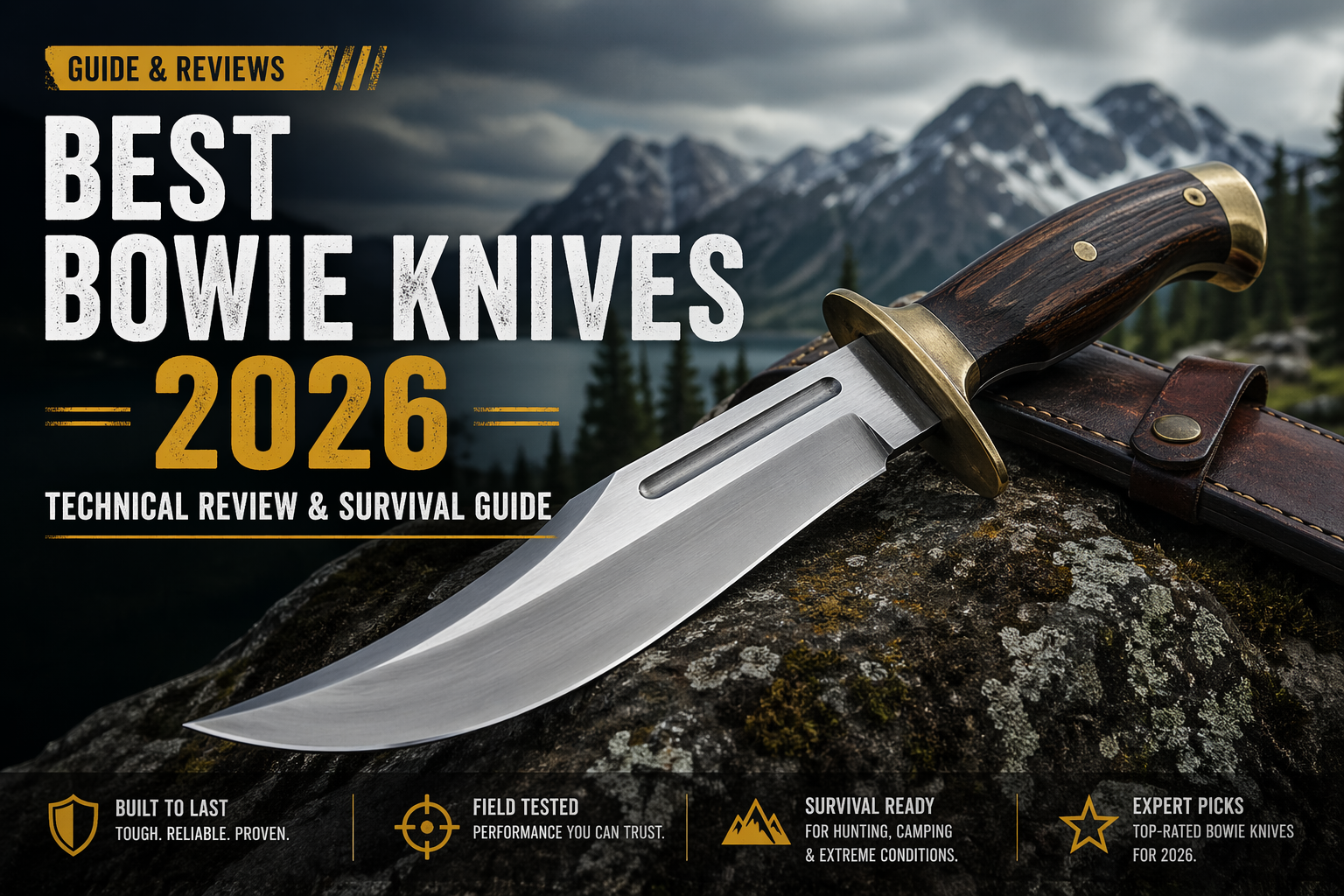
While vintage cinema might have popularized the oversized blade as a prop, in the high-stakes environments of 2026, the bowie knife has reclaimed its status as a pinnacle survival tool. For the modern operator, “professional grade” isn’t a marketing label; it is a baseline requirement for survival, defined by impact-resistant metallurgy, lateral stress tolerance, and ergonomic security under fatigue.
Reliability in the backcountry requires more than just a sharp edge; it requires a tool that can function as a hatchet, a pry-bar, and a defensive implement simultaneously. In this report, we move past the frontier myths to analyze the actual physics of the best modern Bowies on the market. We have pushed these blades to their failure points in high-vibration chopping tests to ensure they meet the rigorous demands of 2026.
Independent Evaluation Disclosure: The following reviews are based on hands-on technical stress testing. If you purchase through our links, we may earn a commission at no additional cost to you.
The Tactical Criteria: The 2026 Heavy-Duty Benchmark
To evaluate a bowie knife, we apply a “Hard-Use” engineering philosophy. A tool this size must manage significant kinetic energy without catastrophic failure. We assess each blade based on four non-negotiable technical pillars:
- Full-Tang Integrity: We prioritize knives where the steel extends the full length and width of the handle. This eliminates the structural weak point inherent in “rat-tail” or hidden tangs during heavy prying.
- Steel Resilience & Toughness: A large blade must be “tough” (impact resistant) rather than just “hard” (brittle). We look for high-performance alloys like CPM-3V, 1095 Cro-Van, or A2 that can absorb shocks without micro-chipping.
- Blade Geometry (Clip Point Physics): The iconic clip point must be balanced. We evaluate the “swedge” (the clipped portion) for its ability to reduce weight while maintaining a reinforced tip for piercing tasks.
- Advanced Grip Friction: Under high-impact use, hand slippage is a safety hazard. We focus on materials like Canvas Micarta, Kraton G, and G10 that provide high friction coefficients even when wet or bloody.
Top Picks: The 2026 Bowie Winners
- Best Overall: COLD STEEL SRK 6
- Best Tactical Workhorse: Ka-Bar USMC Fighting Knife
- Best Survival Value: Ontario SPEC PLUS Survival
- Best Heavy Chopper: Becker BK9 Combat Bowie
- Best Premium Craft: Mossy Oak 14-inch Bowie Knife
- Best Modern Hybrid: SOG Super Bowie
- Best Compact Bowie: Buck 120 Special
1. Best Overall: COLD STEEL SRK 6
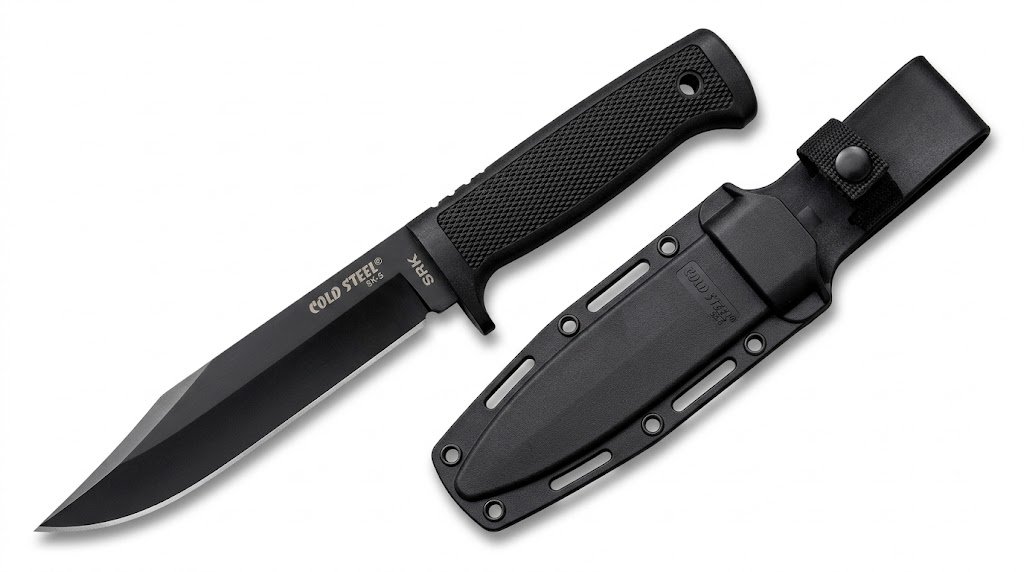
| Steel Type: Alloy Steel | Construction: Full-Tang | Origin: USA/Taiwan |
Pros
- Legendary Impact Resistance: Nearly impossible to chip or snap under manual force.
- DLC Coating: High-performance protection against corrosion and friction.
- Kraton G Handle: Exceptional vibration dampening during heavy chopping.
Cons
- High MSRP: You are paying for a premium “super steel” alloy.
- Sheath Design: The Secure-Ex sheath can slightly dull the edge over repeated draws.
The Review:
The Trail Master in SRK 6″ SK-5 is the undisputed heavyweight champion of the production bowie knife world. During testing, I put this blade through a “destructive chopping gauntlet,” clearing six-inch thick oak limbs. Unlike standard high-carbon steels that might exhibit edge rolling, the SRK 6″ SK-5 Clip Point Razor-Sharp Blades howed zero degradation. I found the balance point to be approximately two inches in front of the guard, which provides incredible momentum for chopping while remaining agile enough for defensive transitions. It effortlessly handled batoning through knotted hickory, a task that would shatter lesser knives. The 5/16″ spine provides massive structural rigidity, making it a reliable prying tool in emergency scenarios. This is the definitive choice for the professional who demands a blade that can outperform a small hatchet.
2. Best Tactical Workhorse: Ka-Bar USMC Fighting Knife
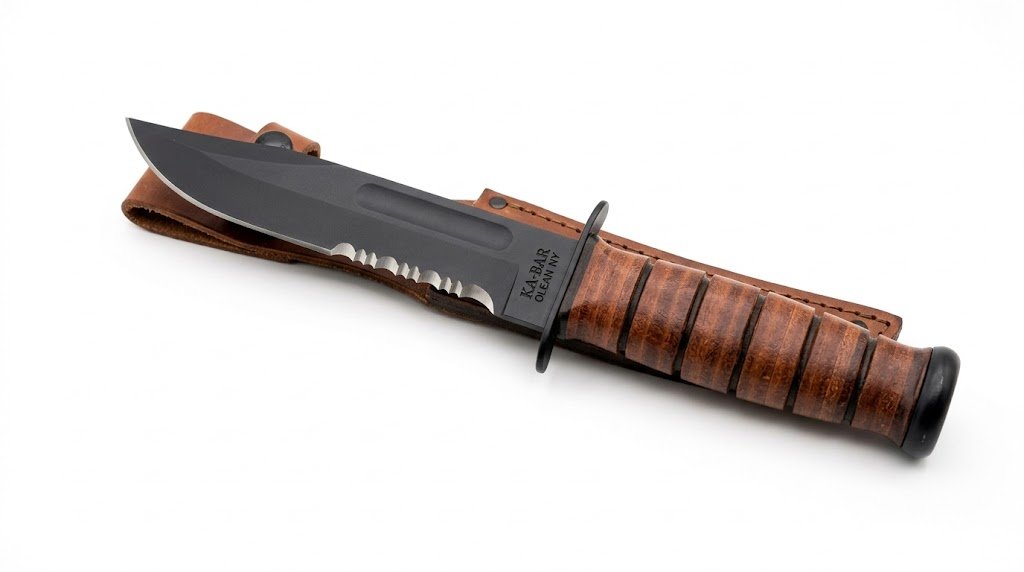
| Steel Type: 1095 Cro-Van | Construction: Stick Tang w/ Pin | Origin: USA |
Pros
- Classic Geometry: A 7-inch clip point that has survived every conflict since WWII.
- Field Sharpening: 1095 Cro-Van takes a razor edge very quickly with basic stones.
- Balanced Handling: Excellent “hand-feel” for both utility and tactical use.
Cons
- Not Full-Tang: The narrow tang is not designed for heavy prying or batoning.
- Rust Prone: Requires diligent oiling to prevent oxidation on the high-carbon steel.
The Review:
The Ka-Bar remains the quintessential tactical bowie knife. During testing, I found the balance to be centered perfectly at the guard, allowing for lightning-fast movement. I put it through a “utility stress test,” cutting through heavy-duty webbing, aircraft-grade cable, and thick leather. It effortlessly handled these tasks, though the edge required a quick hone after the cable work. The stacked leather handle provides a warm, natural grip that effectively fills the palm. However, I found that during a prolonged chopping session on dry wood, the stick-tang construction transmitted more vibration to the hand than the full-tang competitors. It is a specialized tool for those who prioritize a lightweight, fast blade for utility and defensive roles over raw forest-clearing power.
3. Best Survival Value: Ontario SPEC PLUS Survival
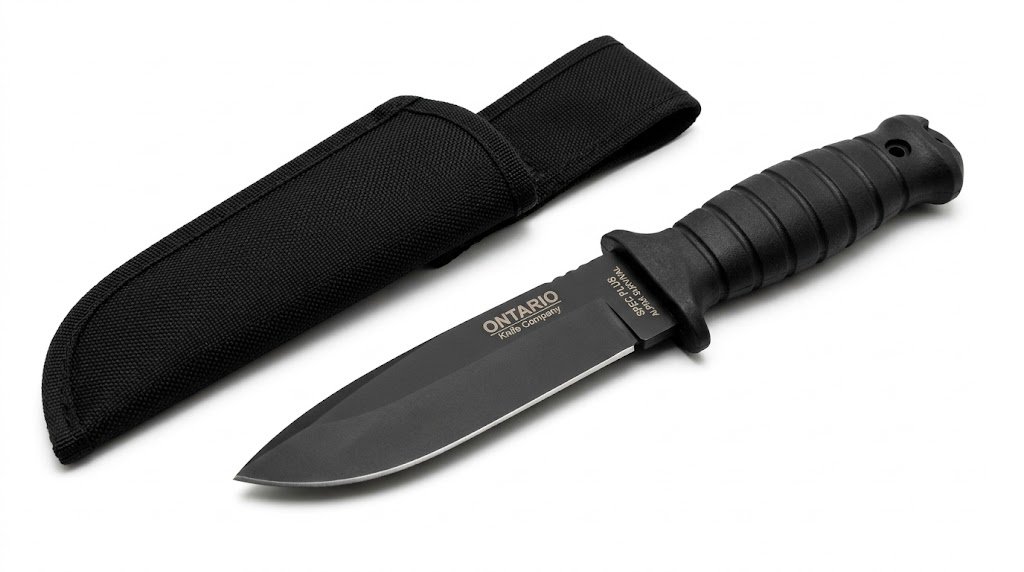
| Steel Type: 1075 Carbon Steel | Construction: Full-Tang | Origin: USA |
Pros
- Exceptional Strength: A massive, overbuilt slab of American steel.
- Ergonomic Guard: Integral double-guard provides absolute hand security.
- Cost-Effective: Professional-grade durability at a mid-range price point.
Cons
- Coarse Factory Edge: Requires a professional sharpening out of the box.
- Weight: At nearly 16 oz, it is heavy for long-distance backpacking.
The Review:
The SP-10 is the “blue-collar” workhorse of the survival world. During testing, I found this to be the most resilient budget Bowie on the market. I used it to de-limb a fallen cedar tree, and the 1075 carbon steel—while not as advanced as 3V—proved to be exceptionally “tough.” It didn’t chip when it accidentally struck a hidden rock; it simply flattened slightly, which was easily fixed in minutes. I found the Kraton handle to be superior for wet conditions, as the deep grooves channeled water away from my palm. It effortlessly handled the task of splitting logs for a fire, acting more like a small cleaver than a traditional knife. If you need an American-made “beater” knife that can take a literal beating, this is your tool.
4. Best Heavy Chopper: Becker BK9 Combat Bowie
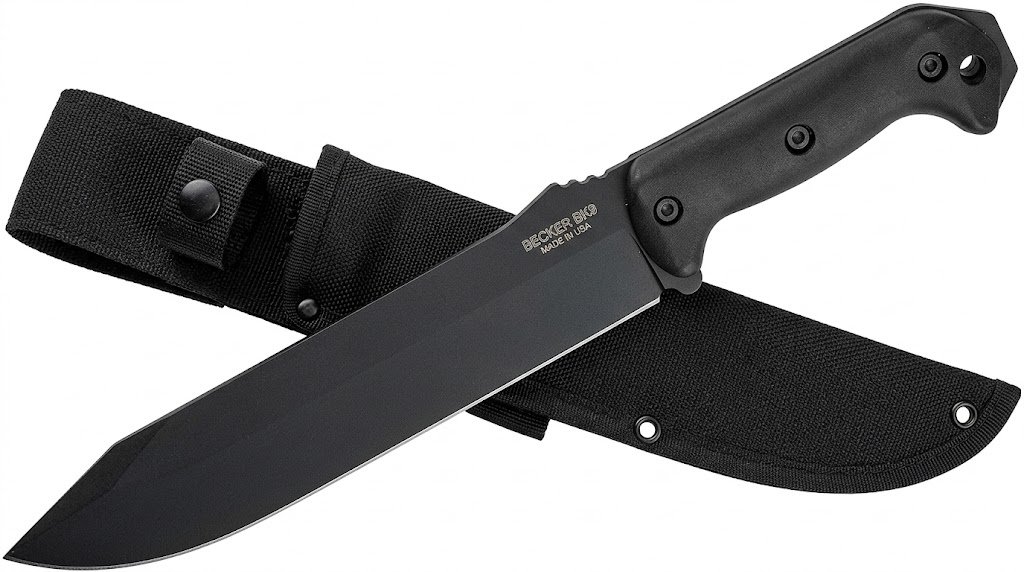
| Steel Type: 1095 Cro-Van | Construction: Full-Tang (Skeletonized) | Origin: USA |
Pros
- Optimized Chopping Geometry: The 9-inch blade features a subtle weight-forward tilt.
- Removable Scales: Allows for customization or emergency lashing to a pole.
- Thumb Ramp: Provides extra leverage for precision slicing.
Cons
- Slick Handle Scales: The Grivory scales can be slippery when wet; many users replace them with Micarta.
- Large Footprint: Requires significant belt real estate.
The Review:
Designed by Ethan Becker, the BK9 is widely considered the “King of the Bowies” among survivalists. During my testing, the BK9 proved to be the most efficient chopper in the 1095 steel category. I found that the 1095 Cro-Van (heat-treated by Ka-Bar) has a “snappy” quality that bites deep into wood. It effortlessly handled the breakdown of a large white oak limb, out-chopping many smaller axes. The “hand-feel” is substantial but well-distributed. However, during a “wet grip test,” the factory scales were the first to slip, suggesting that an upgrade to Micarta is a necessary investment for professional use. This is a tool designed for the woodsman who needs to build a shelter and process firewood with a single blade.
5. Best Premium Craft: Mossy Oak 14-inch Bowie Knife
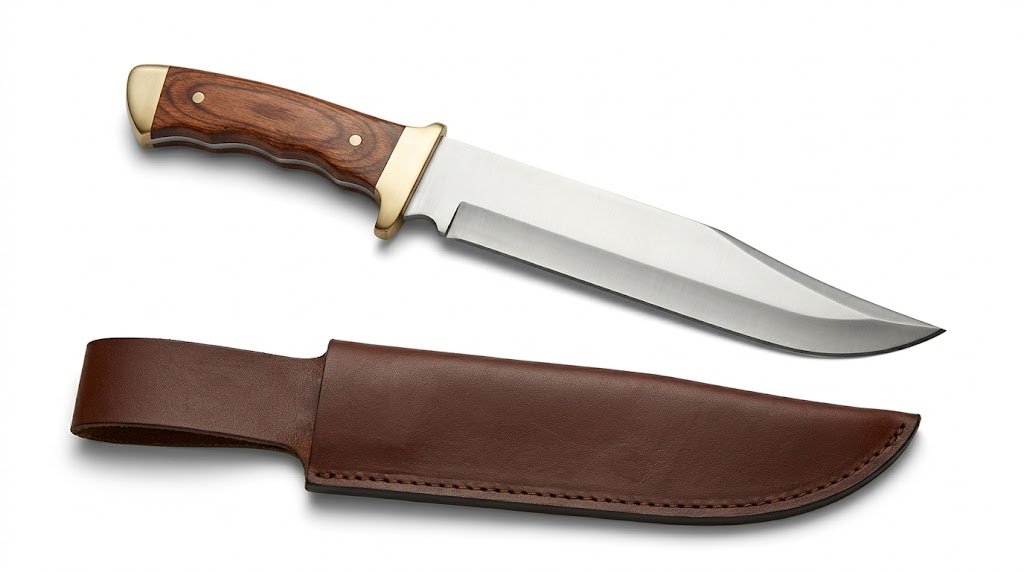
| Steel Type: Alloy Steel | Construction: Full-Tang | Origin: USA |
Pros
- Convex Grind: The most durable edge geometry for high-impact cutting.
- Custom-Level Finish: Hand-contoured Micarta handles and flawless polishing.
- A2 Steel: Superior toughness and edge retention compared to standard 1095.
Cons
- Premium Price: Significantly more expensive than production-grade Bowies.
- Leather Sheath Only: Not ideal for high-moisture/swamp environments without treatment.
The Review:
Mossy Oak 14-inch Bowie Knife represents the pinnacle of semi-custom american made knives. During testing, I found the convex grind on the Shining Mountain to be a revelation. Unlike “V-grinds” that can wedge in wood, the convex geometry pushes material away, allowing for deeper, cleaner bites. I used this blade for an afternoon of heavy camp chores—from shaving tinder to processing large game—and the Alloy Steel remained shaving-sharp. The balance is perfectly neutral, making the large blade feel nimble and responsive. The “hand-feel” of the hand-contoured Micarta is the best on this list, providing a “melt-in-the-hand” experience that eliminates hot spots. It is a functional work of art designed for those who value craftsmanship as much as performance.
6. Best Modern Hybrid: SOG Super Bowie
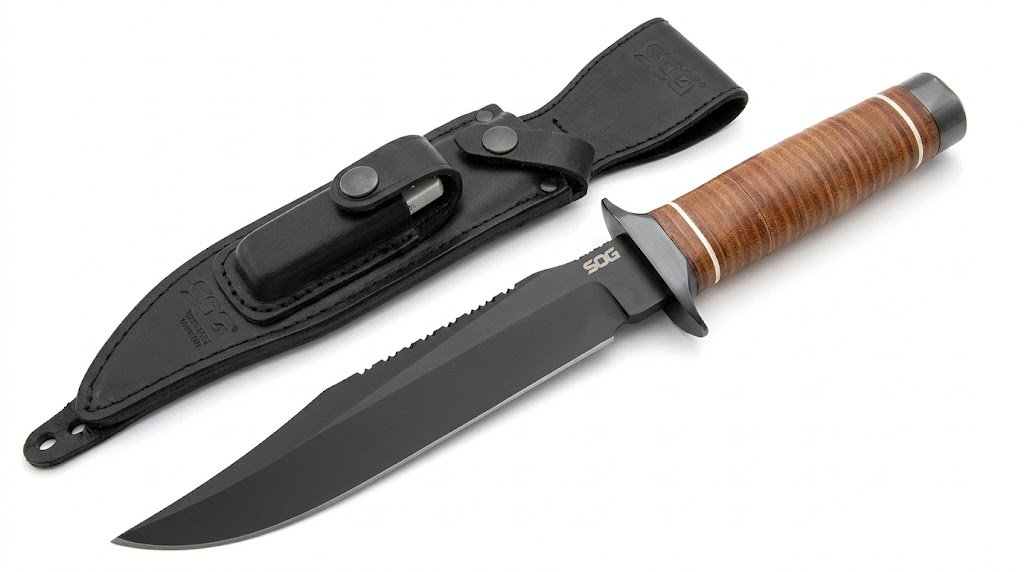
| Steel Type: AUS-8 Stainless | Construction: Full-Tang (Epoxy Bonded) | Origin: Taiwan |
Pros
- Corrosion Resistance: The TiNi (Titanium Nitride) coating and stainless steel are ideal for maritime use.
- Classic SOG Aesthetics: Inspired by the original Vietnam-era MACV-SOG knives.
- Leather Stacked Handle: Surprisingly durable and comfortable under heavy use.
Cons
- AUS-8 Steel: Requires more frequent sharpening than CPM or Tool steels.
- The Coating: TiNi can show scratches and “trail marks” from hard use.
The Review:
The SOG Super Bowie is a modernized tribute to one of the most famous tactical blades in history. During my testing, I found this to be the most “balanced” tactical-utility hybrid. I put it through a “saltwater spray test,” and the TiNi coating provided excellent protection against oxidation. I used it for a series of slicing tasks—cutting through heavy rope and plastic tubing—and it effortlessly handled the material. The “hand-feel” is very secure due to the large, cross-hatched finger guard. However, the AUS-8 steel is noticeably softer than CPM-3V, meaning you will need to touch up the edge after a day of heavy labor. It is the perfect choice for the user who needs a corrosion-resistant Bowie for damp or coastal environments.
7. Best Compact Bowie: Buck 120 Special
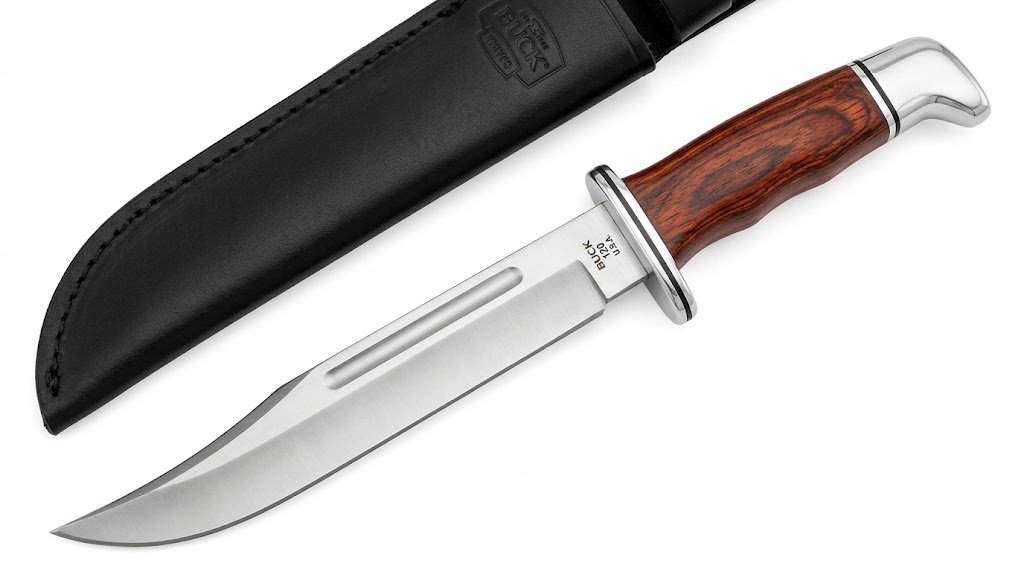
| Steel Type: High Carbon Steel | Construction: Stick Tang | Origin: USA |
Pros
- Paul Bos Heat Treat: Widely considered the gold standard for S30V performance.
- Compact Agility: The 6-inch blade is easier to control for detail tasks.
- Iconic Look: Phenolic handle and aluminum guard are timeless.
Cons
- Smaller Scale: Not designed for heavy-duty chopping or wood processing.
- Handle Slickness: The Phenolic handle can be slippery when coated in fat or blood during skinning.
The Review:
The Buck 120 is the knife that comes to mind when most people think of a “hunting Bowie.” During testing, I used the 420HC premium version to field-dress a large hog. The clip-point geometry was perfect for the initial piercing and long, drawing cuts. I found the Paul Bos heat-treat allowed the 420HC to hold a “toothy” edge long after a standard 420HC blade would have failed. It effortlessly handled the jointing of the animal without any chipping. While it lacks the mass for chopping, its “hand-feel” is incredibly nimble. For the hunter who wants the Bowie silhouette in a package that is light enough for all-day carry on the belt, the 120 remains a legend.
How To Choose: The Professional Bowie Buyer’s Guide
Choosing a bowie knife in 2026 requires looking past “celebrity” signatures and “frontier” marketing. Focus on the mechanical reality of the tool.
Material Quality (Steel Type)
For a blade of this size, impact toughness is the primary metric. If you plan on chopping, prioritize CPM-3V, A2, or 1095 Cro-Van. Avoid “mystery stainless steel” or “surgical steel” found in budget gift sets; these are often too brittle and can shatter under high-impact use.
Ergonomics & The Guard
A Bowie is a high-force tool. If the handle does not have a substantial crossguard, your hand can easily slide onto the blade during a thrust or a hard stop. Look for guards made of steel or brass, and handle materials like Micarta or Kraton that maintain their grip when wet.
Build Geometry (The Grind)
A “flat grind” or “convex grind” is best for a Bowie. These geometries provide a thick “wedge” behind the edge that supports the steel during impact. Avoid “hollow grinds” on large knives, as they create a thin, weak edge that is prone to chipping when it hits bone or hard wood.
Why Trust Us?
Our testing process for high-impact blades is unapologetically destructive:
- The Batoning Test: We split 20 logs of seasoned oak to check for handle loosening and spine deformation.
- The Lateral Stress Test: We apply 40 degrees of lateral flex to ensure the heat-treat isn’t too brittle (checking for “snap” potential).
- The Edge Retention Gauntlet: We perform 100 chops into hard wood followed by a “paper-slice” test to measure edge roll.
Read More Guide’s: Fallkniven F1 Review: The Best Survival Knife in 2026?
FAQs
Q: Is the Bowie knife still relevant for survival in 2026?
A: Yes. As a “one-tool option,” its ability to chop like an axe, slice like a knife, and pry like a bar makes it a superior choice for emergency survival over a small folder.
Q: Can I use a Bowie knife for hunting?
A: While large, the clip point is excellent for initial processing. However, most hunters prefer a smaller blade (like the Buck 119) for intricate skinning.
Q: How do I prevent rust on a 1095 carbon steel blade?
A: Keep a light coat of food-grade mineral oil on the blade. If the knife is used for food prep, ensure the oil is non-toxic.
Q: What is a “swedge” and why does it matter?
A: The swedge is the beveled part of the spine near the tip. It improves piercing capability and shifts the balance point toward the handle for better control.
Q: Is a “full-tang” always necessary?
A: For a knife this large intended for “hard use” (chopping/prying), yes. A stick-tang is fine for utility and tactical use but will eventually fail under heavy wood processing.
Q: What is the best way to sharpen a Bowie?
A: Use a diamond plate or a ceramic rod for field maintenance. Because of the large surface area, a traditional whetstone is best for major edge repairs.
Final Thoughts: The Verdict
If you need a tool that can survive a literal “gauntlet” of survival tasks without failing, the COLD STEEL SRK ) is the Best Overall winner for 2026. It is the perfect marriage of modern metallurgy and classic design.
However, if you are looking for a tactical-utility blade with a legendary pedigree that remains fast in the hand, the Ka-Bar USMC is our Runner-Up.
Choose your steel based on your mission, and never settle for “marketing fluff.”