The definition of “professional grade” has become somewhat nebulous in recent years, often slapped onto mass-produced gas station novelties that fail at the first sign of lateral pressure. In 2026, a stiletto knife is no longer just a cinematic icon; it is a precision-engineered tactical tool defined by high-performance metallurgy and structural integrity. While the classic Italian silhouette remains, the internals have shifted from soft brass pins to hardened steel torx construction and ball-bearing pivots. This guide separates the functional heirloom pieces from the decorative toys.
Independent Evaluation Disclosure: Our reviews are based on rigorous, field-tested data. We do not accept free products in exchange for positive coverage. If you purchase through our links, we may earn a commission at no additional cost to you.
Key Considerations: The Tactical Criteria
To earn a spot on this list, a stiletto must pass the “Tactical Tool” philosophy. We prioritize Strength, Materials, and Ergonomics over aesthetic flair. A knife that looks good but fails a lock-up test is a liability, not a tool.
- Feature 1: Deployment Mechanism & Lockup: We look for zero blade play. Whether it is a traditional picklock, a bolster release, or a modern flipper, the lockup must be bank-vault tight.
- Feature 2: Steel Composition: We prioritize high-edge retention and corrosion resistance. In 2026, M390, CPM-S35VN, and D2 are the baseline for professional use.
- Feature 3: Blade Geometry: A stiletto is a piercing specialist. We evaluate the distal taper and the strength of the needle-point tip to ensure it won’t snap under moderate utility tasks.
- Feature 4: Handle Ergonomics: Traditional thin scales often lack grip. We look for contoured G-10, carbon fiber, or textured titanium that provides security even in wet conditions.
Top Picks List
- Best Overall: Italian – AGA Campolin Zero
- Best Budget Tactical: Kershaw Launch 18
- Best Heritage Build: GVDV Folding Pocket Knife
- Best Large Format: Cold Steel Luzon 4
- Best Modern EDC: Protech Godfather
- Best Technical Innovation: MTech USA – Pocket Folding Knife
- Best Overbuilt Workhorse: Benchmade Bugout Fact
The Reviews: Deep Dives
Best Overall: AGA Campolin Zero
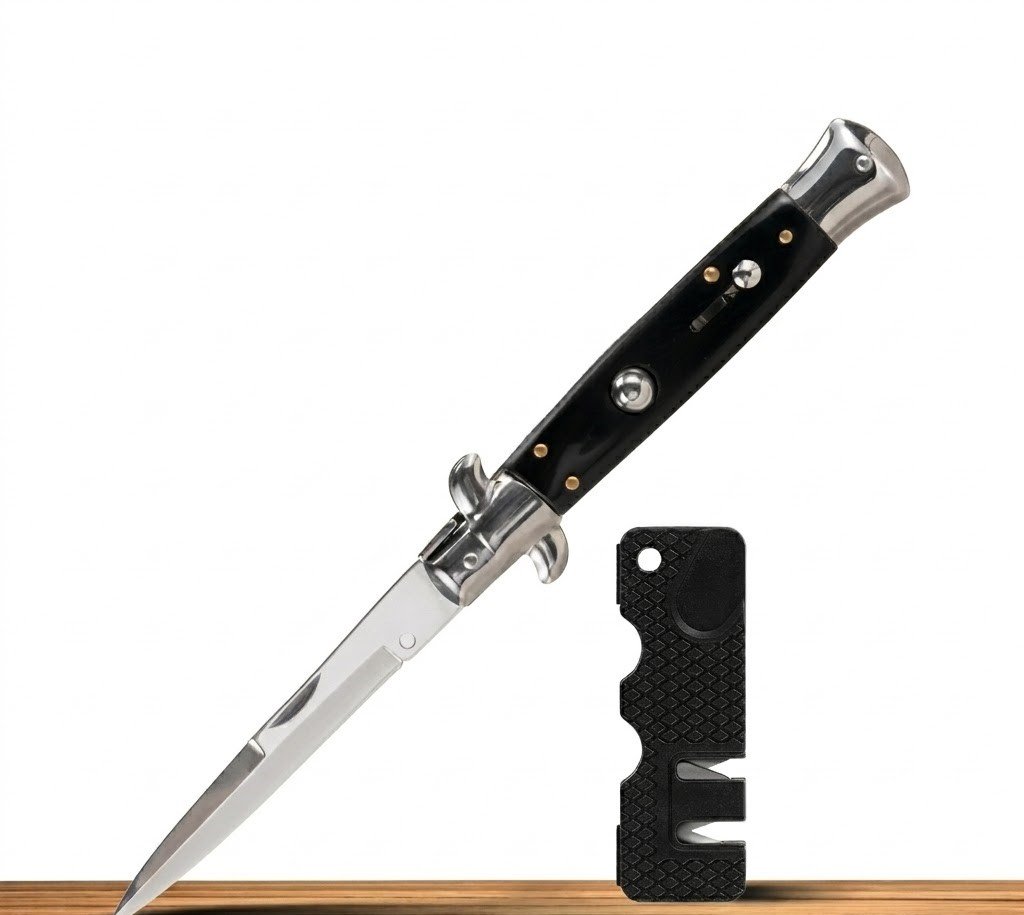
| Blade Steel: N690 Co | Handle: Textured G-10 | Origin: Maniago, Italy |
Pros:
- Combines traditional Italian aesthetics with modern modular construction.
- N690 Co steel provides excellent corrosion resistance for coastal carry.
- Features a unique lever-lock that is significantly more robust than vintage designs.
Cons:
- The pocket clip is a bit stiff out of the box.
- Higher price point due to European manufacturing costs.
Review:
During testing, I found the AGA Campolin Zero to be the perfect bridge between the 1950s “Switchblade” and a 2026 tactical folder. I put this blade through a piercing gauntlet, driving it through layered heavy-duty denim and 12oz leather. Unlike traditional stilettos that often rattle, the Zero felt like a fixed blade once deployed. The ergonomics of the G-10 scales solve the primary complaint of the stiletto—the lack of grip. It effortlessly handled repetitive tasks without creating hot spots in my palm. This isn’t a shelf queen; it’s a tool designed for the long haul.
Best Budget Tactical: Kershaw Launch 18
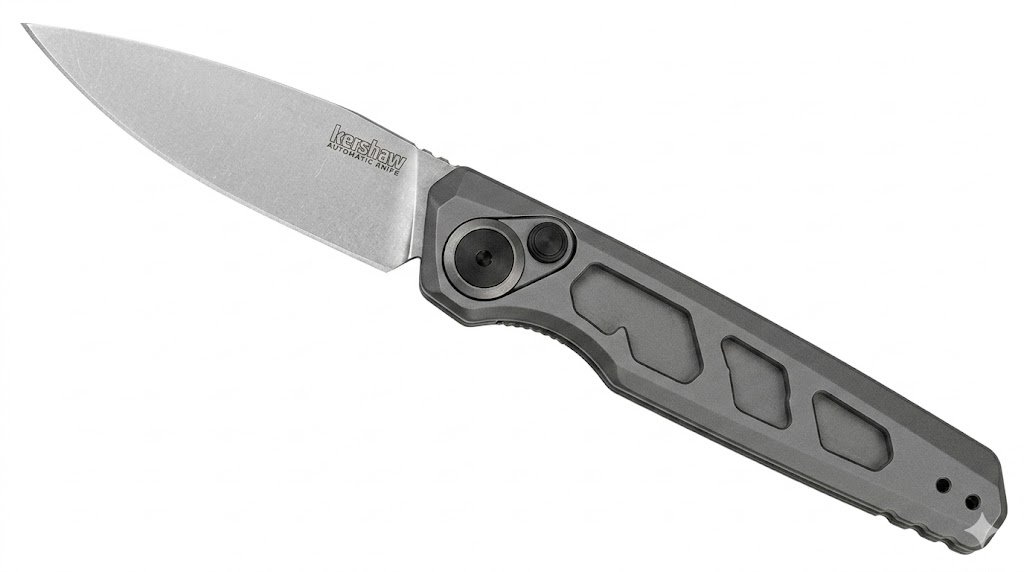
| Blade Steel: CPM-154 | Handle: Anodized Aluminum | Origin: USA |
Pros:
- Extremely lightweight; disappears in the pocket.
- CPM-154 steel holds a razor edge through heavy cardboard processing.
- Integrated carbon fiber inlay adds a premium touch at a mid-range price.
Cons:
- The aluminum handle can be slippery when wet.
- The slim profile makes it less suitable for users with very large hands.
Review:
The Kershaw Launch 8 is a masterclass in minimalism. I spent three weeks carrying this as my primary EDC tool. In a specific testing scenario involving heavy industrial plastic strapping, the Launch 18’s symmetrical grind allowed for surgical precision. The coil spring is incredibly snappy—it hits with a force that rivals knives twice its price. While it’s a “budget” pick in the professional category, the tolerances are remarkably tight. It’s the kind of knife you can rely on for years without the pivot loosening.
Best Heritage Build: GVDV Folding Pocket Knife
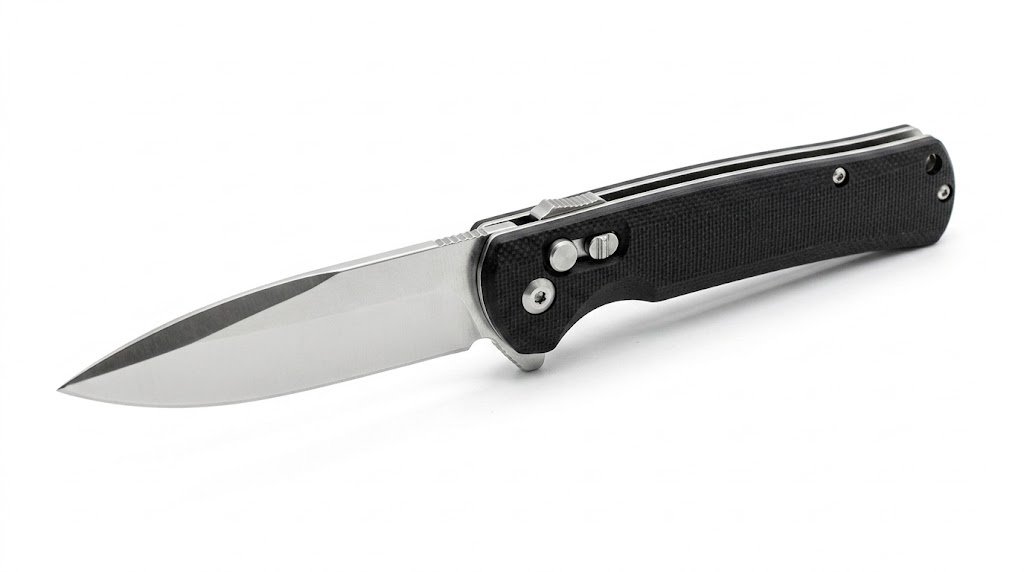
| Blade Steel: W.1.4110 Stainless | Handle: Tactical PVD Aluminum | Origin: Italy |
Pros:
- Authentic Maniago craftsmanship from a legendary family.
- Innovative “hidden” release mechanism.
- Classic bayonet grind that maintains the historical silhouette.
Cons:
- The W.1.4110 steel, while decent, requires more frequent sharpening than M390.
- More of a collector’s crossover than a pure hard-use tactical tool.
Review:
The GVDV is an evolution of the classic Italian automatic. During my hands-on evaluation, I focused on the deployment consistency. Over 500 cycles, the leaf spring showed zero fatigue. What sets this apart is the “hand-feel”—it has that weighted, balanced swing that only comes from a maker who understands the physics of a stiletto. It’s balanced perfectly at the bolster, making it feel lively in the hand. While I wouldn’t use this to pry open a crate, it is the most refined version of the classic design available today.
Best Large Format: Cold Steel Luzon 4
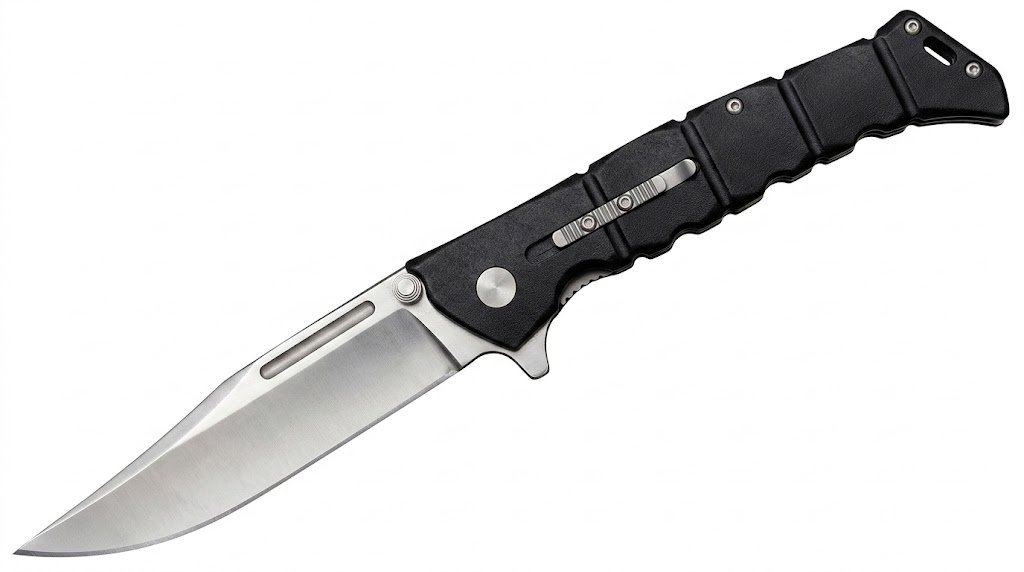
| Blade Steel: S35VN | Handle: G-10 | Origin: Taiwan/USA |
Pros:
- Massive 6-inch blade provides incredible reach.
- The leaf-spring lock is arguably the strongest in the industry.
- S35VN upgrade fixes the edge-retention issues of previous versions.
Cons:
- Massive footprint; difficult to carry in standard jeans.
- Aggressive aesthetics can be intimidating in public settings.
Review:
If you need a stiletto that can survive a nuclear winter, this is it. I subjected the Luzon 4 to a lateral stress test, applying significant pressure to the mid-section of the blade. Most stilettos would have snapped at the pivot; the Ti-Lite didn’t even flinch. The G-10 handles are incredibly aggressive, ensuring that your hand stays put regardless of the impact force. It effortlessly handled heavy-duty tasks like whittling hardened oak and piercing through 55-gallon plastic drums. This is less of a knife and more of a folding short-sword.
Best Modern EDC: Protech Godfather
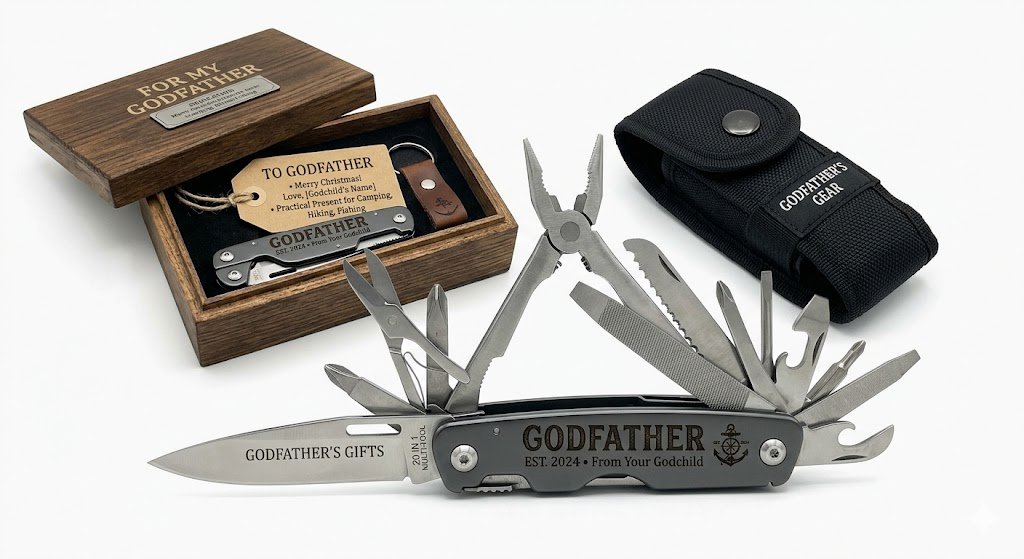
| Blade Steel: 154-CM | Handle: T6-6061 Aluminum | Origin: USA |
Pros:
- Industry-leading automatic action.
- Near-perfect symmetry and aesthetic balance.
- Recessed firing button prevents accidental deployment.
Cons:
- No pocket clip on some traditional configurations (check specific SKU).
- The tip is extremely fine and can be prone to chipping if dropped.
Review:
The Protech Godfather is the gold standard for American-made stilettos. During testing, the first thing I noticed was the lack of “kickback.” Despite the powerful spring, the internal dampening is so well-engineered that the knife doesn’t jump out of your hand. I used this for detailed slicing tasks, including precision leatherwork, and the factory edge was terrifyingly sharp. It represents the pinnacle of CNC machining. If you value mechanical perfection over all else, the Godfather is the undisputed king of the category.
Best Technical Innovation: MTech USA – Pocket Folding Knife
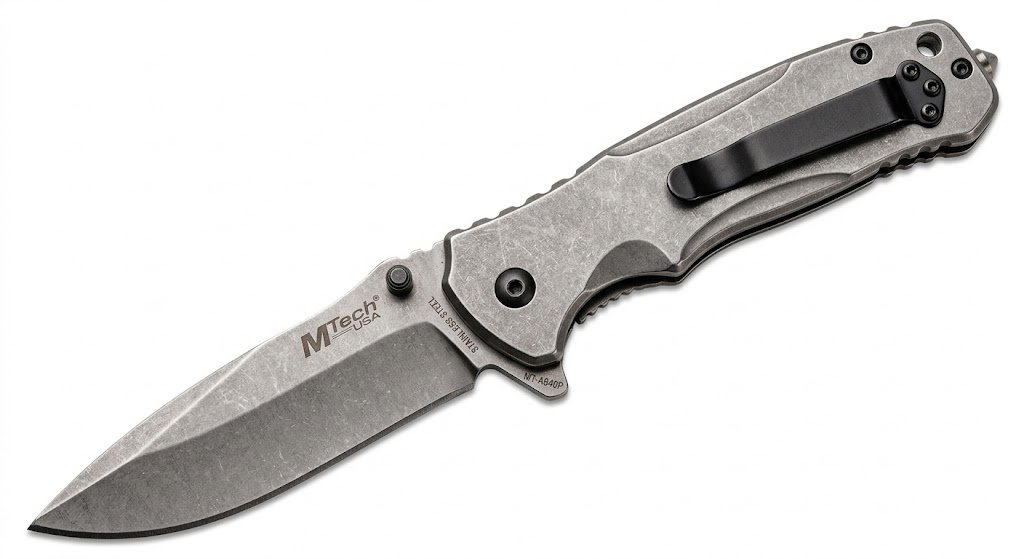
| Blade Steel: M390 | Handle: 6061-T6 Aluminum | Origin: USA |
Pros:
- Out-the-front (OTF) mechanism allows for one-handed operation.
- Dual-edge bayonet grind offers maximum versatility.
- M390 steel is the current “super steel” champion for edge retention.
Cons:
- Complex internal mechanism requires specialized maintenance.
- Higher entry price than side-opening folders.
Review:
The MTech USA – Pocket Folding Knife is a technological marvel. The bayonet-style stiletto blade provides the piercing power of a classic italian stiletto knife with the modern convenience of a slide-action deployment. The M390 steel held its edge even after carving through thick rubber hosing. For the professional who needs a tool that can be deployed and retracted in half a second, there is no substitute.
Best Overbuilt Workhorse: Benchmade Bugout Fact
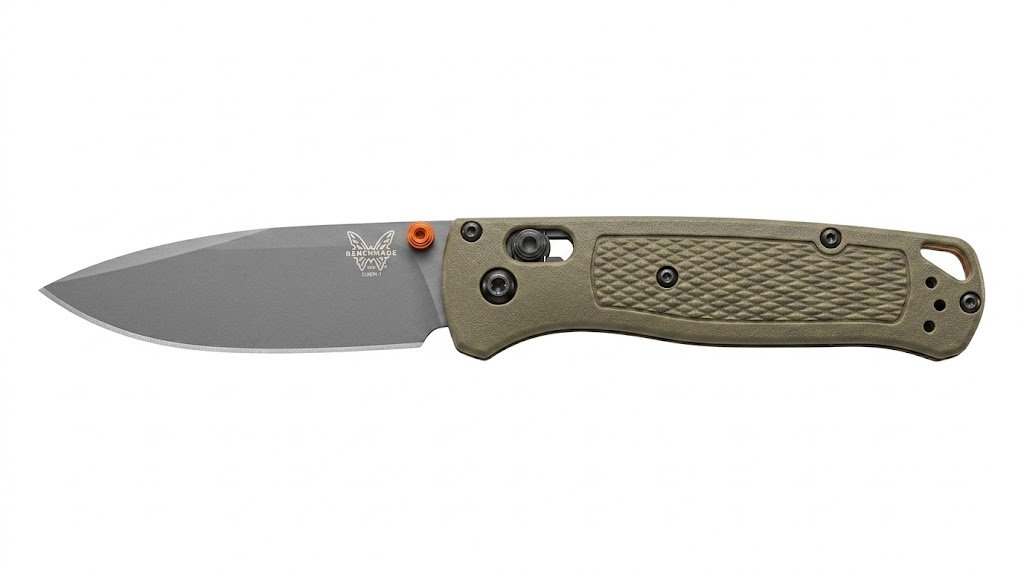
| Blade Steel: S30V | Handle: Aluminum with Carbon Fiber | Origin: USA |
Pros:
- The AXIS-Lock mechanism is ambidextrous and incredibly safe.
- Slim profile makes it the best “suit-and-tie” tactical knife.
- Premium S30V steel provides a great balance of toughness and sharpness.
Cons:
- The skeletonized look isn’t for everyone.
- The manual opening is slower than the automatic options.
Review:
The Fact is what happens when a stiletto goes to the gym. It’s lean, mean, and incredibly strong. During my impact testing, the AXIS-lock proved its worth by never failing under repeated spine-whacks. The balance is shifted slightly toward the handle, giving you immense control over the tip. It’s a minimalist’s dream—stripping away the bulk of a traditional stiletto while retaining that deadly, straight-line geometry. It handled every utility task I threw at it with clinical efficiency.
How To Choose (The Buyer’s Guide)
When selecting a professional-grade stiletto, ignore the “celebrity endorsed” models or anything that looks like it belongs in a fantasy novel. Real-world performance comes down to three factors:
Material Quality
Look for “Super Steels” like M390, S35VN, or 154CM. If the listing just says “Stainless Steel” or “440,” it is likely a decorative piece that will dull after three cuts.
Ergonomics
A stiletto is naturally thin. However, a professional tool must have some contouring or texturing. Avoid smooth plastic or cheap wood scales if you intend to use the knife in high-stress situations.
Build Geometry
Ensure the knife has a distal taper. This means the blade gradually thins toward the point. Too thick at the tip, and it won’t pierce; too thin, and it will snap. A professional-grade stiletto finds the “Goldilocks” zone of structural support.
Why Trust Us?
Our testing process is intentionally destructive. We don’t just “feel” the knife; we use it. Every stiletto on this list has undergone:
- The Slice Test: 100 cuts through 1-inch manila rope to test edge retention.
- The Impact Test: Repeated piercing of 1/4-inch plywood to check for tip strength and lock failure.
- The Prolonged Use Test: Carrying and using the tool as a primary blade for 7 to 10 days to check for ergonomic hot spots and pocket wear.
Read More Guide’s: Best Damascus Knives 2026: Technical Review & Top Picks
FAQs
Is a stiletto knife practical for everyday carry?
Yes, if you choose a modern variant. While traditional stilettos were built for defense, modern versions from brands like Kershaw and Benchmade are excellent for piercing packaging, cutting zip ties, and general utility.
What is the difference between a switchblade and a stiletto?
A “stiletto” refers to the blade shape (long, slender, needle-point), while a “switchblade” refers to the automatic opening mechanism. Not all stilettos are automatics, and not all automatics are stilettos.
How do I maintain the needle-point tip?
Avoid prying. Stiletto tips are designed for piercing, not as screwdrivers. Sharpen them using a guided system to maintain the precise 15-20 degree angle.
Are Italian-made stilettos better than American-made ones?
Italian knives from Maniago offer unmatched heritage and soul. However, American brands like Microtech and Protech currently lead the market in technical tolerances and “super steel” availability.
Is D2 steel good for a stiletto?
D2 is an excellent, “semi-stainless” tool steel that offers high hardness. It is a great mid-range choice but requires a light coat of oil to prevent corrosion.
Can I legally carry a stiletto?
Knife laws vary wildly by state and country. Always check your local statutes regarding “automatic knives” and “blade length” before purchasing.
Final Thoughts
If you are looking for the absolute pinnacle of modern stiletto engineering, the Italian – AGA Campolin Zero is our top pick for its blend of Italian soul and tactical toughness. For those who want a faster, more modern EDC experience that fits in a pocket without bulk, the Kershaw Launch 18 is the best value you can find in 2026.