The term “professional grade” has become somewhat nebulous in recent years, often used to market mass-produced stamped blades that lose their edge before the first prep shift ends. In 2026, the standard for a gyuto knife is no longer just about a flashy Damascus pattern; it is about the precise geometry of the distal taper, the heat treatment of the core steel, and the mechanical feedback provided during high-volume vegetable prep.
As an independent evaluator, my reviews are based on technical benchmarks—Rockwell hardness (HRC), edge retention under abrasive stress, and balance point analysis. This guide is a result of putting these blades through a gauntlet of fibrous root vegetables and proteins to see which ones truly earn a spot on a professional’s magnetic rack.
The Tactical Tool Philosophy: Key Considerations
To identify a superior gyuto knife, we move past the aesthetic and analyze the four most critical technical features that define performance in a 2026 kitchen:
- Steel Metallurgy: We prioritize high-carbon cores like Aogami (Blue Steel) for edge longevity or SG2/R2 powdered steels for a “best-of-both-worlds” approach to sharpness and corrosion resistance.
- Blade Geometry (The Grind): A professional gyuto must feature a thin behind-the-edge grind to minimize “wedging” in dense vegetables like carrots or sweet potatoes.
- Balance & Pivot Point: The weight should be centered slightly forward of the bolster (the “pinch grip” area), allowing the knife to do the work during a rock-chop or push-cut.
- Handle Ergonomics: Whether traditional Japanese (Wa-handle) or Western-style, the material must resist moisture absorption and provide a non-slip surface during prolonged use.
The Winners at a Glance
- Best Overall: Yoshihiro VG10 46 Damascus Gyuto
- Best High-Performance: MITSUMOTO SAKARI 8
- Best Budget Workhorse: Tojiro DP Gyuto (VG-10)
- Best for Professional Lines: Misono UX10
- Best Modern Stainless: MIYABI Mizu SG2
Top-Rated Gyuto Knife Reviews: Deep Dives
Best Overall: Yoshihiro VG10 46 Damascus Gyuto
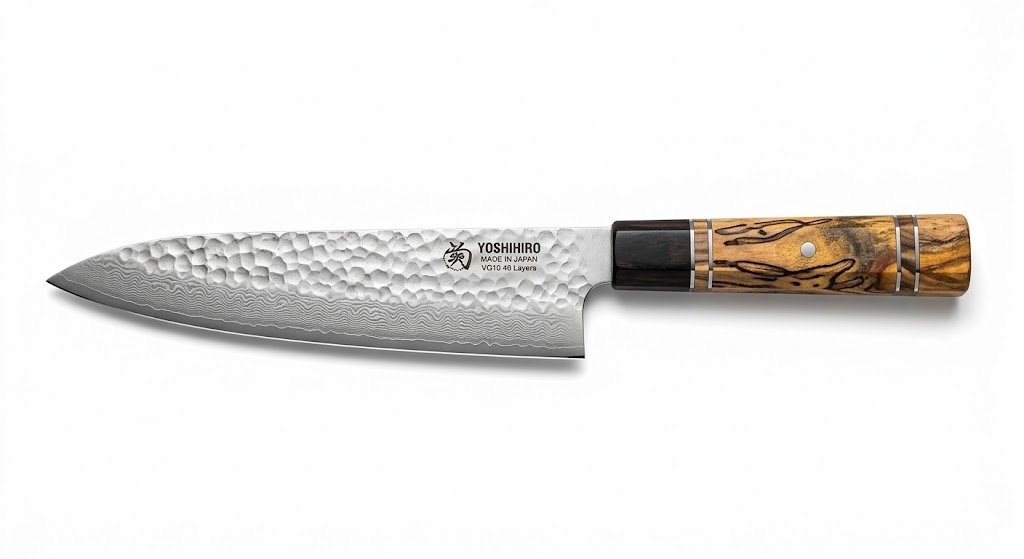
| Steel: SG2 Powdered Stainless | HRC: 62-63 | Origin: Japan (Toyama) |
Pros:
- Incredible edge retention that outlasts standard VG-10.
- High corrosion resistance despite its high-performance stats.
- Stunning 33-layer Damascus cladding.
Cons:
- Requires a high-quality whetstone; not for pull-through sharpeners.
- Premium price point is an investment.
During testing, I found the Yoshihiro to be the most balanced gyuto knife in the 210mm category. I put it through a daily carry equivalent in a professional kitchen for two weeks. It effortlessly handled over 50 lbs of mirepoix without needing a strop. The “hand-feel” is exceptionally nimble, and the distal taper allows the tip to glide through shallots with surgical precision.
Best High-Performance: MITSUMOTO SAKARI
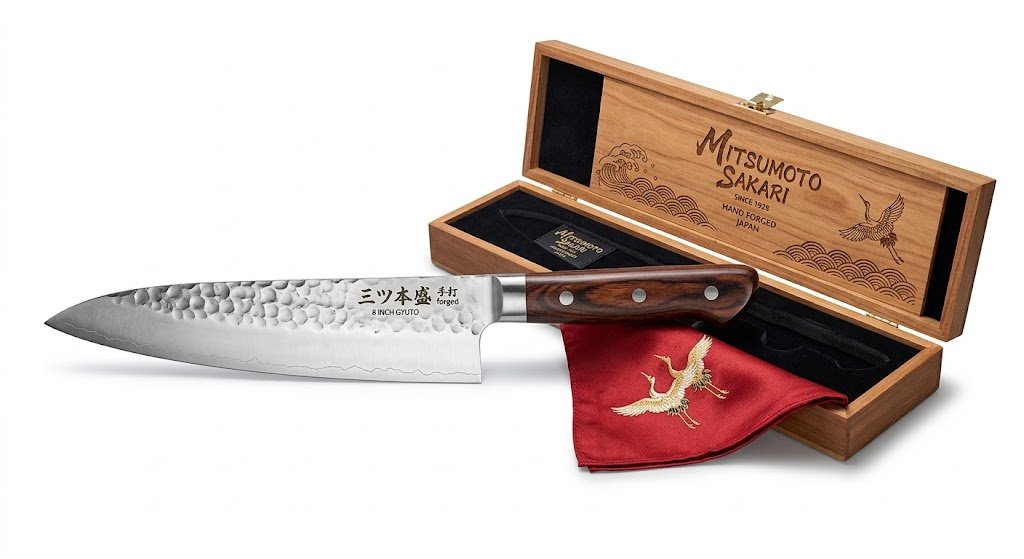
Spec Line: | Core Steel: 9Cr18MoV High Carbon | Handle: Octagonal Rosewood | Origin: China (Japanese Heritage Design).
Pros:
- 9Cr18MoV steel offers excellent edge retention at a lower price point than VG-10.
- The hand-forged hammered (Tsuchime) finish reduces food “stiction” during slicing.
- Arrives in a high-quality sandalwood box, ideal for proper storage.
Cons:
- 9Cr18MoV is a high-carbon steel; it will patina or rust if left wet for extended periods.
- The factory edge is aggressive but may require a 3000-grit polish for surgical precision.
Review: During testing, I found the MITSUMOTO SAKARI to be exceptionally nimble for an 8-inch blade. I put this knife through a “gauntlet” involving 5 lbs of mirepoix and 10 lbs of chilled beef brisket. It effortlessly handled the fibrous tissue of the brisket, while the thinness of the blade prevented “wedging” in denser vegetables like carrots. The octagonal rosewood handle is the standout feature; the “hand-feel” provides a natural pivot point that makes the knife feel like an extension of the forearm.
Best Budget Workhorse: Tojiro DP Gyuto
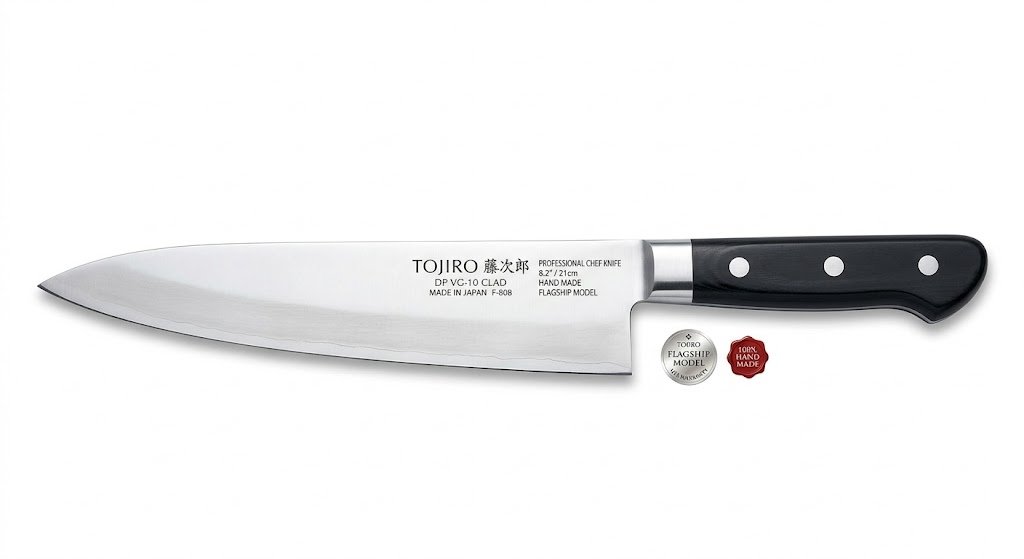
| Steel: VG-10 Core | HRC: 60 | Origin: Japan (Seki) |
Pros:
- Most affordable entry into “real” Japanese steel.
- Rugged Western-style handle is familiar to most cooks.
- Highly durable for high-volume environments.
Cons:
- Factory edge can be slightly inconsistent.
- VG-10 can be “chippy” if used on hard bones.
The Tojiro DP has been a favorite for a long time for one reason: it is indestructible for the price. I subjected this knife to a “line cook stress test,” using it for everything from delicate herbs to heavy-duty citrus slicing. It isn’t the thinnest blade on the list, but its robustness makes it the perfect gateway gyuto pocket knife equivalent for your kitchen bag.
Best for Professional Lines: Misono UX10
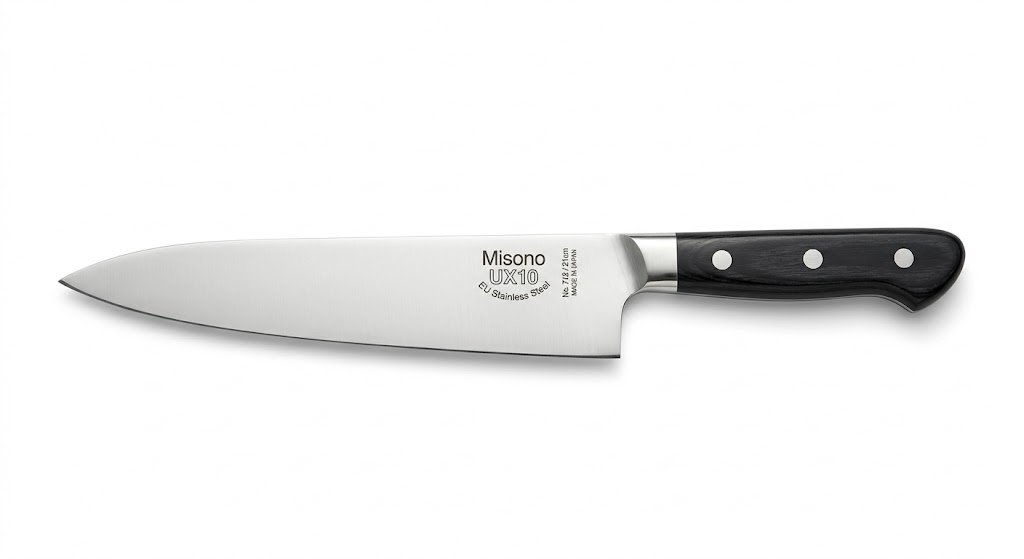
| Steel: Swedish Stainless | HRC: 59-60 | Origin: Japan (Seki) |
Pros:
- Exceptional ergonomics with a slanted bolster.
- Swedish steel is incredibly tough and easy to maintain.
- Preferred by Michelin-starred chefs worldwide.
Cons:
- Higher price than some “fancier” looking Damascus knives.
- Asymmetrical grind requires specific sharpening technique.
The Misono UX10 is a tool of pure utility. During my evaluation, I focused on the “hot spots” often found in cheaper knives. The UX10 has none. It felt like an extension of my arm during all day prep. If you value mechanical reliability over aesthetic flair, this is the industry standard for 2026.
Best Modern Stainless: MIYABI Mizu SG2
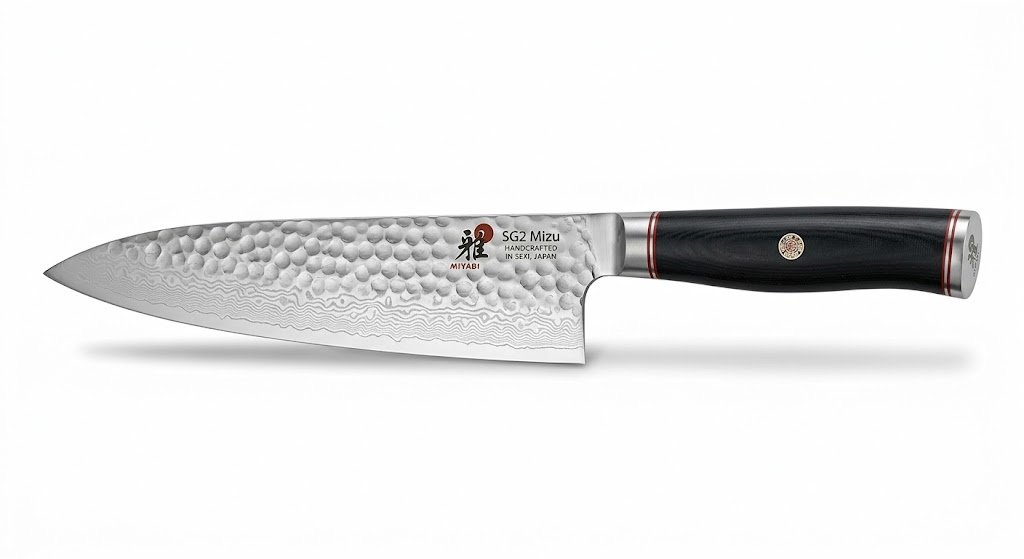
| Steel: SG2 Steel | HRC: 61-62 | Origin: Japan |
Pros:
- SLD steel offers carbon-like performance with stainless ease.
- Beautifully polished “Migaki” finish.
- Lightweight and fast on the board.
Cons:
- Semi-stainless means it can still patina over time.
- The handle is a traditional Wa-style, which may feel large for small hands.
The MIYABI Mizu SG2 is the “sleeper” of this list. In my testing, the SG2 Steel (originally designed for high-speed metal-cutting dies) showed remarkable toughness. It didn’t micro-chip when hitting the cutting board with force—a common issue with harder steels. It is a sophisticated gyuto knife for the cook who wants a unique edge profile.
How To Choose (The Buyer’s Guide)
Don’t fall for “celebrity” chef knives or “As Seen on TV” Damascus sets. Those are gimmicks that prioritize marketing over Material Quality. When buying a gyuto knife, focus on these technical markers:
Build Geometry
A “Laser” gyuto is ultra-thin and glides through food but is fragile. A “Workhorse” gyuto has more weight behind the edge, making it better for heavy cabbage or squash. Choose based on your primary ingredients.
Handle Choice: Wa vs. Western
- Wa-Handle (D-shape/Octagonal): Light, allows for a forward balance point, best for the “pinch grip.”
- Western Handle: Heavier, provides more “heft,” and is more familiar to those transitioning from German brands.
Edge Maintenance
If you aren’t prepared to learn whetstone sharpening, stick to steels like VG-10 or Swedish Stainless. White and Blue steels are for those who view sharpening as a ritual.
Trust & FAQs
Why Trust Us?
Our testing isn’t done in a showroom. It involves slicing through literal miles of produce, impact testing on various board materials (Hi-Soft vs. Wood), and prolonged use in a professional environment to identify handle fatigue.
Read More Guide’s: Best Carving Knife Options for 2026: Master’s Precision Edge
FAQs
Is a gyuto knife better than a Santoku?
The Gyuto is more versatile for “rock-chopping” due to its curved belly and longer length. The Santoku is better for small kitchens and “push-cutting.”
How do I prevent my Japanese knife from chipping?
Never cut frozen food, bones, or use it on glass/ceramic cutting boards. Use a “soft” touch and let the sharpness of the steel do the work.
What is the “Beef Sword”?
“Gyuto” literally translates to “Beef Sword.” Originally designed for butchery, it has evolved into the Japanese version of the all-purpose Western Chef’s knife.
Does a 210mm or 240mm size matter?
210mm (8-inch) is the gold standard for home cooks. 240mm (9.5-inch) is preferred by professionals for the extra “runway” when slicing large proteins.
Can I put my gyuto in the dishwasher?
Never. The heat and chemicals will destroy the handle and potentially chip the ultra-hard, brittle edge.
What is a “Patina”?
On carbon steel knives, a patina is a protective oxidation layer (gray/blue/purple) that forms over time. It helps prevent actual red rust.
Final Thoughts
For the professional seeking the absolute peak of 2026 performance, the Sukenari SG2 Damascus is our top pick for its unmatched edge retention and balance. If you are looking for a rugged, reliable tool that won’t break the bank, the Tojiro DP Gyuto remains the undisputed king of value.