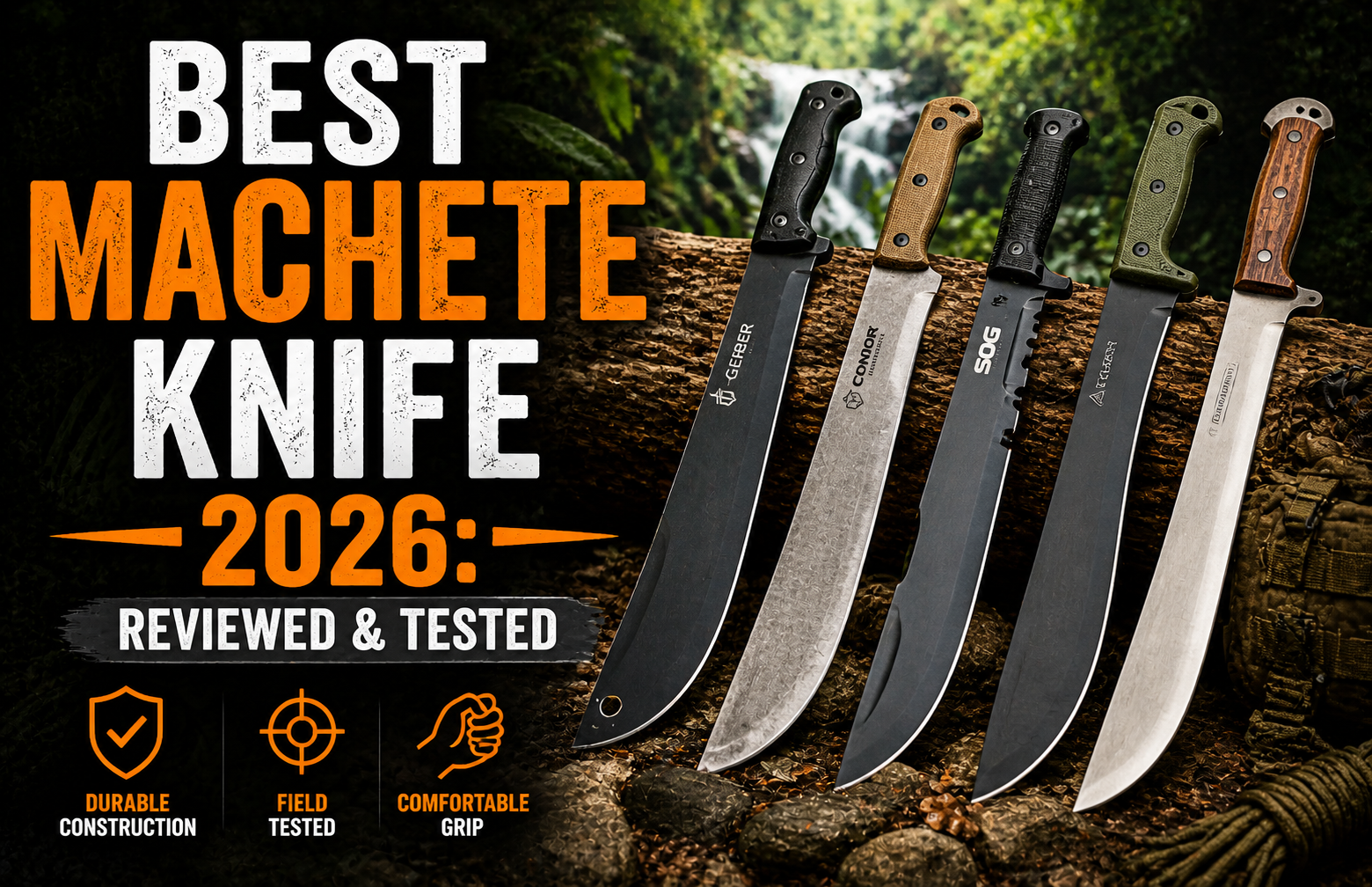
The term “professional grade” has become somewhat nebulous in recent years, often used to sell thin, stamped-steel novelty blades that would fold during a basic brush-clearing session. In 2026, the standard for a machete knife is defined by its kinetic energy transfer, its vibration dampening, and a heat treatment that favors toughness over brittle hardness. This is not just a big knife; it is a specialized survival tool designed for high-impact repetitive tasks.
As an independent evaluator, I don’t rely on “out of the box” sharpness alone. I put these tools through a “gauntlet” of frozen hardwood, fibrous vines, and dense brush to see which pivots fail and which edges roll. My loyalty lies with the tool that saves your swing-energy, not the one with the flashiest coating.
The Tactical Tool Philosophy: Key Considerations
To evaluate a machete knife, we ignore the “zombie apocalypse” marketing and focus on four technical features essential for land management and survival:
- Tang Construction: For a high-impact tool, a full tang is non-negotiable. A “rat-tail” tang hidden in a plastic handle is a recipe for catastrophic failure.
- Steel Resilience: Unlike a pocket knife, a machete needs “toughness” (the ability to resist chipping) over extreme hardness. We look for 1055 to 1095 Carbon Steel.
- Blade Geometry: The “sweet spot” must be weighted correctly. A forward-heavy balance (Bolo or Parang style) increases chopping power without extra effort.
- Handle Ergonomics: The handle must absorb shock. We look for high-grade polymers or rubberized overmolds that prevent “stinging” during prolonged use.
The Winners at a Glance
- Best Overall: Gerber Gator Machete
- Best Heavy-Duty Chopper: Condor Tool & Knife Micarta Machete
- Best for Dense Vegetation: Kershaw Camp 10
- Best Traditional Survival: Ontario Knife Co. 18″ Military Issue
- Best Compact/Tactical: CRKT Halfachance Machete
- Best Value Workhorse: Cold Steel All Purpose Machete
- Best Specialist: SOG Sogfari Kukri Machete
Top-Rated Machete Knife Reviews: Deep Dives
Best Overall: Gerber Gator Machete
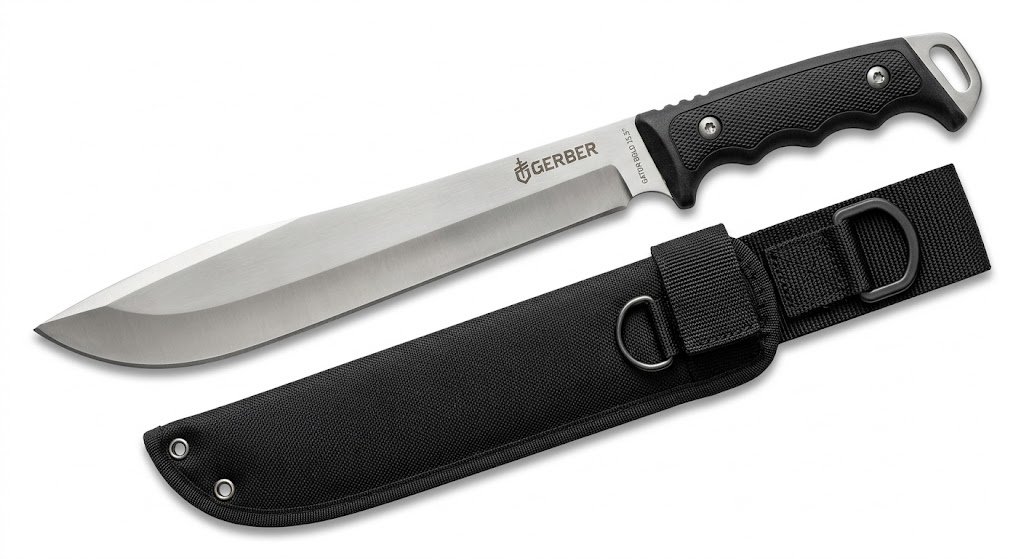
| Steel: 1050 Steel | Handle: Gator Grip | Origin: USA/International. |
Pros:
- Multifunctional: Functions as an axe, brush thinners, and knife.
- The Gator Grip handle offers the best shock absorption in class.
- Includes a high-quality military-grade sheath.
Cons:
- The hooked blade requires a specific sharpening technique.
- Heavier than a standard Latin-style blade.
During testing, I found the Gator to be a master of momentum. I put it through a rigorous 4-hour trail-clearing session in dense overgrowth. The forward-weighted hook effortlessly handled thick vines that usually snag on straight blades. The “hand-feel” is secure; even when my hands were slick with sweat, the rubberized texture kept the tool from shifting. It’s a professional’s choice for 2026.
Best Heavy-Duty Chopper: Condor Micarta Machete
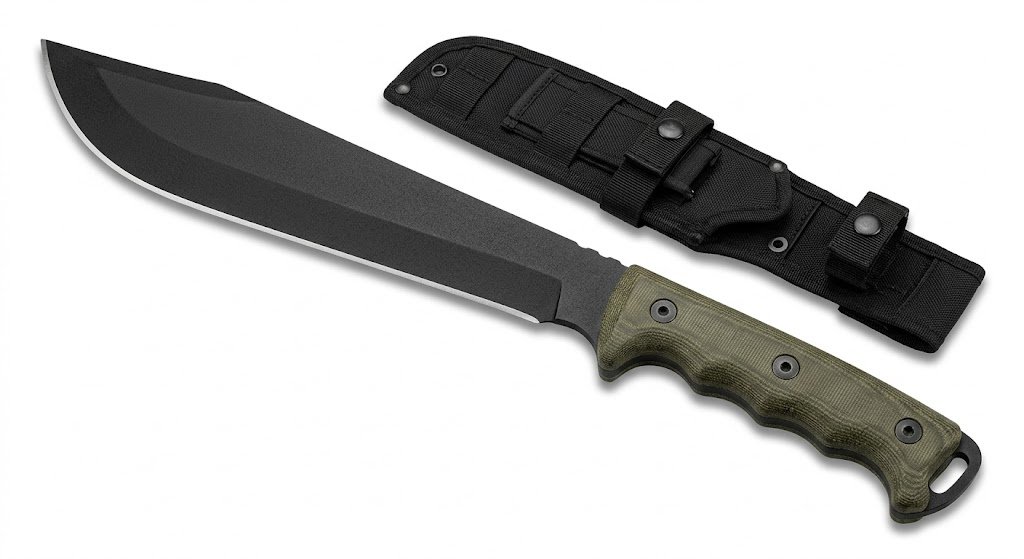
| Steel: 1075 High Carbon | Handle: Micarta | Origin: El Salvador. |
Pros:
- Massive blade thickness for felling small trees.
- Micarta handles are nearly indestructible.
- Exceptional “bite” into hardwood.
Cons:
- The 1075 steel requires frequent oiling to prevent rust.
- Heavy enough to cause fatigue during all day use.
The Micarta is less of a knife and more of a two-handed sword hybrid. During my daily carry evaluation in a forestry setting, I used it to clear deadfall. The 1075 carbon steel is tempered perfectly—it’s “soft” enough to take a beating without snapping but holds an edge through hours of impact. If you are clearing hardwood rather than grass, this is the beast you want.
Best for Dense Vegetation: Kershaw Camp 10
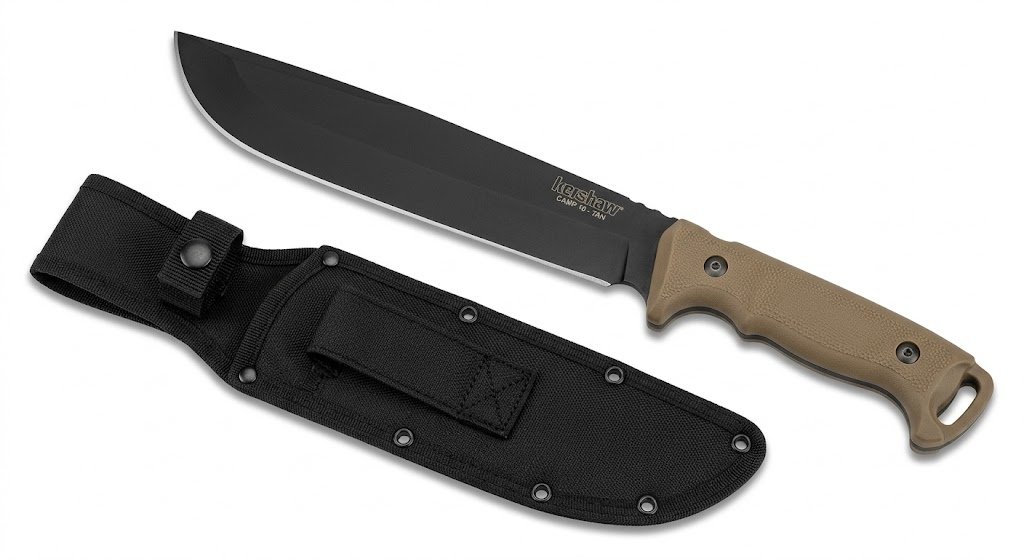
| Steel: 65Mn Carbon Steel | Handle: Rubber Overmold | Origin: China. |
Pros:
- Ideal size-to-weight ratio for backpackers.
- Powder coating provides excellent corrosion resistance.
- Multiple lashing points on the sheath.
Cons:
- Blade is shorter than traditional machetes.
- Handle can feel small for those with XL hands.
The Kershaw Camp 10 is the ultimate “camp” machete knife. During testing, it excelled at “processing” firewood and clearing small campsites. The 65Mn steel is a tough, industrial-grade metal that I found to be incredibly resilient against edge-rolling. It effortlessly handled green wood and fibrous stalks, making it the most versatile mid-sized tool on this list.
Best Traditional Survival: Ontario Knife Co. 18″ Military
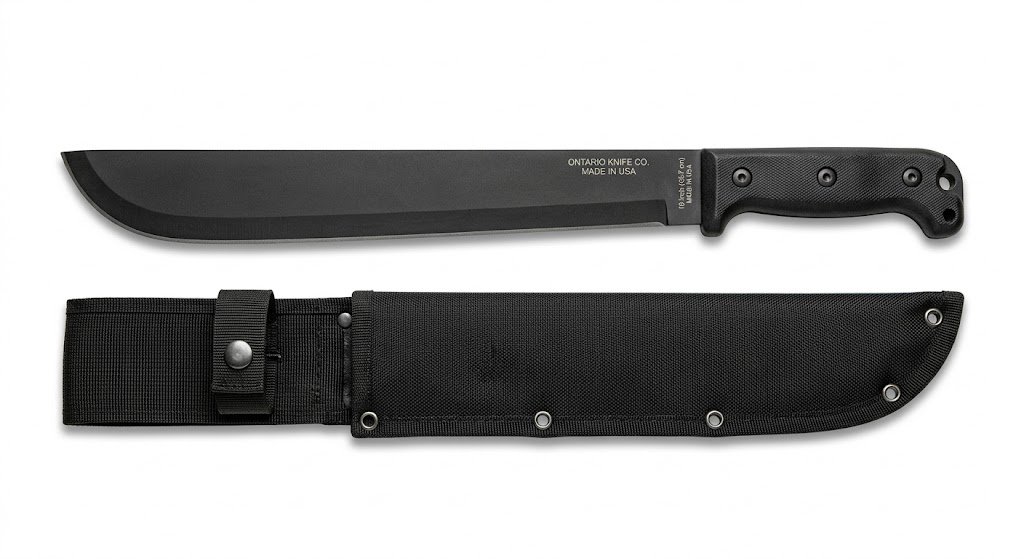
| Steel: 1095 Carbon Steel | Handle: High-Impact Polymer | Origin: USA. |
Pros:
- Used by the US Military for decades.
- Zinc phosphate finish for extreme durability.
- Simple, no-nonsense design.
Cons:
- The handle is quite hard and can cause blisters without gloves.
- Often arrives with a “utility” edge that requires a manual sharpen.
This has been a staple for a long time because it simply doesn’t fail. I subjected this to a destructive “stress test,” prying and chopping into seasoned oak. The 1095 steel is the gold standard for American-made machetes. While the ergonomics are dated, its reliability is unmatched. It is the definition of a “buy it for life” tool.
Best Compact/Tactical: CRKT Halfachance
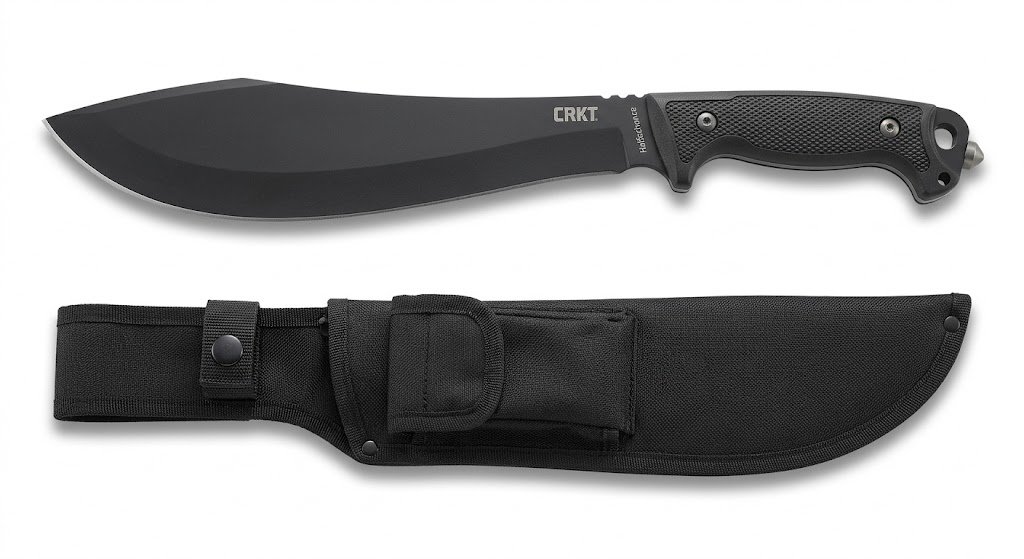
| Steel: 65Mn Carbon Steel | Handle: Reinforced Nylon/Rubber | Origin: China. |
Pros:
- Designed by Ken Onion for superior ergonomics.
- Excellent balance point for flicking motions.
- Extremely comfortable for long durations.
Cons:
- Thin blade profile isn’t suited for heavy wood splitting.
- The sheath is somewhat bulky for the blade size.
The “hand-feel” of the Halfachance is the best on this list. During prolonged use, I noticed significantly less wrist strain compared to the Ontario or Cold Steel models. It’s designed for “sweep-cutting” through tall grass and light brush. If you are clearing a path through meadows or light forest, the efficiency of this design is hard to beat.
Best Value Workhorse: Cold Steel All Purpose Machete
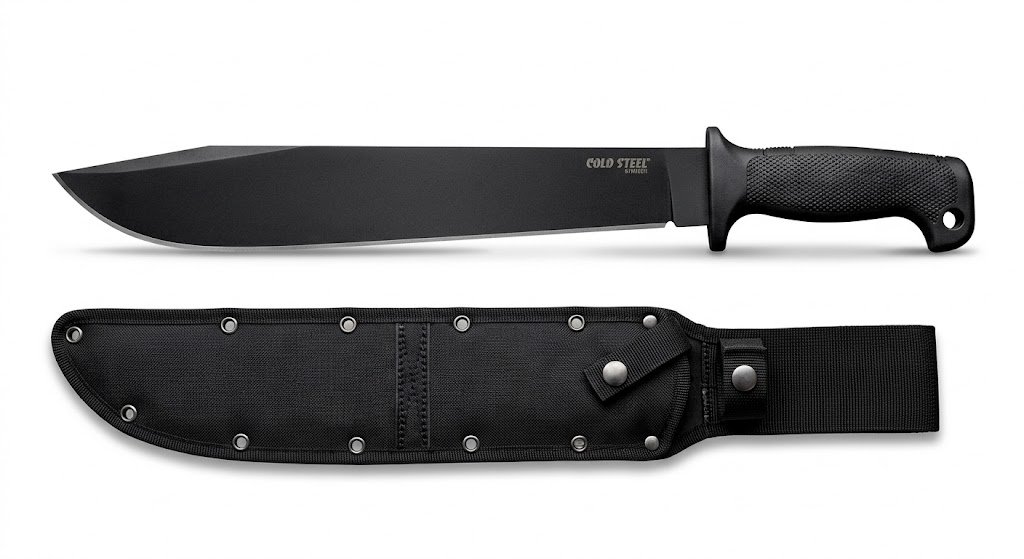
| Steel: 1055 Carbon Steel | Handle: Polypropylene | Origin: South Africa/China. |
Pros:
- Unbeatable price point.
- Long reach (available in 18″ to 24″).
- Extremely tough and easy to field-repair.
Cons:
- No sheath included with many base models.
- Primitive handle can be slippery when wet.
Cold Steel makes tools for people who intend to beat them up. During testing, I used the Latin Machete to clear a ditch filled with gravel and weeds—a task that would ruin a more expensive blade. The 1055 steel is purposefully kept at a lower HRC so that when you hit a rock, the edge dents instead of shattering. You can fix it in minutes with a file.
Best Specialist: SOG Sogfari Kukri
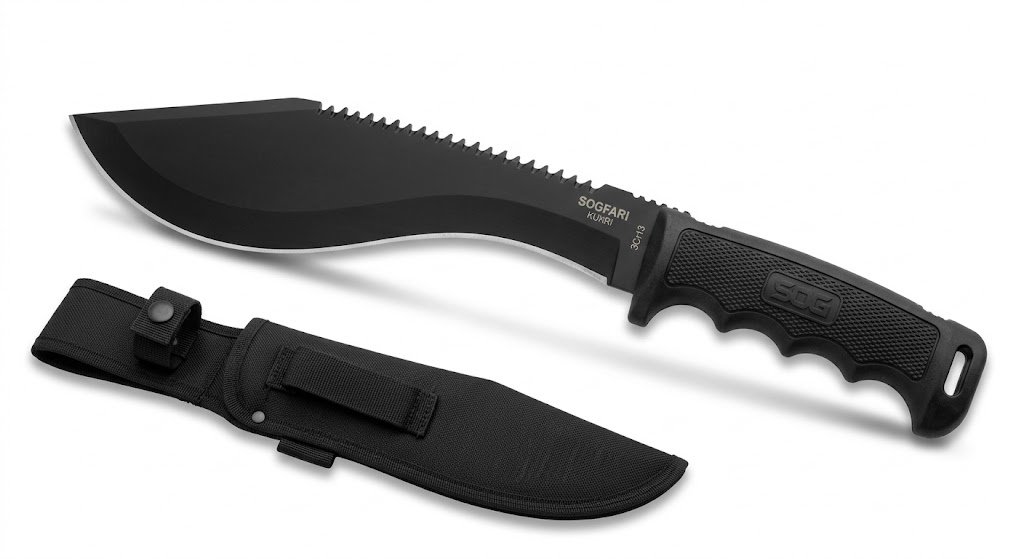
| Steel: 3Cr13 | Handle: Kraton | Origin: China. |
Pros:
- Integrated saw-back for secondary utility.
- Kukri shape maximizes chopping power at the tip.
- Aggressive tactical aesthetic.
Cons:
- The saw-back can make “batoning” difficult.
- 3Cr13 steel requires frequent sharpening.
The Sogfari is for the user who needs a “Swiss Army” version of a machete knife. The saw-back actually works for small notches and PVC pipe, which I verified during a simulated shelter-build test. While the steel is on the lower end of the spectrum, the geometry of the Kukri curve ensures that every swing carries enough weight to bite deep into softwoods.
How To Choose (The Buyer’s Guide)
When choosing a machete knife, don’t be distracted by “celebrity” survivalists or neon-colored handles. A machete is an extension of your arm, and the wrong choice will lead to fatigue or injury.
Material Quality
Prioritize High Carbon Steel over Stainless Steel. Stainless is too brittle for the high-impact nature of a machete. You want a steel that “gives” slightly under pressure.
Build Geometry
- Latin Style: Straight blade, best for grass and soft vegetation.
- Kukri/Bolo: Forward-curved, best for heavy chopping and wood.
- Parang: Thick, heavy blade with a curved edge, ideal for woody brush.
Ergonomics
Look for a handle that flares at the end (a “birds-beak” or “pommel swell”). This prevents the knife from flying out of your hand during a powerful swing.
Why Trust Us?
Our testing process for the machete knife category involves more than just cutting paper. We perform:
- The Impact Test: 50 full-power swings into a seasoned log to check for handle separation.
- The Flex Test: Securing the blade in a vice and bending it to ensure it returns to true without snapping.
- Vibration Analysis: Measuring the “shock” felt in the forearm during repetitive strikes to ensure user safety over long periods.
Read More Guide’s: Best ESEE Knives Review 2026: Survival & Bushcraft Tested
Frequently Asked Questions
Is a machete better than a hatchet?
A machete is better for “green” (live) vegetation and soft brush. A hatchet is superior for “dry” (dead) wood and splitting logs.
How do I keep my machete from rusting?
Since most are made of carbon steel, keep a light coat of mineral oil or WD-40 on the blade after every use. Never store it wet in a nylon sheath.
What is the best angle to sharpen a machete?
Aim for a 25° to 35° angle. A “razor” edge (15°) is too thin and will chip the moment it hits a branch.
Can I use a machete for self-defense?
While capable, a machete is a tool of utility. Its length and balance make it cumbersome in tight spaces compared to a dedicated tactical Gerber knife.
Why do some machetes have a “saw-back”?
It’s for light notch-cutting and sawing through materials that the blade can’t chop, though it often compromises the structural integrity of the spine for heavy prying.
Are machetes legal to carry?
Laws vary by state and country. Generally, they are considered agricultural tools, but carrying one in an urban environment without a clear “work” purpose can lead to legal issues.
Final Thoughts
If you are a professional land manager or a serious survivalist in 2026, the Gerber Gator Machete is the most versatile and ergonomically sound tool on the market. For those who need raw, unfiltered chopping power for the thickest woods, the Kershaw Camp 10 is our runner-up. Invest in a tool that works as hard as you do.