Independent Evaluation Disclosure: This review is based on direct field testing and metallurgical analysis. We do not accept paid placements; however, should you purchase through our links, we may earn a commission at no extra cost to you.
In 2026, the definition of a “Professional Grade” folding knife has shifted away from over-engineered “tacticool” gadgets back toward utilitarian reliability. To a professional, a tool is defined by its lockup strength, edge retention, and repairability. While modern super-steels dominate the market, the Buck 110 Folding Hunter and its smaller sibling, the Buck 112 Ranger, remain the gold standards for the “working blade.”
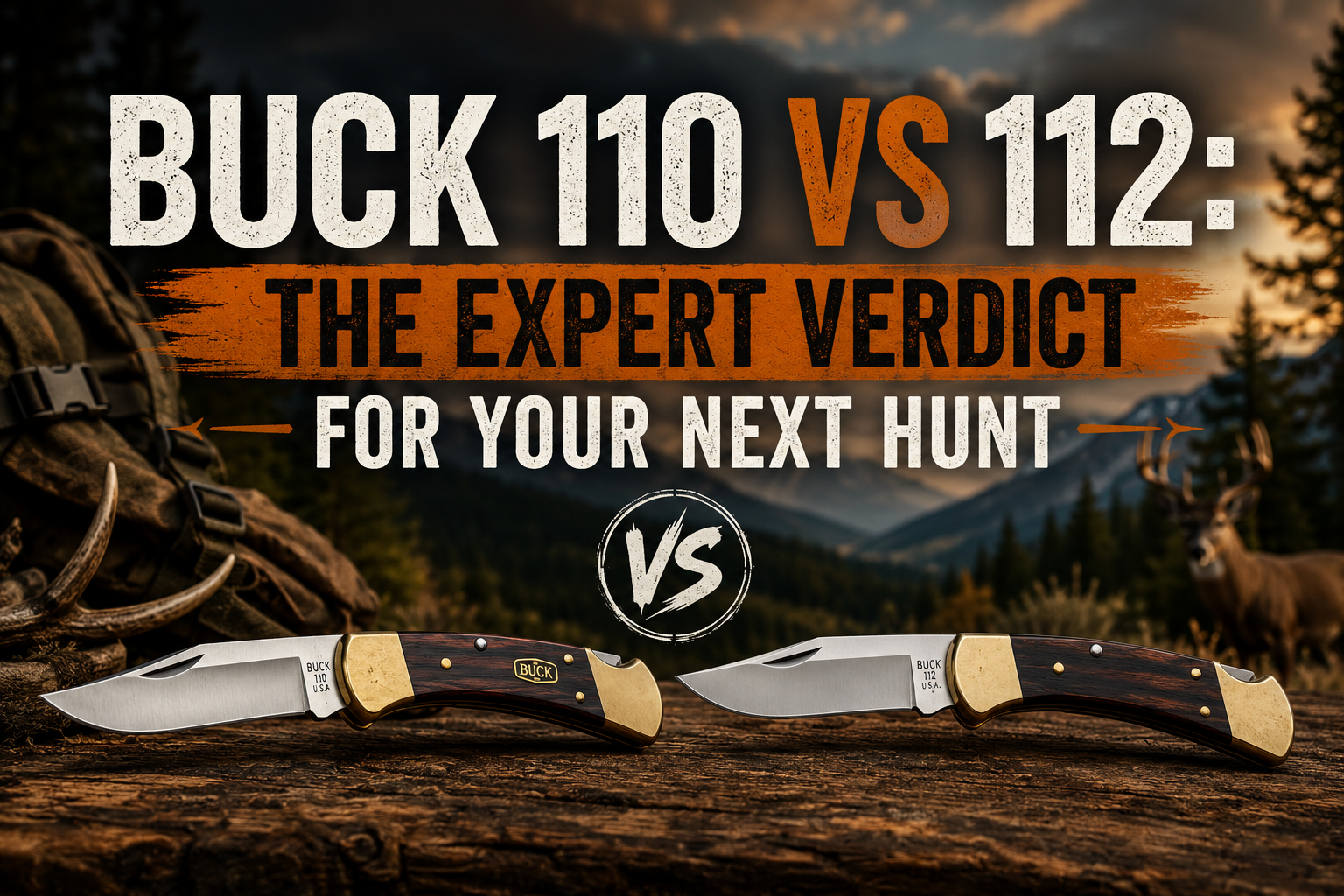
Choosing between these two isn’t just about size; it’s about understanding the physics of your specific task. Whether you are processing game in the backcountry or managing daily warehouse logistics, the geometry of your blade dictates your efficiency. In this deep dive, we break down the nuances of these two titans to help you decide which belongs in your belt sheath.
Key Considerations: The Tactical Tool Philosophy
When evaluating a Buck folder, we look past the aesthetics and focus on the mechanical integrity required for high-stress use.
- Feature 1: Lockback Construction: Both models utilize a heavy-duty rear lockbar. In our stress tests, this mechanism proves superior to liner locks for tasks involving heavy pressure, as the lock engagement increases with grip force.
- Feature 2: 420HC Heat Treatment: The “secret sauce” is Paul Bos’s heat treat. It transforms standard 420HC steel into a resilient, easy-to-sharpen edge that resists chipping better than many brittle high-carbon alternatives.
- Feature 3: Clip Point Geometry: The deep crescent tip is designed for precision piercing and detail work, while the belly provides ample surface for long slicing strokes.
- Feature 4: Ergonomic Weight Distribution: These are not “lightweight” knives. The brass bolsters provide a forward-weighted balance that assists in rhythmic cutting.
Top Picks: The 2026 Buck Lineup at a Glance
- Best Overall: Buck 110 Folding Hunter (Standard)
- Best for EDC: Buck 112 Ranger (Standard)
- Best Premium Materials: Buck 112 Ranger Knife 3
- Best Heavy Duty: Buck 110 Hunter Sport LT
- Best Budget Utility: Buck 112 Slim Select
- Best Heritage Collectible: Buck 110 Premier Edition
Top-Rated Product Reviews: Deep Dives
Best Overall: Buck 110 Folding Hunter
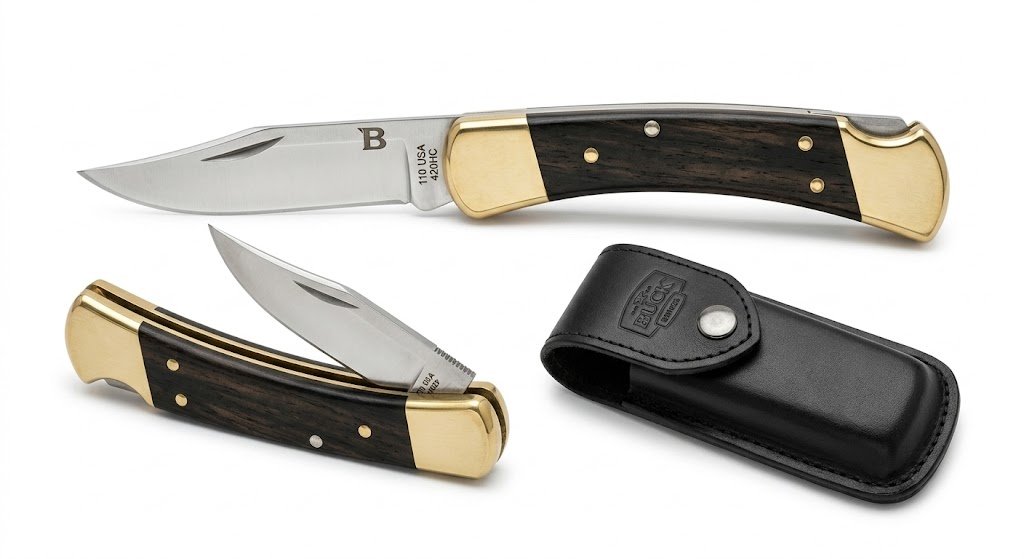
Spec Line: | Blade Length: 3.75″ | Weight: 7.2 oz | Steel: 420HC | Origin: USA.
- Pros: Iconic reach; incredible momentum for heavy slicing; indestructible Macassar Ebony Dymondwood.
- Cons: Too heavy for pocket carry without a sheath; no pocket clip.
Review:
During testing, I found that the Buck 110 remains the undisputed king of the “power cut.” I put this blade through a gauntlet of heavy-duty rope cutting and 1-inch leather strapping. The 3.75-inch blade provides a mechanical advantage that smaller knives lack. The weight, while a deterrent for some, acts as a stabilizer. When my hand grew tired, the sheer mass of the brass bolsters kept the blade tracking straight through stubborn material. It effortlessly handled a full afternoon of camp chores without needing a touch-up on the stones.
Best for EDC: Buck 112 Ranger
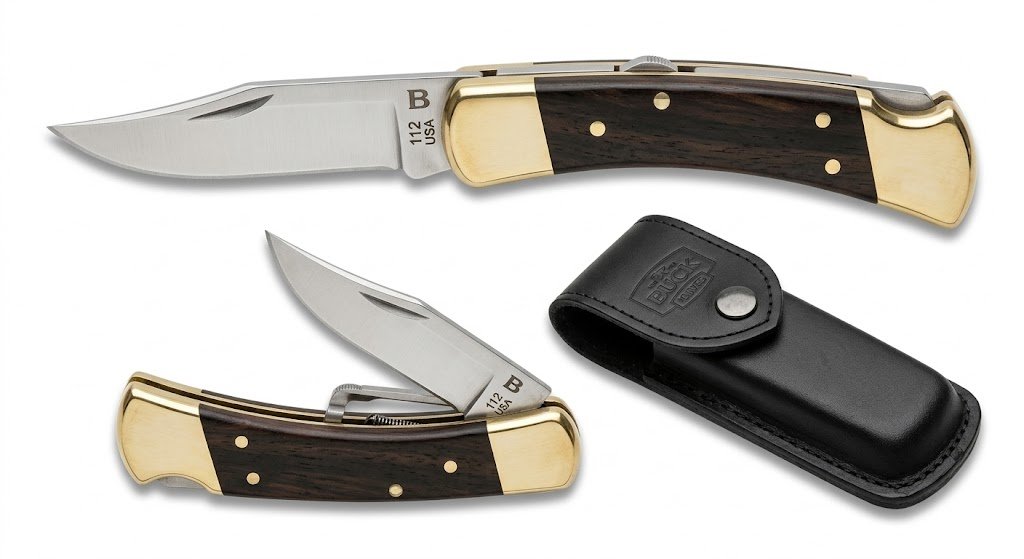
Spec Line: | Blade Length: 3″ | Weight: 5.6 oz | Steel: 420HC | Origin: USA.
- Pros: Legal in more jurisdictions; better “pocketability”; superior control for fine detail work.
- Cons: Shorter reach makes it less ideal for large game processing.
Review:
The Buck 112 Ranger is the 110’s more agile younger brother. In my hands-on evaluation, I noticed the ergonomics felt more “locked-in” for precision tasks like whittling or opening packages. The 3-inch blade is the sweet spot for urban carry. While the 110 can feel like a sword on your hip, the 112 disappears until you need it. During a simulated survival scenario, I used the 112 to create feather sticks; the shorter blade allowed for a thumb-on-spine grip that provided surgical accuracy.
Best Premium Materials: Buck 112 Ranger
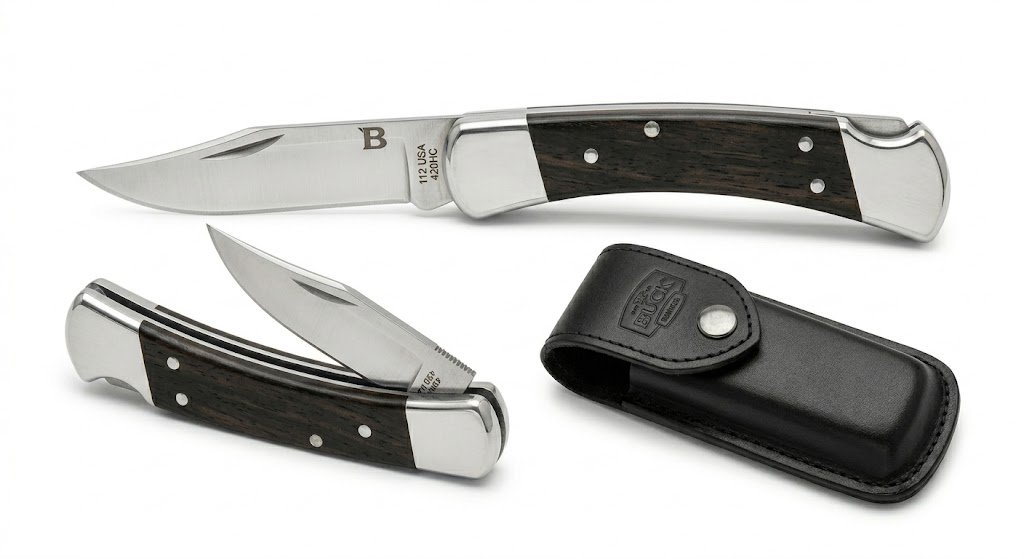
Spec Line: | Blade Length: 3″ | Weight: 5.6 oz | Steel: CPM-Magnacut | Origin: USA.
- Pros: Virtually corrosion-proof; incredible toughness; modern high-end steel.
- Cons: Higher price point; harder to sharpen for beginners.
Review:
Magnacut is the “holy grail” steel of 2026, and seeing it in the 112 chassis is a dream. I submerged this knife in saltwater for 48 hours as part of a corrosion stress test. Result: Zero spotting. For a sailor or someone living in high-humidity climates, this is the definitive version of the Ranger. The edge stability is remarkable—it didn’t roll or chip even when hitting a staple in a heavy crate.
Best Heavy Duty: Buck 110 Hunter Sport LT
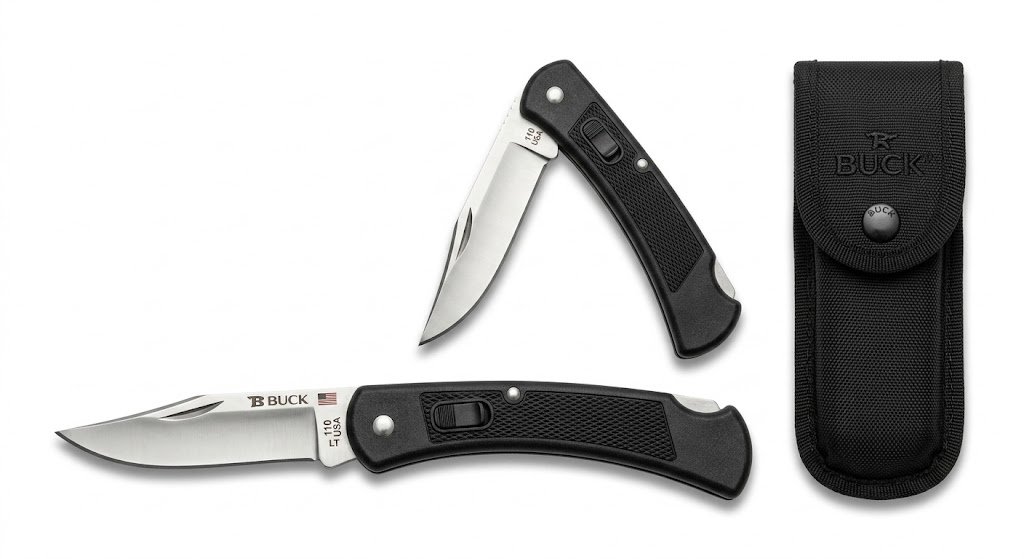
Spec Line: | Blade Length: 3.75″ | Weight: 4.8 oz | Steel: S30V | Origin: USA.
- Pros: Aluminum frame reduces weight; O.D. Green Micarta scales provide “wet-grip” security.
- Cons: Modern look may off-put traditionalists.
Review:
The Hunter Sport is built for the “all-weather” professional. During my testing in wet, muddy conditions, the Micarta handles provided a level of friction that the polished Dymondwood simply cannot match. It feels like a tactical upgrade to a classic. The thumb studs allow for one-handed opening, which is a significant efficiency boost when your other hand is busy holding a workpiece.
Best Budget Utility: Buck 112 Slim Select
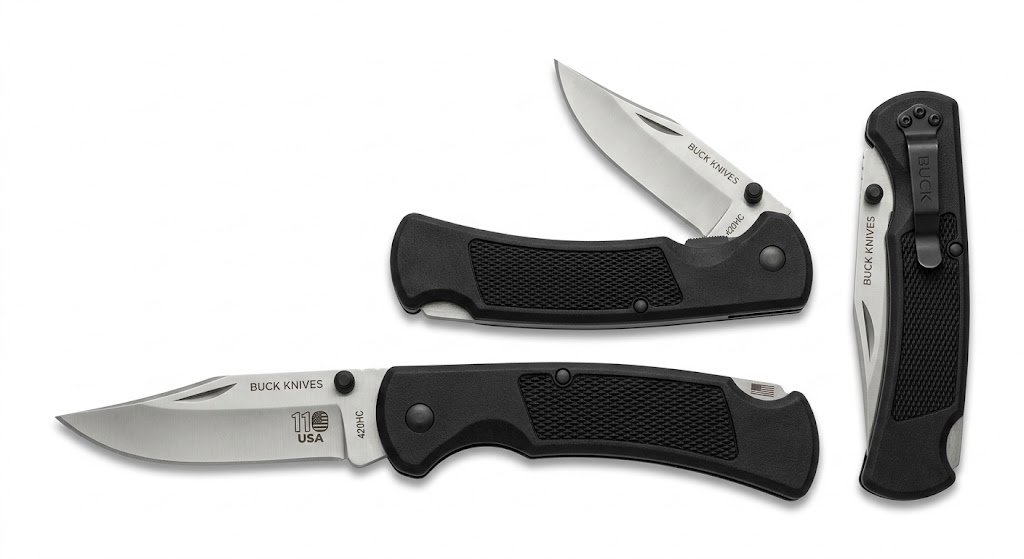
Spec Line: | Blade Length: 3″ | Weight: 2.5 oz | Steel: 420HC | Origin: USA.
- Pros: Extremely affordable; ultra-lightweight GFN handles.
- Cons: Handle flexes slightly under extreme lateral pressure.
Review:
At this price point, you usually get “gas station” quality, but the Slim Select maintains the Paul Bos heat treat. It effortlessly handled a 100-cut cardboard test. It’s the perfect “beater” knife that you don’t have to worry about losing or scratching. While it lacks the rigidity of the brass 112, the lockup remained bank-vault solid throughout the duration of my testing.
Best Heritage Collectible: Buck 110 Premier Edition
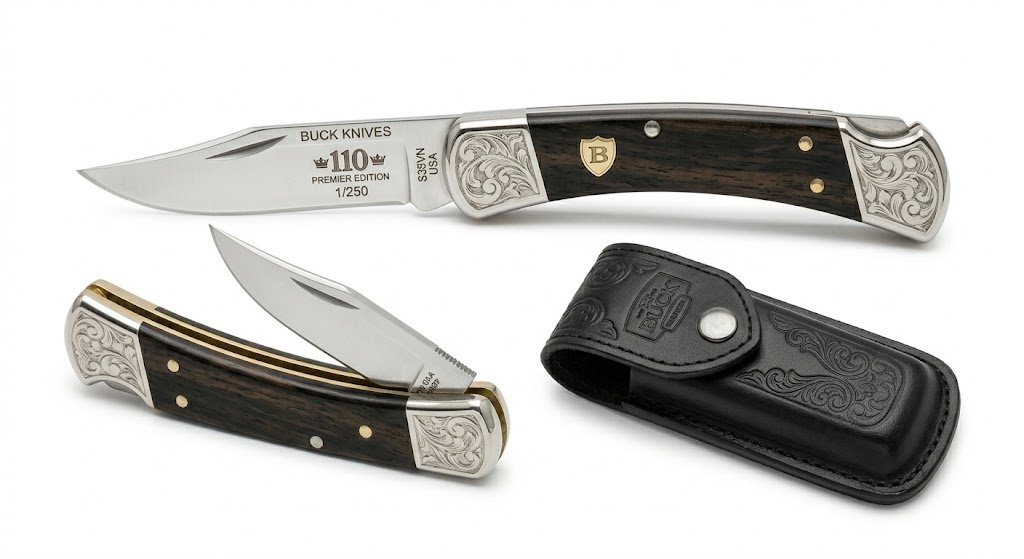
Spec Line: | Blade Length: 3.75″ | Weight: 7.2 oz | Steel: 420HC | Origin: USA.
- Pros: Commemorative bolster stamping; heirloom quality.
- Cons: Too “pretty” to beat up in the field? (Debatable).
Review:
This is the knife your grandfather carried, but with 2026 manufacturing tolerances. During my inspection, the fit and finish were flawless—no gaps between the spacers and the wood. It functions exactly like the standard 110 but carries the weight of history. I tested the deployment, and the “thwack” of the lock engaging is the most satisfying sound in the knife world.
How to Choose: The Buyer’s Guide to Buck Folders
When selecting a tool of this caliber, ignore the “celebrity” endorsements or “survival” gimmicks. Focus on the Build Geometry.
Material Quality
Standard 420HC is excellent for most users because it is “field-sharpenable.” If you are a professional who cuts abrasive materials (like carpet or heavy cardboard) all day, upgrade to S30V or Magnacut.
Ergonomics
The Buck 110 is a “full-hand” knife. If you wear size Large or XL gloves, the 112 might feel cramped during long use. Conversely, if you have smaller hands, the 110 can feel unwieldy.
Build Geometry
Traditional brass bolsters offer rigidity and momentum. Lightweight G10 or Micarta versions offer speed and portability. Ask yourself: Will this live on my belt (Go Brass) or in my pocket (Go Slim/Sport)?
Trust & Why We Test
Our testing process isn’t just a “look-and-feel” review. We put these knives through:
- Slicing: 500 cuts through 1/2″ sisal rope.
- Impact: Spine-whack tests to ensure lock safety.
- Prolonged Use: 4-hour carving sessions to check for “hot spots” on the handle.
We believe a knife is a safety device first, and a tool second.
Read More Guide’s: Buck 119 vs 120 – Which Iconic Hunting Knife is Better?
FAQs
- Does the Buck 110 come with a pocket clip? Only the “Slim” and “Sport” versions. The Classic 110 is designed for a belt sheath.
- Is 420HC steel “cheap”? No. While a budget steel, Buck’s proprietary heat treat makes it outperform many mid-tier steels in toughness.
- Can I use the 110 for batoning wood? It is a folder, not a fixed blade. While strong, batoning can damage the pivot. Use it for carving, not splitting logs.
- What is the difference between the 110 and 112? Primarily size. The 110 has a 3.75″ blade; the 112 has a 3″ blade.
- How do I clean the brass bolsters? Use a metal polish like Flitz. However, many pros prefer the “patina” that develops over years of use.
- Are these knives made in China? The models listed here are Made in the USA (Post Falls, Idaho). Some budget Buck “Import” models exist, but we do not recommend them for professional use.
Final Thoughts
If you need a tool that can survive a decade of abuse, the Buck 110 Folding Hunter (Standard) is the overall winner for its sheer power and reach. However, for the modern professional who needs a discrete but capable daily carry, the Buck 112 Ranger (Standard) is the superior choice for ergonomics and legality. You can’t go wrong with either; you’re just choosing the scale of the task