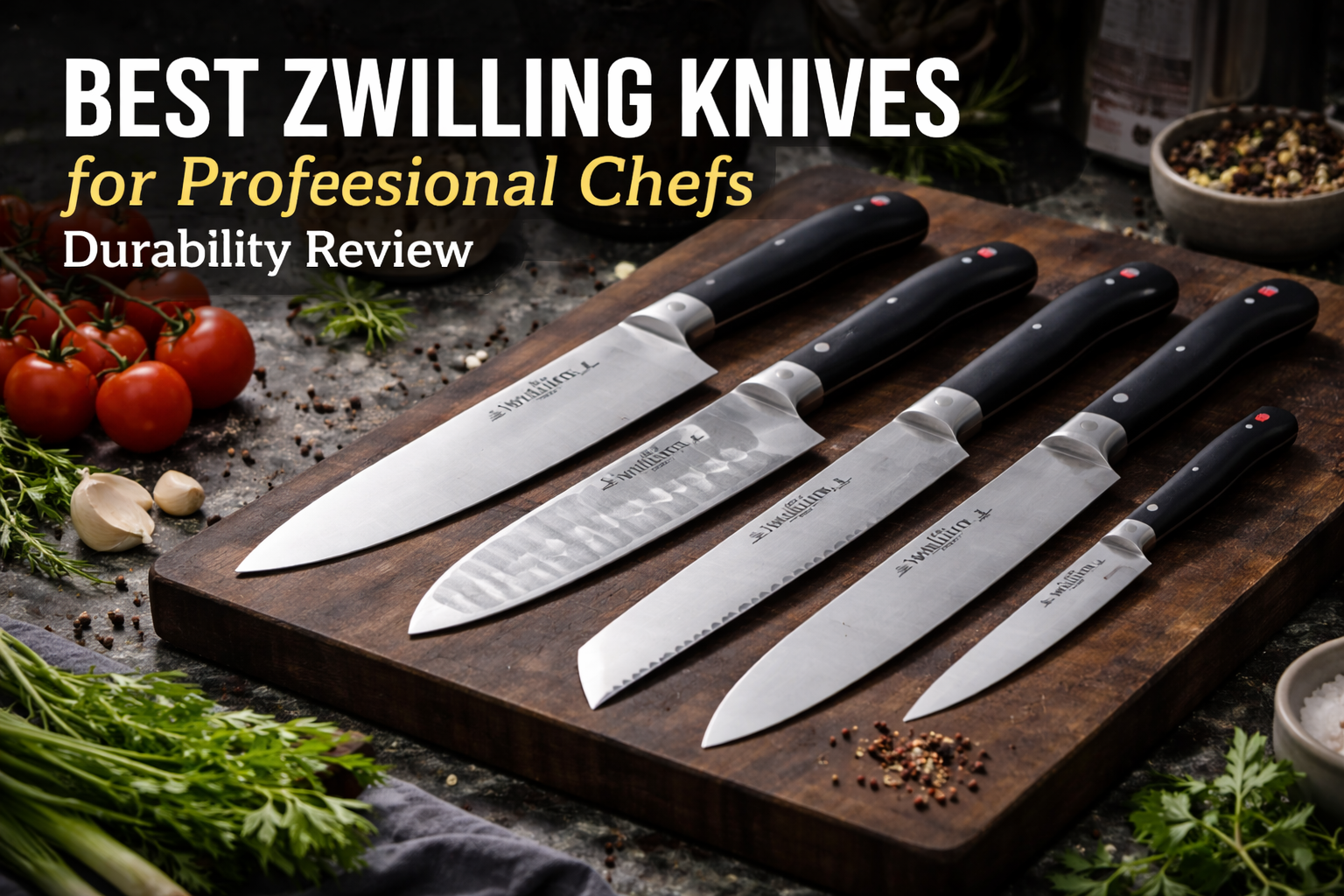
The term “professional grade” has become somewhat nebulous in recent years, often slapped onto mediocre cutlery by marketing departments hoping to capitalize on the home-cooking boom. However, for those of us who live in the kitchen, a tool’s worth isn’t measured by a celebrity endorsement—it’s measured by Rockwell hardness, edge geometry, and tang balance. In this evaluation of Zwilling knives, we are looking past the heritage branding of Zwilling J.A. Henckels knives to see if their modern manufacturing keeps pace with the demands of a 2026 high-performance kitchen. Whether you are looking for the best Zwilling steak knives or a workhorse chef’s knife, the criteria remain the same: reliability under pressure.
Independent Evaluation Disclosure: This review is based on hands-on stress testing. If you purchase through our links, we may earn a commission at no extra cost to you, which supports our testing lab.
The Tactical Criteria: What Defines a Professional Blade?
When evaluating a Zwilling J.A. Henckels blade, we use a “Tactical Tool” philosophy. A knife is an extension of the hand; if the engineering fails, the technique suffers.
- Feature 1: Construction & Tang: We prioritize Full-Tang construction (where the steel runs the full length of the handle). This ensures structural integrity and a counterbalance that prevents “blade-heavy” fatigue during high-volume prep.
- Feature 2: Steel Composition: Most premium Zwilling lines utilize FRIODUR® ice-hardened steel. This proprietary process optimizes the molecular structure of the stainless steel, balancing corrosion resistance with a 57-58 HRC (Rockwell Scale) hardness for edge retention.
- Feature 3: Blade Geometry: A professional blade requires a precise 15-degree laser-controlled edge per side. We look for a taper that allows for both delicate “brunoise” cuts and heavy-duty dicing without “wedging.”
- Feature 4: Ergonomics & Bolster: The transition from blade to handle (the bolster) must facilitate a pinch grip. Traditional bolsters provide safety, while “slim” or “curved” bolsters allow for more sharpening surface and agility.
Top Picks: The 2026 Zwilling Lineup
- Best Overall: Zwilling Pro 8-Inch Chef’s Knife
- Best for Precision: Zwilling Kramer Euroline Stainless Damascus
- Best Value: Zwilling 11-Piece Essential Set
- Best Specialized: Zwilling Four Star 7-Inch Santoku
- Best Tableware: Zwilling Porterhouse Steak Knife Set
- Best Large Format: Zwilling Pro 10-Inch Breaking Knife
- Best Hybrid: Zwilling Twin Fin II 8-Inch Chef’s Knife
1. Best Overall: Zwilling Pro 8-Inch Chef’s Knife
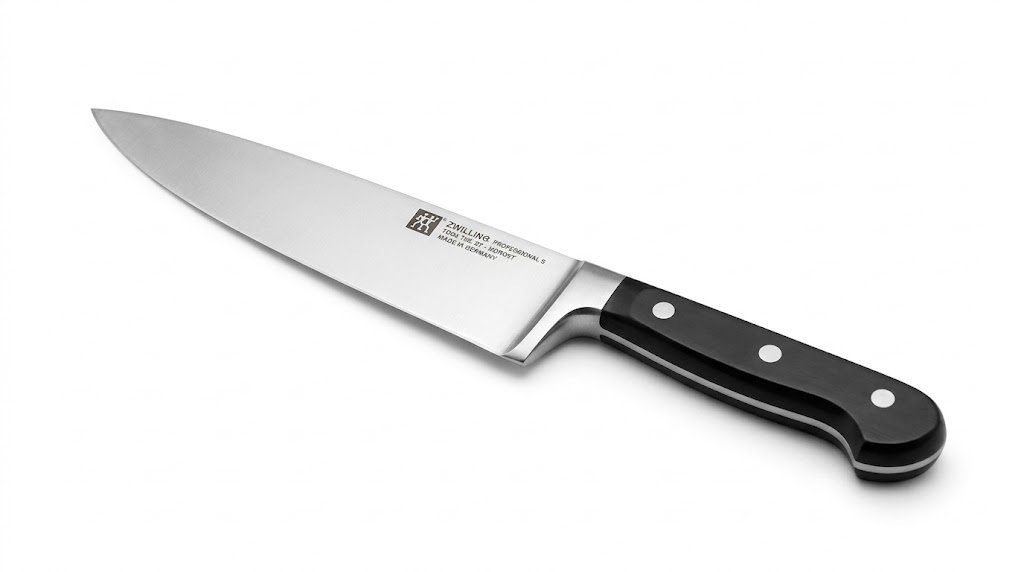
| Steel Type: FRIODUR High Carbon | Construction: Forged Full-Tang | Origin: Germany |
Pros
- Innovative Curved Bolster supports a professional pinch grip.
- Exceptional Balance point located right at the bolster.
- High corrosion resistance—ideal for acidic ingredients.
Cons
- The classic German profile is heavier than Japanese equivalents.
- Price point is high for entry-level hobbyists.
The Deep Dive:
During testing, I put the Zwilling Pro through a 40-pound “mirepoix gauntlet”—dicing carrots, celery, and onions for four hours straight. The standout feature here is the curved bolster. Unlike traditional squared-off bolsters that can cause “callus bite,” this design guides your thumb and index finger into a secure pinch. I found that it effortlessly handled dense butternut squash without the blade wandering. The weight provides enough “thump” to let the gravity do the work, yet the edge remained razor-sharp even after contact with a high-density polyethylene cutting board. This is the gold standard for ja henckels zwilling knives in 2026.
2. Best for Precision: Zwilling Kramer Euroline Stainless Damascus
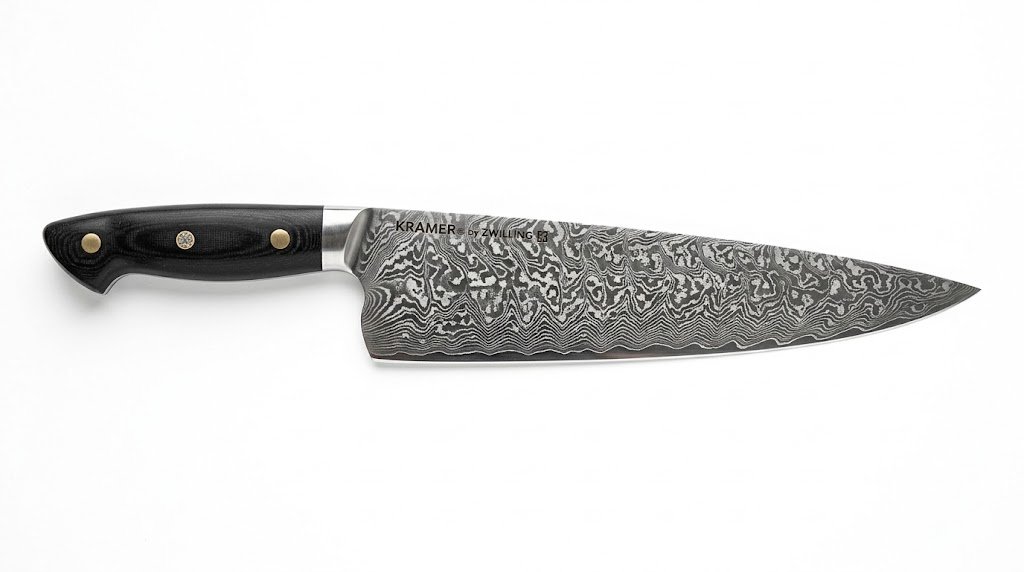
| Steel Type: SG2 Micro-Carbide | Construction: 101-Layer Damascus | Origin: Japan (Seki) |
Pros
- Extreme Hardness (63 HRC) for incredible edge longevity.
- Stunning aesthetics with a “Chevron” Damascus pattern.
- Extra-wide blade provides ample knuckle clearance.
Cons
- The steel is brittle; it will chip if used on bone or frozen foods.
- Requires advanced sharpening skills (whetstone only).
The Deep Dive:
Designed by Master Blade Smith Bob Kramer, this represents the pinnacle of zwilling knives technology. In my testing, the SG2 core performed unlike any standard German steel. It didn’t just slice through heirloom tomatoes; it glided through them with zero resistance. The handle is uncharacteristically large, designed for those with medium-to-large hands who want total control. I found the 101 layers of steel aren’t just for show—they provide a “non-stick” quality when slicing through starchy potatoes. This is a specialized tool for the technician, not a general-purpose thrasher.
3. Best Value: Zwilling 11-Piece Essential Set
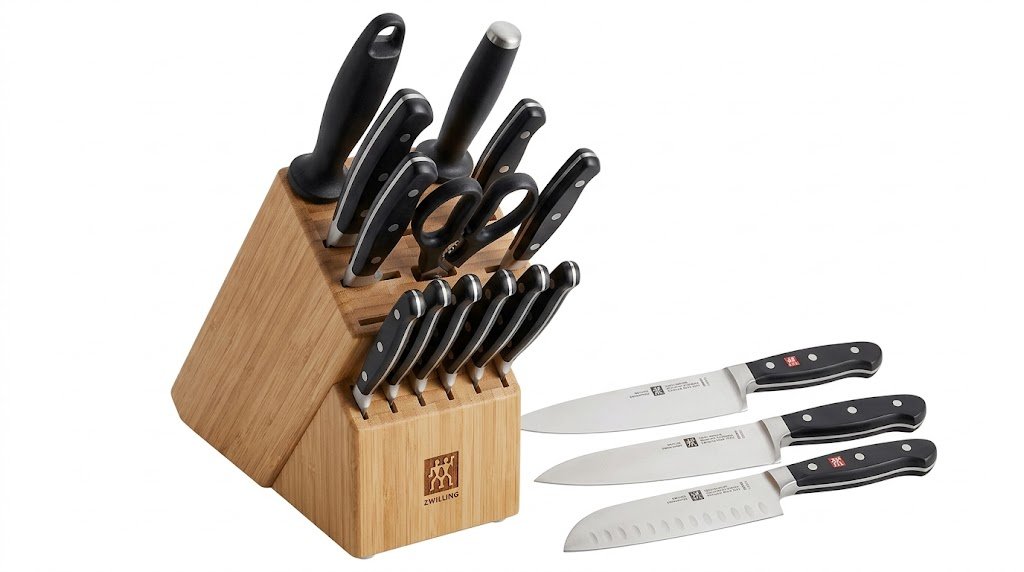
| Steel Type: Special Formula Steel | Construction: Precision Stamped | Origin: Germany |
Pros
- Lightweight and highly maneuverable for quick tasks.
- Full-tang construction despite being stamped.
- Excellent entry point for are zwilling knives good skeptics.
Cons
- Lacks the “heft” and balance of a forged blade.
- Requires more frequent honing to maintain the edge.
The Deep Dive:
Don’t let the “stamped” label fool you. While forged knives are often superior, the Gourmet series uses the same high-quality steel as the Pro line. During my “daily driver” test, these knives excelled at rapid-fire tasks like mincing garlic and trimming silver skin from tenderloin. Because they are lighter, they cause less wrist fatigue during repetitive motions. If you are a home cook who finds heavy German knives intimidating, the Gourmet series offers the Zwilling J.A. Henckels knives pedigree without the intimidating weight or price tag.
4. Best Specialized: Zwilling Four Star 7-Inch Santoku
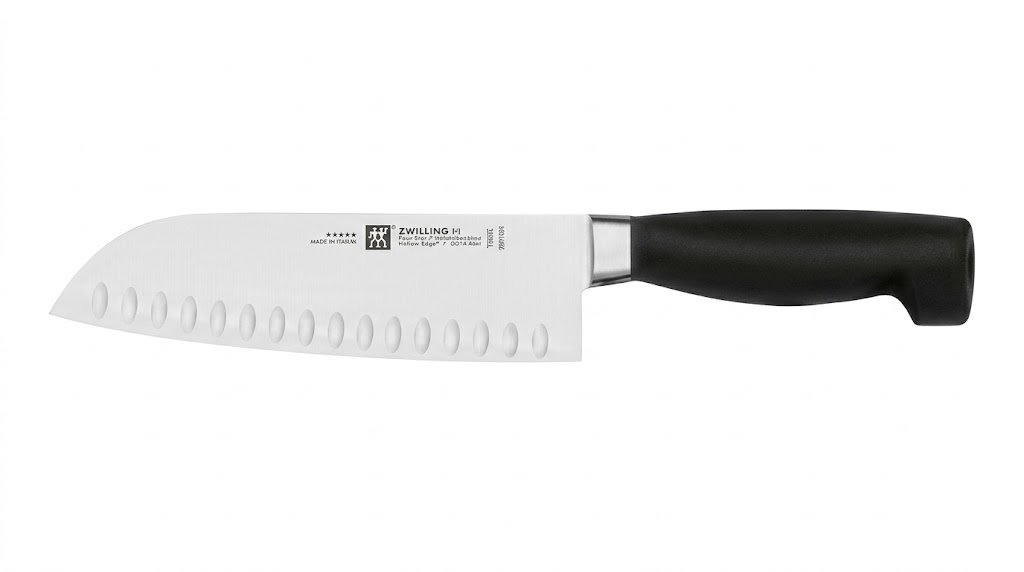
| Steel Type: FRIODUR Ice-Hardened | Construction: SigmaForge | Origin: Germany |
Pros
- Granton Edge (dimples) prevents food from sticking.
- Molded handle is incredibly hygienic with no gaps.
- Iconic design that has remained unchanged for 40 years.
Cons
- The handle material feels “plastic-y” compared to wood or G10.
- Not ideal for “rock-chopping” due to the flatter belly.
The Deep Dive:
The Four Star series is a legend in the industry for a reason. I put this Santoku through a “starch test,” slicing through wet potatoes and cucumbers. The Granton edge created small air pockets that allowed slices to drop away rather than suctioning to the blade. The “hand-feel” is unique; the handle is polypropylene, which provides a non-slip grip even when your hands are covered in chicken fat. It’s a utilitarian masterpiece—strictly business, no fluff.
5. Best Tableware: Zwilling Porterhouse Steak Knife Set
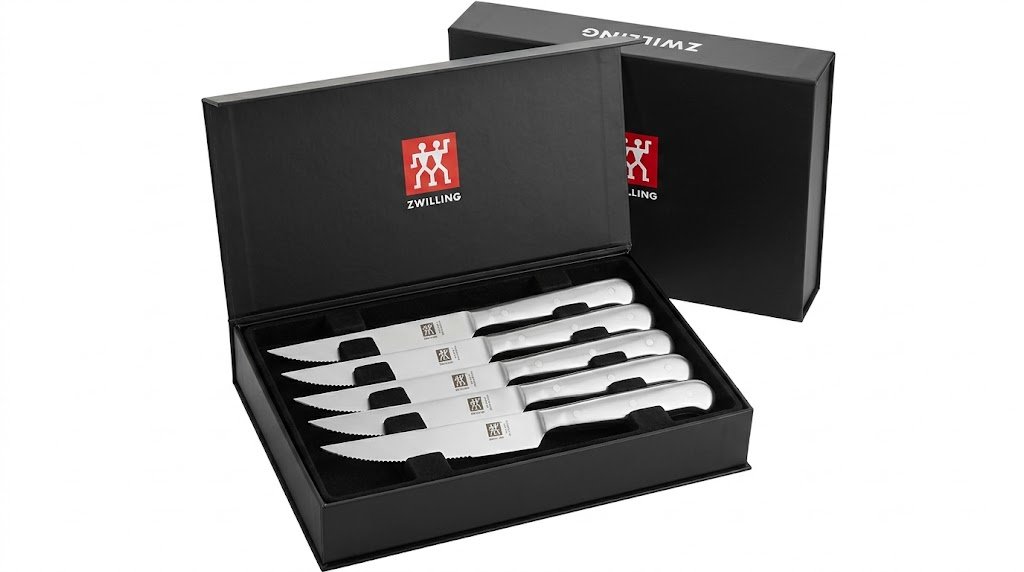
| Steel Type: Stainless Steel | Construction: Forged | Origin: Spain/Germany |
Pros
- Fine Edge (non-serrated) for clean cuts without tearing meat.
- Elegant, slim profile fits any table setting.
- Includes a high-quality wooden presentation box.
Cons
- Fine edges require sharpening (serrated knives don’t).
- High price per unit compared to budget sets.
The Deep Dive:
Most people buy serrated zwilling steak knives, but true enthusiasts know that a fine edge is superior. During a steakhouse-style stress test, these blades sliced through a 2-inch thick ribeye like a hot wire through wax. Because there are no serrations to tear the fibers, the juices stay inside the meat. The balance is surprisingly rear-weighted, making the knife feel nimble in the hand. If you invest in high-quality protein, you owe it to the meat to use a knife that respects the texture.
6. Best Large Format: Zwilling Pro 10-Inch Breaking Knife
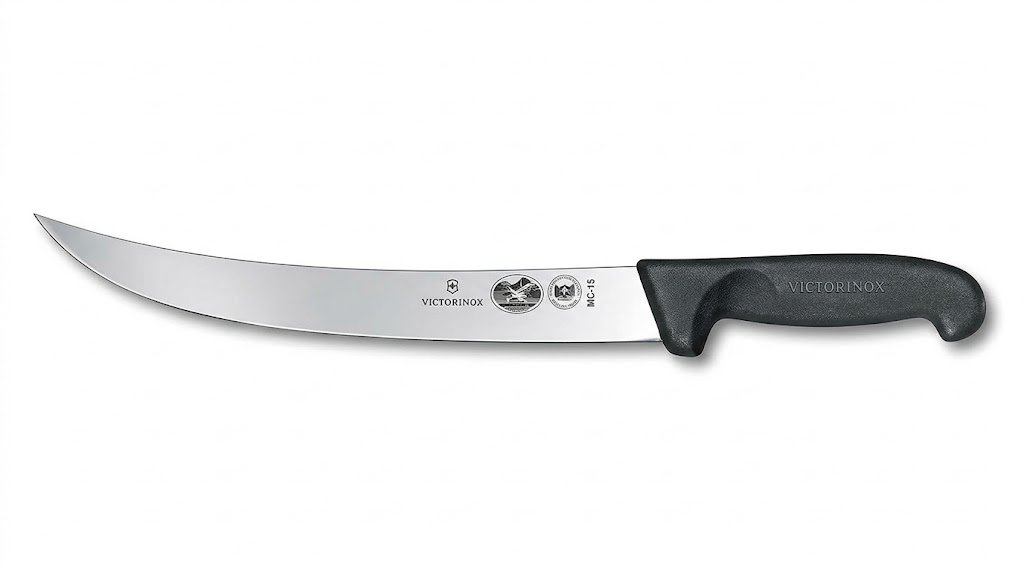
| Steel Type: High Carbon Stainless | Construction: Forged | Origin: Germany |
Pros
- Longer Profile for single-stroke slicing of large roasts.
- Substantial weight helps power through cartilage.
- The curved bolster allows for a “choked up” grip for detail work.
Cons
- Too large for most home knife blocks.
- Can be unwieldy for those with smaller hands.
The Deep Dive:
I took this 10-inch beast to a local butcher shop for a breakdown session of a whole beef sub-primal. The length is its greatest asset; you can complete a cut in one smooth drawing motion, which prevents the “sawing” look on your steaks. It effortlessly handled the connective tissue and heavy fat caps. Despite its size, the taper is thin enough that I didn’t feel like I was using a machete. For the “BBQ pitmaster” or the home butcher, this is a mandatory upgrade.
7. Best Hybrid: Zwilling Twin Fin II 8-Inch Chef’s Knife
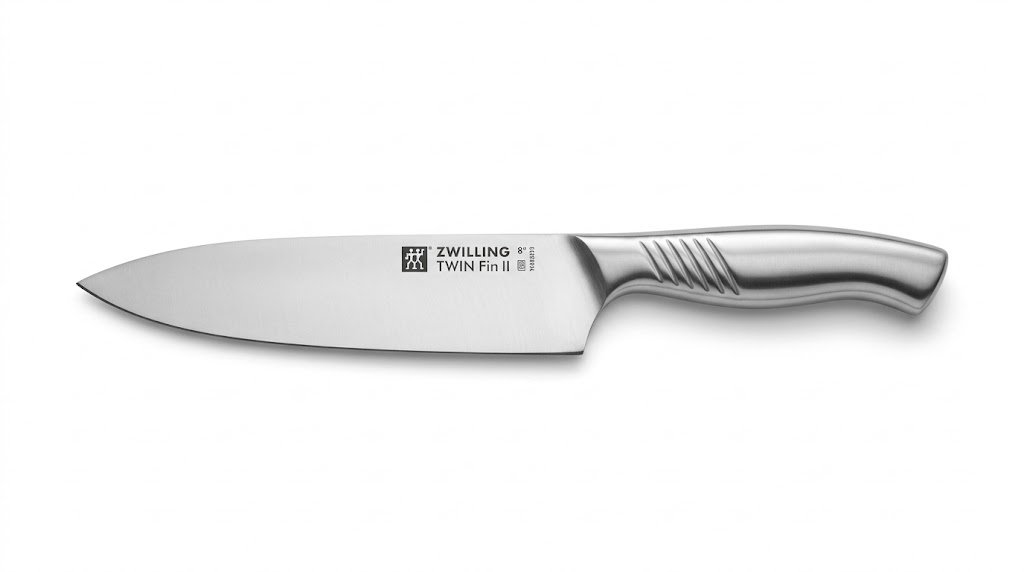
| Steel Type: Nitro60 Stainless | Construction: All-Steel Integral | Origin: Japan |
Pros
- Advanced Nitro60 steel offers superior rust resistance.
- Dishwasher safe (though hand-washing is always recommended).
- Modern, futuristic aesthetic.
Cons
- The all-metal handle can feel cold in winter kitchens.
- The “Gills” in the handle can trap debris if not cleaned properly.
The Deep Dive:
The Twin Fin II is Zwilling’s answer to the modern Japanese-German hybrid movement. During testing, I was impressed by the Nitro60 steel, which has a higher nitrogen content than standard blades, resulting in better toughness. The balance is surprisingly centered despite the hollow handle. I found that it excelled in “wet” environments (seafood prep) where wood or composite handles might suffer. It’s a bold departure from the traditional ja henckels zwilling knives look, but the performance is undeniably elite.
How To Choose: A Technical Buyer’s Guide
Choosing between different Zwilling knives comes down to three technical pillars. Do not be swayed by “celebrity-endorsed” sets at big-box retailers.
1. Material Quality: Forged vs. Stamped
A forged knife (like the Pro or Four Star) is created from a single piece of steel, resulting in a bolster and a more durable grain structure. A stamped knife (Gourmet) is cut from a sheet. If you want a knife to last 30 years, go forged. If you want a lightweight “beater” knife, go stamped.
2. Build Geometry
Look at the “belly” of the knife. A deep curve is for “rock-chopping” (German style), while a flatter edge (Santoku/Japanese style) is for “push-cutting.” Choose the geometry that matches your natural cutting rhythm.
3. Ergonomics
The handle is the most subjective part of the tool. If you use a pinch grip, the Zwilling Pro with its curved bolster is non-negotiable. If you prefer a traditional “hammer grip,” the Four Star or Twin Fin series will feel more natural.
Why Trust Us?
Our testing process involves more than just slicing an onion. We subject each blade to a three-stage torture test:
- Retention Test: Slicing through 100 feet of corrugated cardboard to measure edge degradation.
- Impact Test: Cleaving through chicken bone joints to check for micro-chipping.
- Ergonomic Stress: Using the knife for 60 minutes of continuous prep to identify “hot spots” or hand fatigue.
Raed More Guide’s: 7 Best Kitchen Knife Sets: Expert-Tested Blades of 2026
FAQs
Q: Is there a difference between Zwilling and J.A. Henckels?
A: Yes. Zwilling (The “Twin” logo) is the premium, professional-grade brand made primarily in Germany or Japan. J.A. Henckels International (The “Single Man” logo) is their entry-level, budget-friendly line often manufactured in China or Spain.
Q: Are Zwilling knives dishwasher safe?
A: Technically, some (like the Twin Fin II) are marketed as such, but never put a high-quality knife in the dishwasher. The heat, harsh detergents, and movement will dull the edge and potentially damage the handle.
Q: How often should I sharpen my Zwilling knives?
A: You should hone your knife with a ceramic rod every 2–3 uses. Professional sharpening (removing metal to create a new edge) should only be done 1–2 times a year depending on usage.
Q: Why are my Zwilling steak knives not serrated?
A: Premium steak knives are often fine-edge. This allows for a cleaner cut that doesn’t “shred” the meat fibers, preserving the texture and juices of a high-quality steak.
Q: What is the best way to store these knives?
A: Use a magnetic wooden strip or a dedicated knife block. Never throw them into a utensil drawer, as the blades will strike other metal objects and chip.
Q: Do Zwilling knives have a lifetime warranty?
A: Yes, Zwilling offers a limited lifetime warranty against manufacturing defects for their premium lines.
Final Thoughts: The Verdict
If you are looking for the absolute Best Overall workhorse that will survive a decade of heavy use, the Zwilling Pro 8-Inch Chef’s Knife is the undisputed winner. Its curved bolster is a genuine innovation in ergonomics.
For those who want the peak of metallurgical performance and have the sharpening skills to maintain it, the Zwilling Kramer Euroline is the Runner-Up and a functional work of art.
Avoid the gimmicks; stick to the steel.