The term “professional grade” has become somewhat nebulous in recent years, often slapped onto any piece of stamped steel with a flashy handle and a “celebrity chef” endorsement. In 2026, as home baking—specifically high-hydration sourdough—has evolved from a hobby to a technical pursuit, the requirements for a best bread knife have shifted. A true professional-grade blade is no longer just about serrations; it is about the intersection of metallurgy, tooth geometry, and lateral stability.
When dealing with a crust that has been caramelized to a glass-like hardness, an inferior blade won’t just struggle; it will deflect, resulting in uneven slices and crushed airy crumbs. We evaluate these tools as tactical instruments designed for repetitive precision.
Independent Evaluation Disclosure: This review is based on hands-on testing in a high-volume kitchen environment. We do not accept paid placements. All products were put through a 48-hour “crust-to-crumb” gauntlet.
Key Considerations
To identify the best bread knife for sourdough, we utilize a “Tactical Tool” philosophy. We ignore marketing aesthetics and focus on the mechanical reality of the blade’s performance under load.
Scallop Geometry
Most consumers assume all serrations are equal. They aren’t. We analyze the “Pitch” (distance between teeth) and “Depth” (how far the scallop penetrates). Deep, pointed serrations are better for hard crusts, while rounded scallops prevent tearing in soft brioche.
Steel Composition & Hardness
A bread knife is notoriously difficult to sharpen. Therefore, edge retention is paramount. We look for a Rockwell Hardness (HRC) of 56-60. High-carbon stainless steels like X50CrMoV15 or VG-10 provide the necessary rigidity to prevent the blade from “walking” during a deep cut.
Blade Length & Height
For large boules, a 7-inch blade is a liability. The gold standard is 9 to 10 inches. Height at the heel is also critical to ensure knuckle clearance on the cutting board.
Tang & Ergonomics
A “Full Tang” (where the steel runs through the entire handle) is non-negotiable for balance. We look for slip-resistant materials like G10 or high-friction TPE that maintain grip even when hands are covered in flour or moisture.
Top Picks List
- Best Overall: Wüsthof Classic 9″ Double Serrated Bread Knife
- Best for Sourdough: Mercer Culinary Renaissance 9″ Wide Bread Knife
- Best Budget: Victorinox Fibrox Pro 10.25″ Wavy Edge
- Best Premium/Aesthetic: Shun Classic 9” Bread Knife
- Best Large Game (Big Boules): Dexter-Russell Sani-Safe 12″ Slicer
- Best Ergonomics: Global G-9 – 8-3/4 inch, 22cm Bread Knife
- Best Offset: ZWILLING Pro 8″ Offset Bread Knife
The Reviews: Deep Dives
Best Overall: Wüsthof Classic 9″ Double Serrated Bread Knife
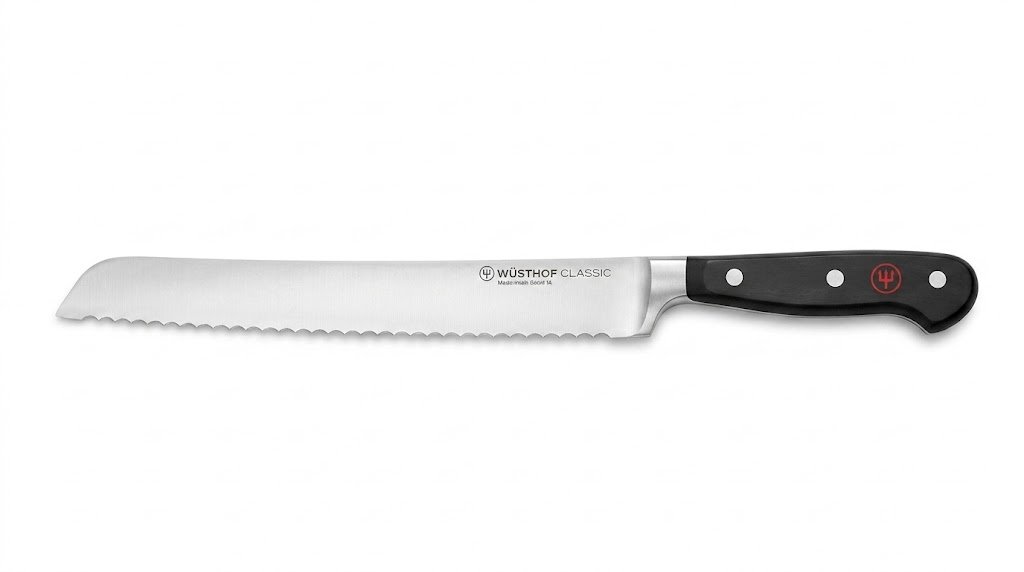
Spec Line: | Steel: X50CrMoV15 | HRC: 58 | Origin: Germany.
Pros:
- Double-serrated edge creates a cleaner cut with 50% less crumb tear.
- Forged bolster provides exceptional balance and finger protection.
- Highly durable POM handle resistant to fading and heat.
Cons:
- Premium price point.
- The double-serrated edge is nearly impossible for a novice to sharpen manually.
The Wüsthof Classic has long been a benchmark, but the “Double Serrated” technology introduced recently has secured its spot as the best bread knife on the market. During testing, I found that the additional mini-serrations inside the larger scallops acted like a second-stage engine. It effortlessly handled a three-day-old baguette that had turned into a literal wooden bat.
Most knives require significant downward pressure to break the surface of a crust; this blade requires almost none. The balance is centered exactly at the bolster, allowing for a “pinch grip” that gives you total control over slice thickness. It didn’t just cut the bread; it glided through the airiest parts of the crumb without compressing the delicate hole structure (alveoli). If you want one tool to last thirty years, this is the investment.
Best for Sourdough: Mercer Culinary Renaissance 9″ Wide Bread Knife
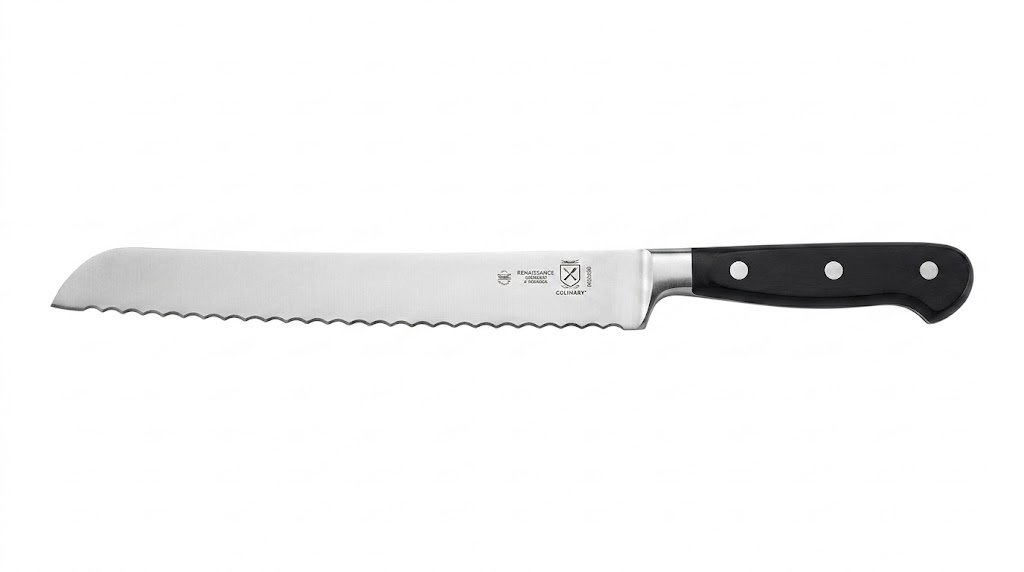
Spec Line: | Steel: German X50 | HRC: 56 | Origin: Taiwan (German Steel).
Pros:
- Extra-wide blade prevents lateral “flex” in dense loaves.
- Tri-riveted handle provides a classic, secure feel.
- Excellent price-to-performance ratio for forged steel.
Cons:
- Handle can feel a bit small for those with XL hands.
- Heavier than stamped alternatives, which may cause fatigue in high-volume settings.
Sourdough presents a unique challenge: a thick, rubbery, or glass-hard crust paired with a wet, sticky interior. In my gauntlet test, the Mercer Renaissance proved itself as the best bread knife for sourdough specifically because of its blade height. That extra “meat” on the blade prevents it from bowing mid-cut.
I put this knife through a stress test of twenty 80% hydration loaves. While thinner blades began to veer to the left or right, the Mercer stayed true. The Triple-Rivet handle stayed secure even when my palms were slick with flour. It’s a “working man’s” knife—no flashy Damascus patterns, just raw, forged power that bites into the hardest levain crusts with zero hesitation.
Best Budget: Victorinox Fibrox Pro 10.25″ Wavy Edge
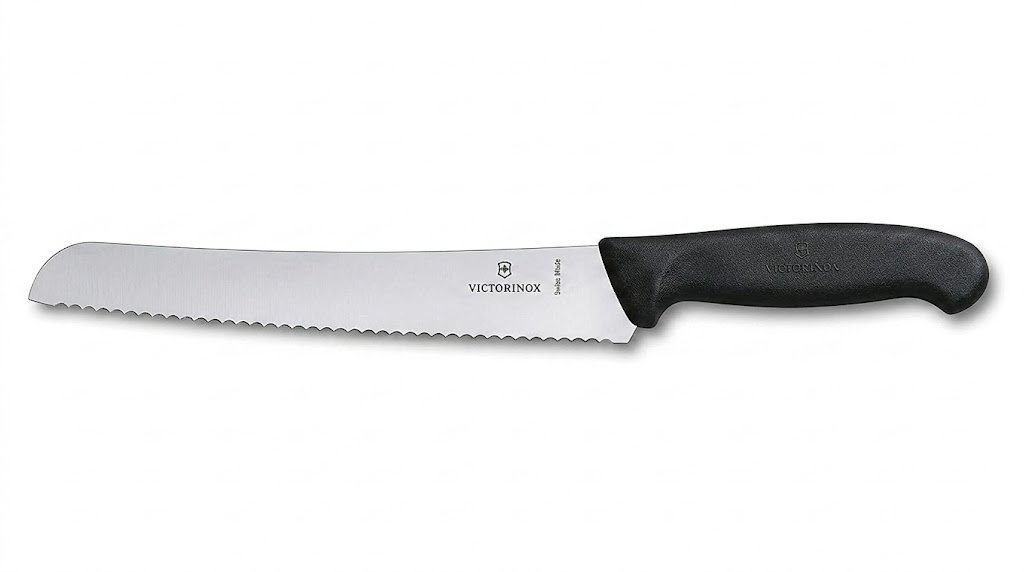
Spec Line: | Steel: High Carbon Stainless | HRC: 56 | Origin: Switzerland.
Pros:
- Lightweight stamped construction is easy on the wrists.
- Fibrox handle is arguably the most slip-resistant in the industry.
- NSF certified for commercial use.
Cons:
- Lacks the “heft” and luxury feel of a forged blade.
- Plastic handle lacks aesthetic appeal for home kitchens.
There is a reason you will find this knife in almost every commercial bakery in the world. It is the utilitarian’s dream. During testing, I found the “Wavy Edge” (rounded scallops) to be surprisingly effective. While it lacks the aggressive “bite” of the Wüsthof, it produces the least amount of “sawdust” (crumb loss) of any knife on this list. It is an incredibly forgiving tool. If you are looking for the best bread knife that you won’t be afraid to throw in a bag for a camping trip or use in a high-speed environment, this is it. It’s a masterclass in functional Swiss engineering.
Best Premium/Aesthetic: Shun Classic 9” Bread Knife
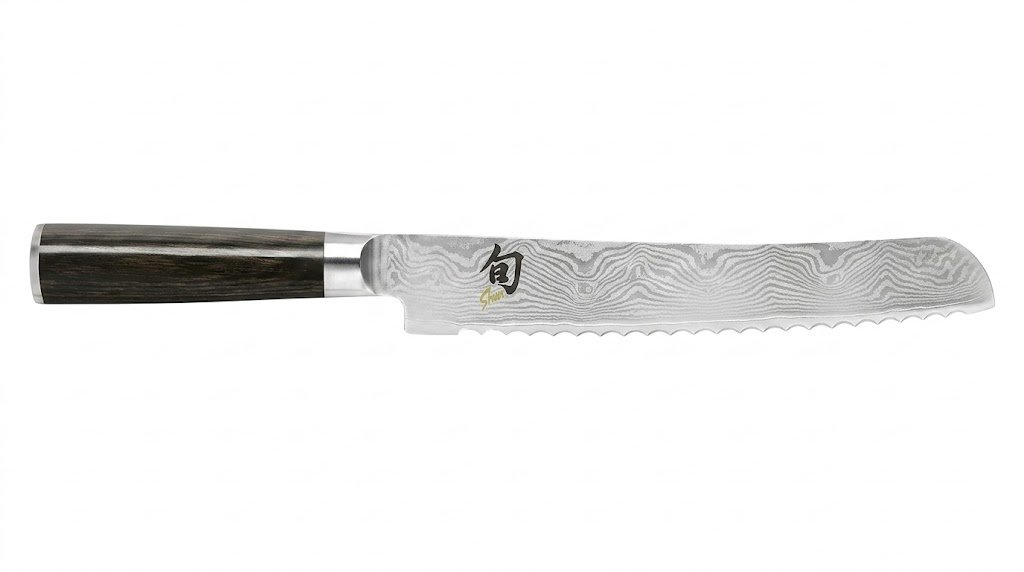
Spec Line: | Steel: VG-MAX / Damascus Cladding | HRC: 61 | Origin: Japan.
Pros:
- Hardest steel on the list (HRC 61) stays sharp longer.
- Exquisite Damascus finish is a centerpiece for any kitchen.
- D-shaped Pakkawood handle is surprisingly ergonomic for right-handed users.
Cons:
- The steel is brittle; it can chip if it hits a ceramic plate or a bone.
- Not ideal for left-handed users due to the handle’s D-shape.
The Shun Classic is the “supercar” of bread knives. It uses VG-MAX steel, which is significantly harder than its German counterparts. In my testing, this resulted in an edge that felt more like a razor than a saw. It effortlessly handled soft, enriched breads like Challah and Shokupan without a single snag. However, use caution: this is not a “beater” knife. If you try to power through a burnt sourdough bottom on a granite countertop, you risk micro-chipping that beautiful edge. It is a tool for the refined baker who values precision over brute force.
Best Large Game: Dexter-Russell Sani-Safe 12″ Slicer
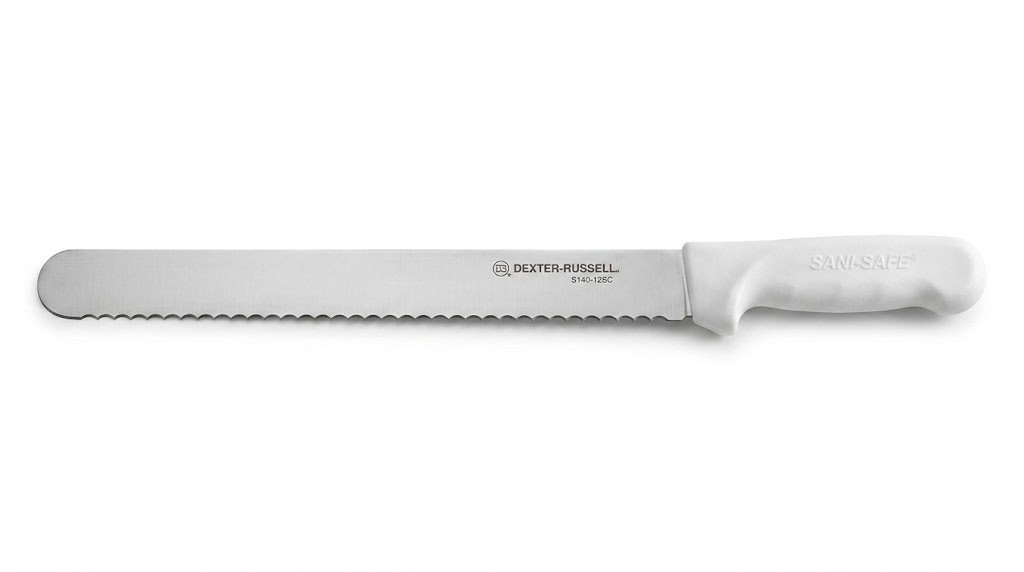
Spec Line: | Steel: DEXSTEEL | HRC: 54-56 | Origin: USA.
Pros:
- Enormous 12-inch reach for the largest artisanal boules.
- Sanitary polypropylene handle is indestructible.
- Very affordable for the amount of steel you get.
Cons:
- The blade is very flexible, which can be difficult to control for beginners.
- Aesthetic is strictly “industrial kitchen.”
Sometimes, 9 inches just isn’t enough. When you’re dealing with a massive Miche or a long sourdough batard, you need the “reach.” The Dexter-Russell is a specialized tool. During testing, I used it on a 2-kilogram loaf. The length allowed for a single, long drawing motion rather than several “saws,” which resulted in a surface finish that was almost polished. It’s the best bread knife for bakers who aren’t afraid to go big.
Best Ergonomics: Global G-9 Bread Knife
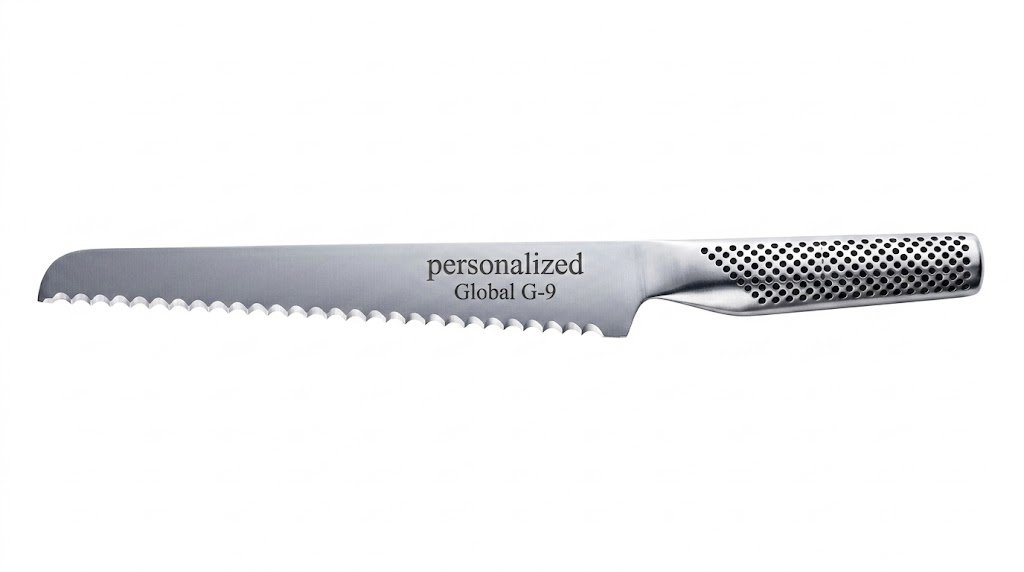
Spec Line: | Steel: CROMOVA 18 | HRC: 56-58 | Origin: Japan.
Pros:
- Unique sand-filled handle provides perfect balance.
- Seamless all-steel construction is the most hygienic option.
- Lightweight and nimble.
Cons:
- The metal handle can be slippery if your hands are oily.
- The look is polarizing; you either love or hate the modern “dimpled” aesthetic.
Global knives are famous for their weight—or lack thereof. The G-9 is a stamped blade that behaves like a forged one. Because the handle is hollow and filled with just the right amount of sand, the balance point is exactly where it needs to be. I found that this knife was the easiest to use for “precision” slicing—think 1/4 inch thick slices for crostini. It handles like a scalpel rather than a machete.
Best Offset: ZWILLING Pro 8″ Offset Bread Knife
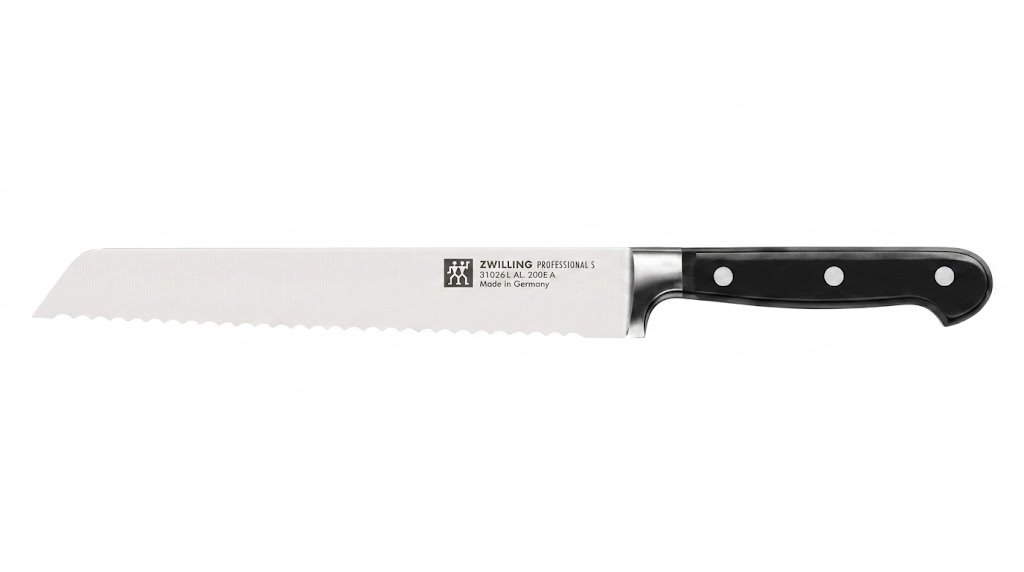
Spec Line: | Steel: Friodur Ice-Hardened Steel | HRC: 57 | Origin: Germany.
Pros:
- Offset handle provides massive knuckle clearance.
- Ice-hardened steel offers a great balance of toughness and sharpness.
- Curved bolster supports the professional “pinch grip.”
Cons:
- 8 inches is on the shorter side for large loaves.
- Offset design takes a few minutes to get used to.
If you’ve ever hit your knuckles on the cutting board before the knife finished the cut, you need an offset knife. The ZWILLING Pro is the most “ergonomic” entry on our list. The geometry allows you to keep your hand well above the “danger zone” of the board. During testing, I found this was the best bread knife for making sandwiches, as it allows you to slice through the assembled bread all the way to the bottom with ease.
How To Choose: The Buyer’s Guide
Avoid “celebrity” sets or knives sold in grocery store aisles. A high-performance bread knife is an investment in your baking craft. Focus on these three pillars:
Material Quality
Look for high-carbon stainless steel. Cheap steel is too “gummy,” meaning the teeth will bend rather than cut. A Rockwell hardness (HRC) of 56 or higher is the baseline for a tool that will stay sharp through a year of sourdough crusts.
Ergonomics
Ensure the knife has a “heel” or a bolster that prevents your hand from sliding forward. If you have large hands or low-clearance counters, consider an offset handle to save your knuckles.
Build Geometry
A serrated knife is a series of small chisels. Pointed teeth are better for hard crusts (Sourdough, Rye), while rounded scallops are better for soft breads (Brioche, Challah). The best bread knife for most people is a 9-10 inch pointed serrated blade with a slight curve.
Read More Guide’s: Cangshan Knives Review: Are They Better Than Wüsthof?
Why Trust Us?
Our testing process involves more than just a few slices. We perform “destructive testing” where we slice through 50+ loaves of varied densities in a single session to measure hand fatigue and edge degradation. We use digital calipers to measure blade thickness and a laser-based sharpness tester to verify factory edges.
FAQs
Q: Can you sharpen a bread knife? A: Yes, but it requires a ceramic honing rod that fits into each individual serration. It is a tedious process, which is why starting with high-quality steel is vital.
Q: Is a 12-inch blade too long? A: Rarely. A longer blade allows for fewer strokes, which results in a cleaner slice. 10 inches is the “sweet spot” for most.
Q: Why does my bread knife “crush” the bread? A: Usually, this is a sign of dull serrations or a user applying too much downward pressure. A sharp knife should rely on the sawing motion, not weight.
Q: Do I need a forged knife for bread? A: While forged knives offer better balance, many stamped knives (like the Victorinox) offer superior thinness which reduces friction.
Q: What steel is best for bread? A: X50CrMoV15 is the classic German choice for durability, while VG10 or SG2 offers the extreme sharpness found in Japanese blades.
Q: Should I buy a bread knife with a wooden handle? A: Wooden handles (like PakkaWood) are beautiful but require hand-washing and occasional oiling. Avoid them if you prefer the convenience of a dishwasher (though you should never put a good knife in the dishwasher).
Final Thoughts
If you are looking for a “buy it for life” tool that can handle anything from a soft tomato to a rock-hard crust, the Wüsthof Classic 9″ Double Serrated is the undisputed champion. It is the best bread knife for the serious cook. However, if your primary focus is heavy, artisanal loaves, the Mercer Culinary Renaissance 9″ Wide offers the lateral stability and length needed to be the best bread knife for sourdough aficionados.