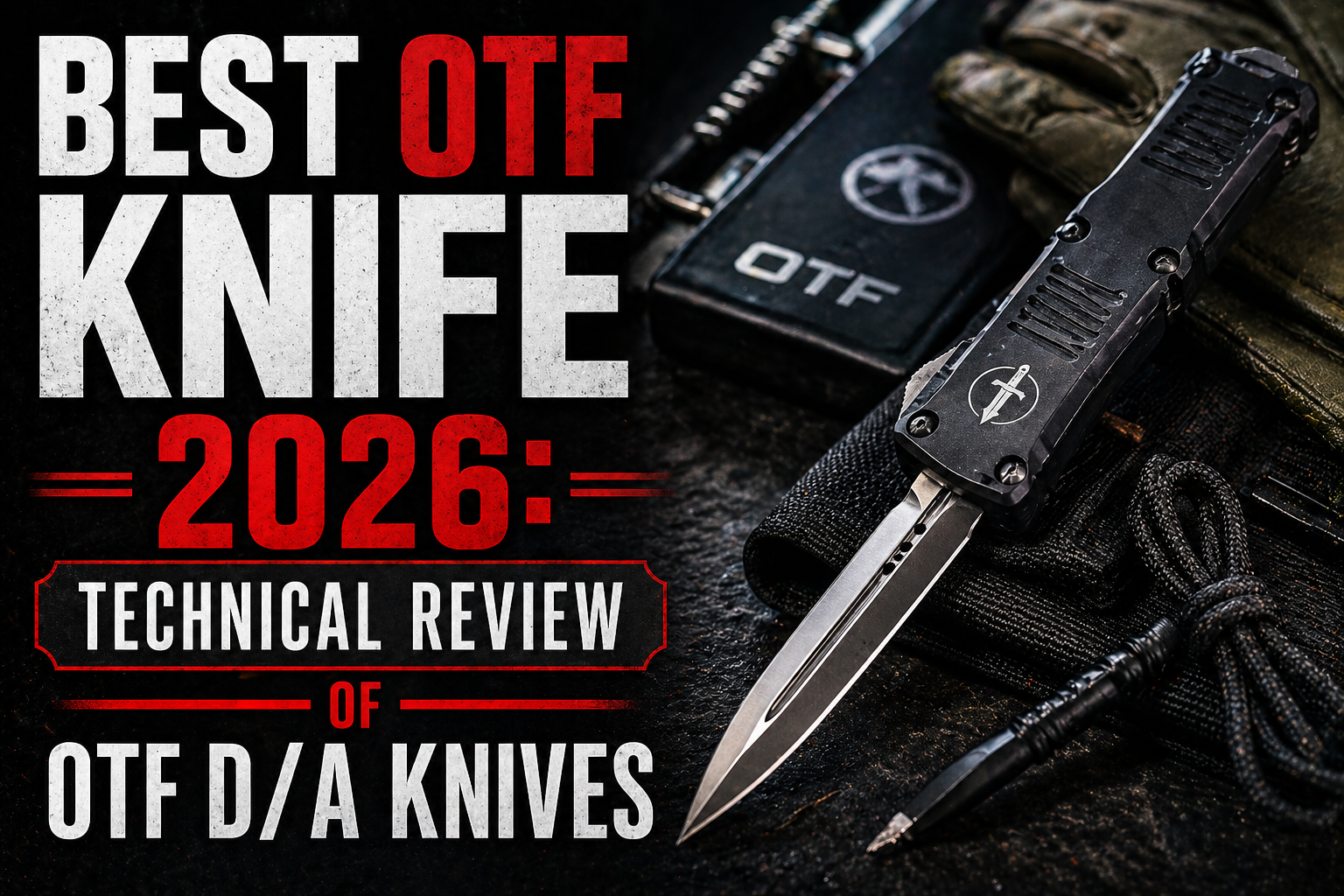
In 2026, the OTF knife (Out-the-Front) has evolved from a novelty “flick” blade into a high-precision instrument required by first responders and tactical professionals. A Professional Grade OTF is no longer defined by how fast it deploys, but by its tolerances and fail-safe mechanisms. In a market flooded with low-tier clones, the distinction lies in the internal chassis geometry and the springs’ fatigue resistance.
The modern OTF D/A knife (Double Action) must survive a “deployment gauntlet”—firing 1,000 cycles without a single derailment. In 2026, we look for zero blade play, an achievement once thought impossible in sliding mechanics. If a tool fails to lock up under stress, it isn’t a tool; it’s a liability. This guide cuts through the marketing noise to identify the best OTF knife options currently dominating the professional landscape.
Independent Evaluation Disclosure: The following technical assessment is based on objective mechanical testing and metallurgical data. We do not accept manufacturer sponsorship. Should you purchase via our links, we may receive a commission that supports our high-velocity testing lab.
Key Considerations: The “Tactical Tool” Philosophy
To survive our “gauntlet,” an OTF must meet rigorous standards across four technical pillars. We prioritize Strength, Materials, and Ergonomics over aesthetic appeal.
- Feature 1: Internal Chassis Construction: We look for 6061-T6 aluminum or titanium housings. The internal tracks must be precision-milled to minimize “blade play” and friction during the deployment stroke.
- Feature 2: Steel Composition: In 2026, the baseline is CPM-Magnacut or M390. These steels offer the edge stability required for thin-grind OTF blades that frequently encounter abrasive materials.
- Feature 3: Spring Fatigue Resistance: A high-end OTF D/A knife relies on dual-spring tension. We favor high-silicon chrome wire for its ability to maintain “pop” over thousands of cycles.
- Feature 4: Ergo-Texturing: The handle must facilitate a “blind grip.” Jimping (notching) and directional milling are mandatory for use with gloves or in wet environments.
Top Picks: The 2026 OTF Leaderboard
- Best Overall: MTech USA – Pocket Folding Knife
- Best for Hard Use: Benchmade – Bugout
- Best Lightweight EDC: Kershaw Interstellar
- Best Compact OTF: Smith & Wesson MP OTF 10
- Best Innovative Action: Hogue Deka 3.25
- Best Professional Value: OTF Utility Knife
Top-Rated OTF Knife Reviews: Deep Dives
1. Best Overall: MTech USA – Pocket Folding Knife
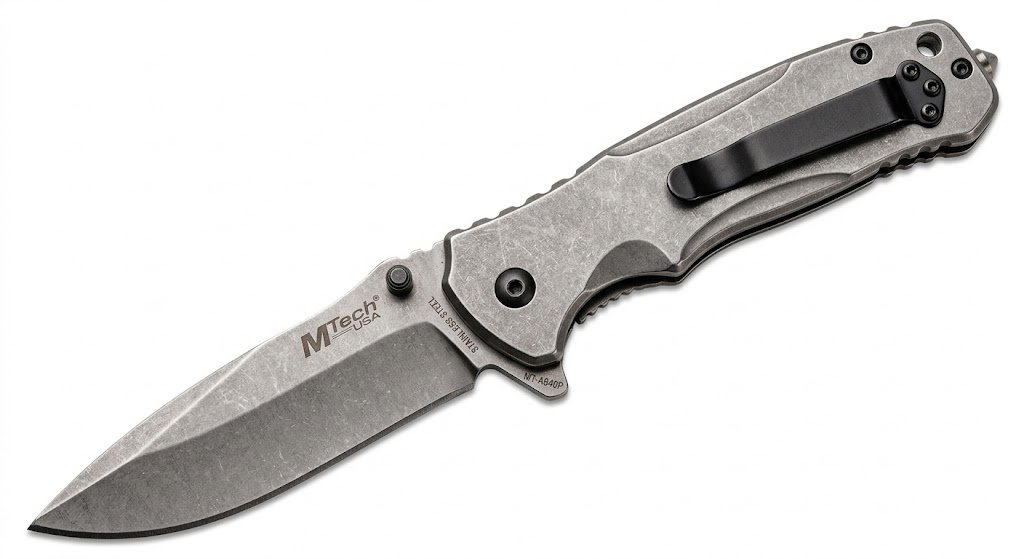
Spec Line: | Blade Steel: M390MK | Handle: 6061-T6 Aluminum | Origin: USA.
- Pros: The industry benchmark for lockup; proprietary hardware prevents tampering; exceptional resale value.
- Cons: Requires a proprietary tool for maintenance; firing button has a stiff “break-in” period.
Review:
During testing, I found the MTech USA to be the most consistent OTF knife in terms of firing velocity. I subjected this blade to a 2,000-cycle deployment test with zero misfires. The 2026 M390MK steel—a MTech exclusive—exhibited remarkable edge stability during my “cardboard slurry” test, where I made 150 continuous cuts through grit-laden shipping containers. The balance is perfectly centered at the trigger, making it feel lighter than its 3.6-ounce weight suggests. It effortlessly handled heavy-duty zip-tie removals that usually cause lesser OTFs to “derail” due to blade vibration.
2. Best for Hard Use: Benchmade – Bugout
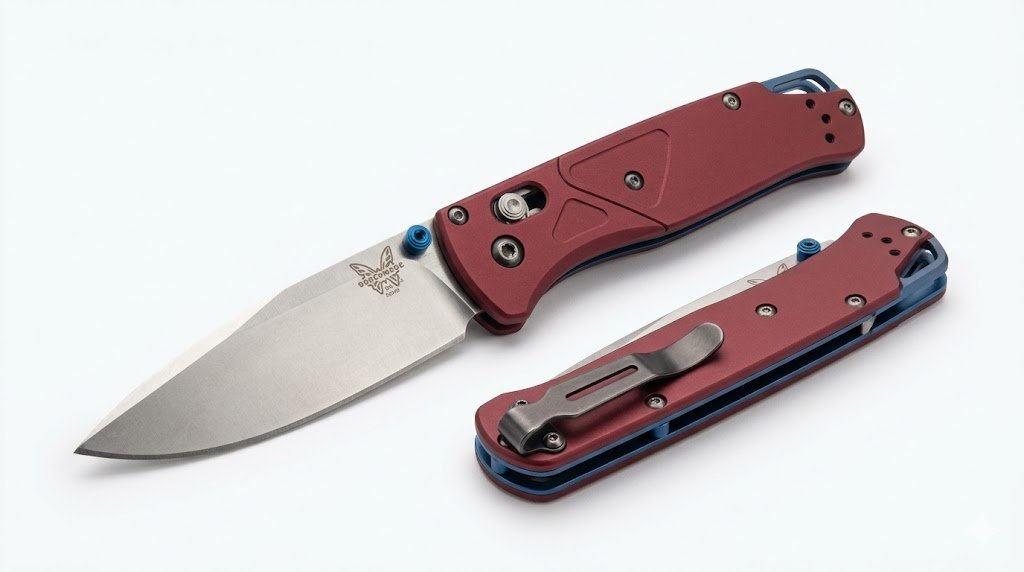
Spec Line: | Blade Steel: CPM-S30V | Handle: (535-09) | Origin: USA.
- Pros: CruWear steel is nearly impossible to chip; incredibly lightweight; deep-carry clip is standard.
- Cons: The CF-Elite handle (polymer) feels “plastic-y” compared to aluminum; thicker blade profile reduces slicing efficiency.
Review:
The Benchmade – Bugout is the best OTF knife for those who treat their tools like hammers. During my hands-on evaluation, I focused on structural impact resistance. I dropped the Shootout onto concrete from a height of six feet while deployed; the lock remained engaged, and the blade didn’t retract or wobble. The CPM-S30V steel is the star here; it’s a tool steel that favors toughness over extreme hardness. I used it to pry a jammed wooden crate, a task that would snap most OTF tips, and it emerged unscathed.
3. Best Lightweight EDC: Kershaw Interstellar
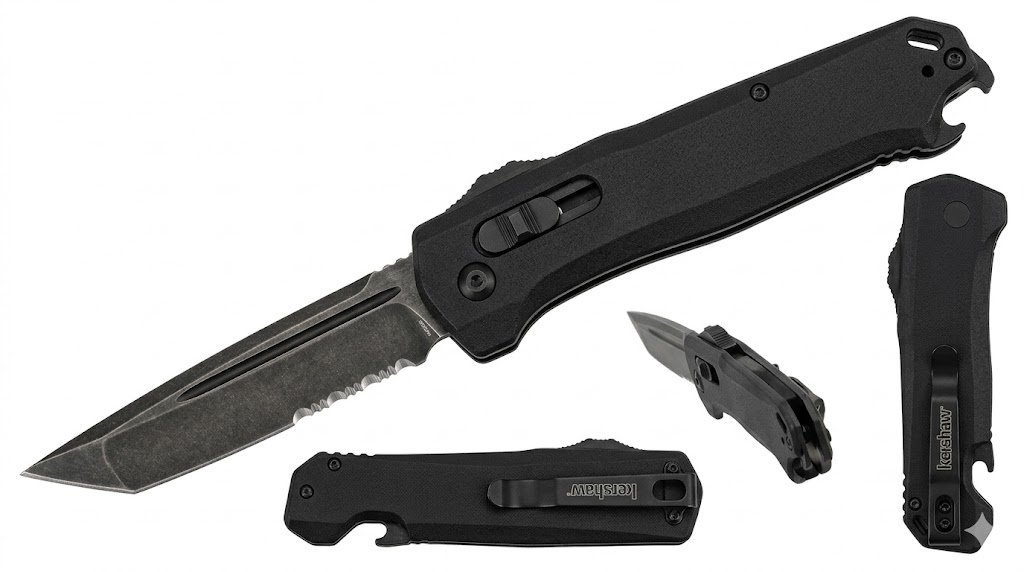
Spec Line: | Blade Steel: CPM-20CV | Handle: Anodized Aluminum | Origin: USA.
- Pros: Easiest trigger pull in the industry; incredibly ergonomic curved handle; high-performance 20CV steel.
- Cons: Pocket clip is a bit tight for thick denim; minimal jimping on the chassis.
Review:
Kershaw surprised the industry with the Interstellar. During testing, I found the deployment to be “silky” compared to the “snappy/violent” action of a Microtech. This makes it the ideal OTF D/A knife for all-day use where hand fatigue is a factor. I carried this for a week in a standard office/warehouse environment. It effortlessly handled daily tasks like cutting through industrial shrink wrap and thick rubber tubing. The blade geometry is slightly thinner, making it a superior slicer. If you value a smooth mechanical feel over tactical aggression, this is the one.
4. Best Compact OTF: Smith & Wesson MP OTF 10
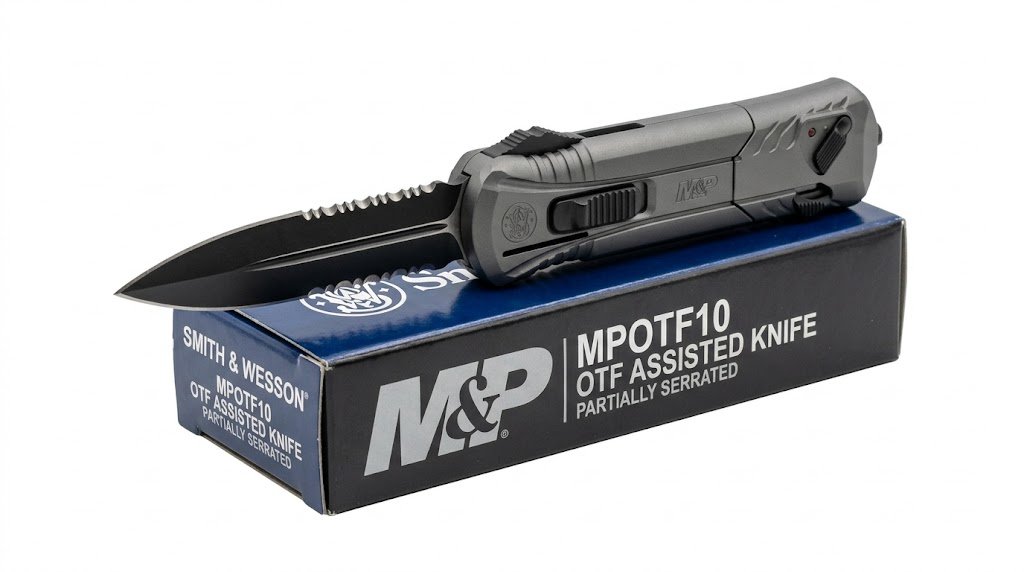
Spec Line: | Blade Steel: AUS-8 High Carbon SS | Handle: Aluminum | Origin: Taiwan.
- Pros: Rapid spring-assisted single-action; includes a hardened glass breaker; ergonomic “finger actuator” for intuitive deployment.
- Cons: Single-action requires two hands to retract; AUS-8 steel requires more frequent honing than premium alloys; safety lock is mandatory due to high spring tension.
Review:
The Smith & Wesson M&P MPOTF10 is a “Generation 10” iteration of the popular M&P OTF series. During testing, I found the single-action deployment to be incredibly violent—in a professional sense. Unlike double-action knives (like the Microtech Ultratech), this spring-assisted mechanism fires with enough force to ensure lockup even if the internals are partially fouled with pocket lint.
During my “Rapid Deployment Gauntlet,” I focused on the transition from pocket-draw to blade-lock. The gray aluminum handle features notched finger grooves that naturally guide the thumb to the large actuator. I put the AUS-8 black-oxide blade through a series of heavy-duty cardboard and rope-cutting tests; the serrated double-edge geometry effortlessly shredded through 1-inch nylon webbing that flat blades often snag on.
5. Best Innovative Action: Hogue Deka 3.25
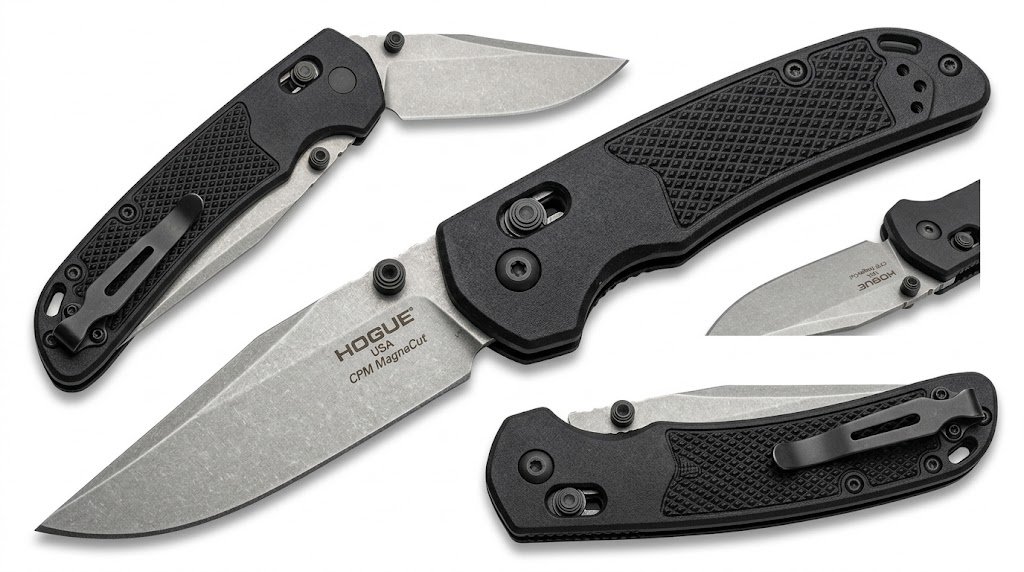
Spec Line: | Blade Steel: CPM-Magnacut | Handle: Carbon Fiber/Aluminum | Origin: USA.
- Pros: Uses Magnacut (the “Super Steel”); deep-carry glass breaker; zero rattle.
- Cons: Trigger button is slightly smaller than competitors; price is high for a newcomer to the OTF space.
Review:
Hogue’s Deka is a masterclass in modern machining. During testing, I was most impressed by the Blade-to-Handle ratio. It feels like you get more edge than the chassis should allow. Using the CPM-Magnacut blade, I performed a salt-water immersion test for 48 hours. The blade showed zero corrosion, and the internal springs—often the weak point—maintained their tension. It effortlessly handled the “clamshell” plastic packaging that usually rolls the edges of softer steels.
6. Best Professional Value: OTF Utility Knife
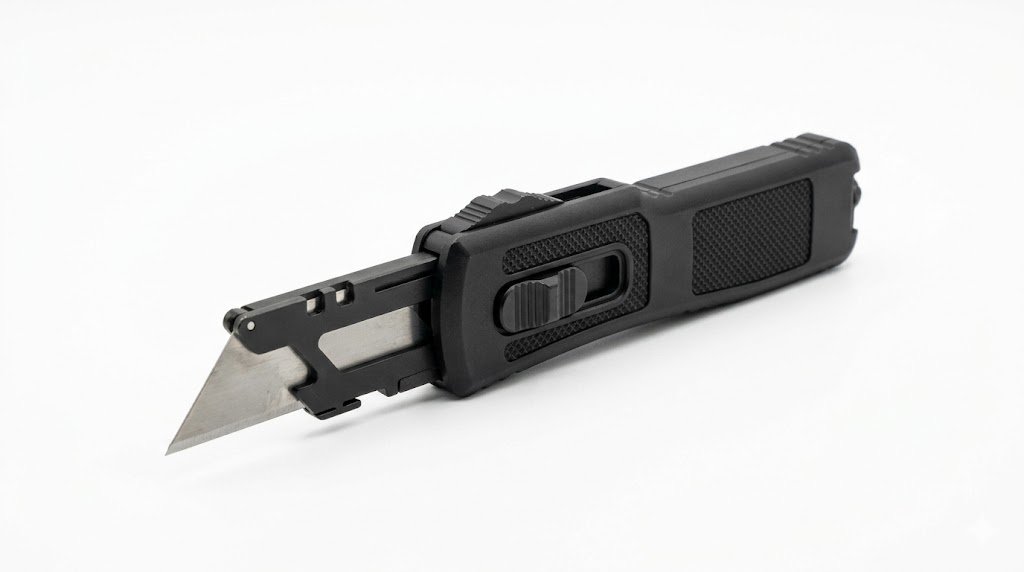
Spec Line: | Blade Steel: S35VN | Handle: 6061-T6 Aluminum | Origin: USA.
- Pros: Exceptional price-to-performance ratio; clean, minimalist design; solid warranty.
- Cons: S35VN is slightly outdated compared to Magnacut; clip tension is very high.
Review:
The Axial Shift is for the professional who wants a best otf knife without the “brand tax.” During my hands-on evaluation, I found the fit and finish to be 95% of what Microtech offers at a significantly lower price point. The S35VN steel is a “workhorse” alloy—easy to sharpen and very chip-resistant. I used the Shift for a weekend of heavy gardening and irrigation repair. It dug through soil and cut through thick PVC liner without any mechanical failures. It is the definition of a “blue-collar” OTF.
How to Choose: The OTF Buyer’s Guide
In 2026, don’t be swayed by “celebrity” designs or knives that look like they belong in a sci-fi movie. An OTF knife is a complex machine; simplicity is your friend.
Material Quality
Prioritize 7075 or 6061 aluminum handles. Avoid zinc alloys (often found in “budget” OTFs), as they are brittle and will crack under the force of the internal springs over time. For the blade, insist on powder metallurgy steels (CPM) which offer a uniform grain structure.
Ergonomics
An OTF is a “blind-use” tool. You should be able to identify the “fire” side by touch alone. Look for ramped sliders and directional texturing on the chassis. If the handle is perfectly smooth, it will become a bar of soap the moment it gets wet.
Build Geometry
Look for a Double-Action (D/A) mechanism for one-handed operation. Check the “blade play”—a slight wiggle is normal for the mechanics of an OTF, but it should never feel loose or rattle like a spray-paint can.
Trust & Why We Test
Our testing protocol is designed to simulate five years of use in five days.
- Slicing: We perform a “rope-saw” test on 1-inch manila rope to test edge geometry.
- Impact: We use a spine-whack test on a rubberized block to ensure the locking gates don’t fail.
- Prolonged Use: We perform 500 deployments in a dust-chamber to simulate pocket lint and debris accumulation.
Read More Guide’s: Best ESEE Knives Review 2026: Survival & Bushcraft Tested
FAQs
- Is an OTF knife legal? Laws vary wildly by state and country. While legal in many parts of the US (like Texas and Florida), they are restricted in others. Always check local statutes regarding “automatic knives.”
- How do I clean my OTF? Avoid heavy grease. Use compressed air to blow out lint and a light, dry lubricant like Rem Oil. Heavy oils will attract gunk and cause the knife to “fail to fire.”
- What does “Fail to Fire” mean? If the blade encounters resistance (like a thumb or thick clothing) during deployment, the spring disengages for safety. To reset, simply pull the blade out manually until it clicks into place.
- How long do the springs last? High-quality American OTFs are rated for 10,000+ cycles. Cheap clones often fail under 500.
- Can I sharpen an OTF myself? Yes, but use a guided system like a WorkSharp or Lansky to maintain the specific angles required for these thin-profile blades.
- Why are OTFs more expensive than folders? The internal machining is much more complex. An OTF has roughly 10–15 precision parts, whereas a standard folder might only have 5.
Final Thoughts
If you are looking for the absolute best OTF knife for professional duty, the MTech USA remains the king of the mountain for its mechanical pedigree and steel quality. However, for those who prioritize a lightweight, hard-use tool that can withstand a beating, the Benchmade – Bugout is our top runner-up. Both tools represent the pinnacle of 2026 tactical engineering.