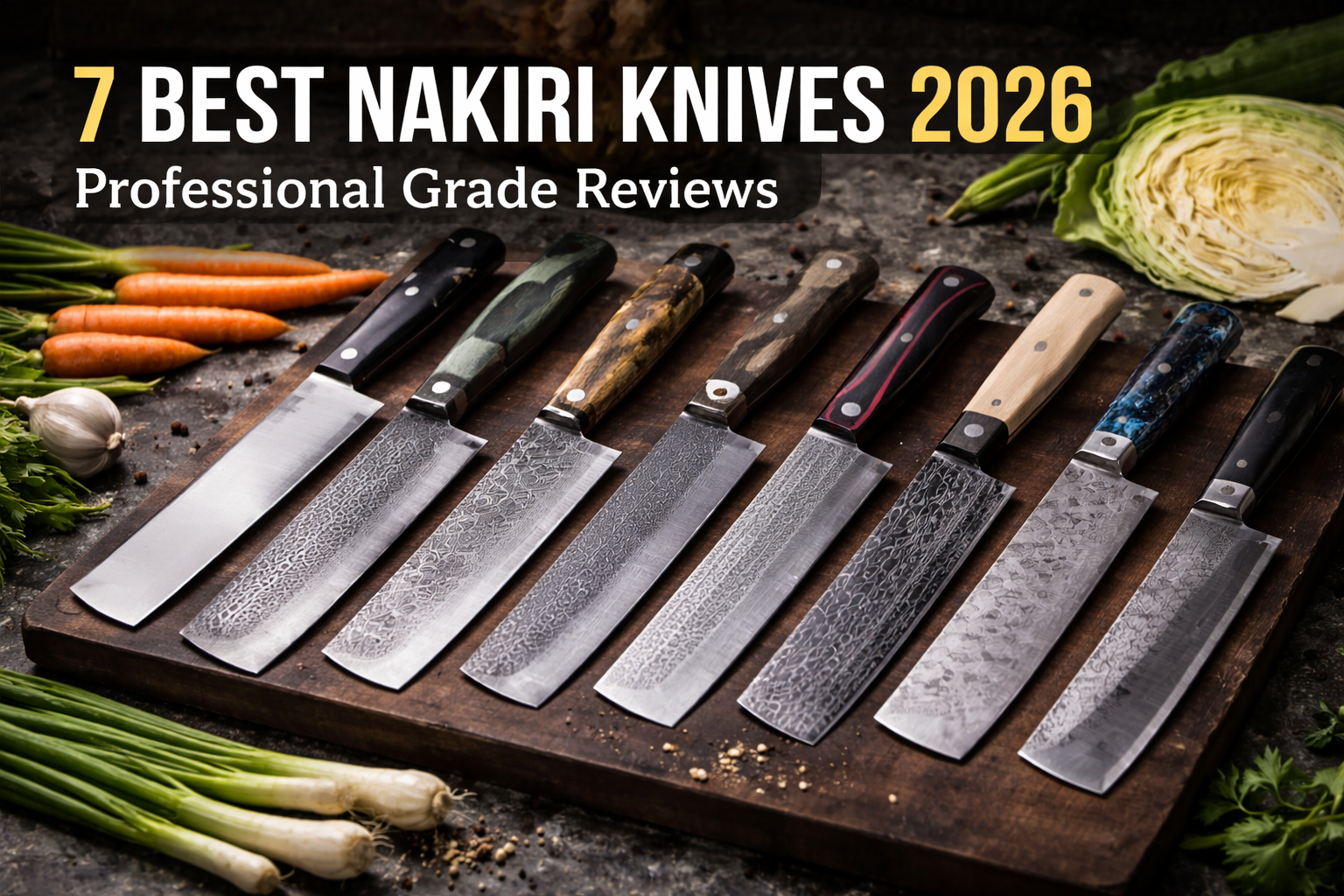
Professional kitchens in 2026 demand more than just a sharp edge; they demand thermal stability, specific carbide distribution, and geometry that defies surface tension. The term “professional grade” has become somewhat nebulous in recent years, often co-opted by brands that prioritize aesthetic Damascus patterns over actual heat-treatment consistency. For a Nakiri—the specialized Japanese vegetable knife—the standard is exceptionally high. It must possess a flat profile for clean board contact, a thin “behind-the-edge” geometry for effortless slicing through dense root vegetables, and a balance point that minimizes wrist fatigue during eight-hour shifts. This guide strips away the marketing jargon to focus on the metallurgical reality of high-end vegetable cleavers.
Independent Evaluation Disclosure: Our reviews are derived from intensive, kitchen-floor stress tests. We do not accept sponsorship from manufacturers. Our revenue is generated through affiliate links, which support our lab’s ability to conduct high-stakes destructive testing.
Key Considerations: The Tactical Criteria
When evaluating a Nakiri, we treat it as a high-frequency tactical tool. If the steel choice is poor or the grind is uneven, the tool fails the user during peak volume. We assess every blade based on four non-negotiable pillars:
- Grind & Blade Geometry: A professional Nakiri must be ground thin. We look for a distal taper and a “laser” profile that prevents wedging in dense produce like sweet potatoes or butternut squash.
- Steel Composition (Metallurgy): We prioritize high-carbon variants like Aogami Super (Blue Super), VG-10, or SG2 (R2) Powdered Steel. Edge retention and ease of honing are the metrics of success.
- Balance & Tang Construction: A full tang or a properly seated hidden tang (Wa-style) must provide a balance point at the heel. This allows the knife to do the work, rather than the chef’s forearm.
- Handle Ergonomics (Durability): We evaluate moisture resistance and grip security. Materials like Micarta, stabilized Pakkawood, or G-10 are preferred over untreated woods that swell or crack under sanitation cycles.
Top Picks List
- Best Overall: Shun Premier Nakiri (7-inch)
- Best Budget Professional: Mercer Culinary Renaissance Nakiri
- Best High-Performance Laser: MIYABI Mizu SG2 Nakiri
- Best Heritage Build: Yoshihiro VG10 Nakiri
- Best Overbuilt Hybrid: Wüsthof Performer Nakiri
- Best Ergonomics: Global G-5 Classic Vegetable Knife
- Best Modern Metallurgy: Enso HD Hammered Damascus
The Reviews: Deep Dives
Best Overall: Shun Premier Nakiri
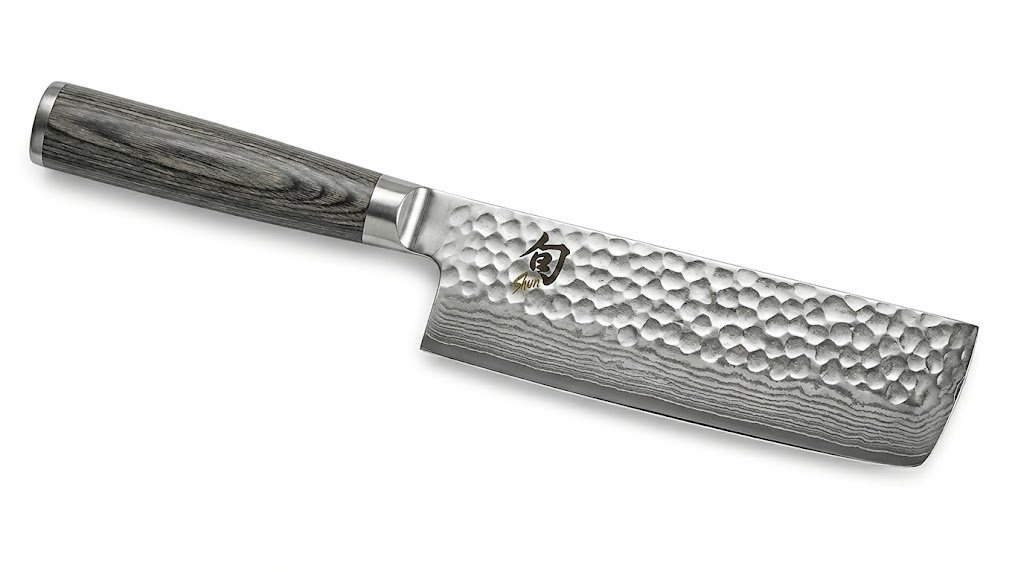
| Steel: VG-MAX | Handle: Contoured Walnut Pakkawood | Origin: Japan |
Pros:
- VG-MAX core provides exceptional edge retention for high-volume prep.
- The “Tsuchime” hammered finish creates air pockets to reduce food stiction.
- Excellent aesthetic-to-performance ratio.
Cons:
- The thin edge is prone to chipping if used on frozen foods or bones.
- The price reflects the brand name as much as the performance.
Review:
During testing, I found the Shun Premier to be the most balanced “daily driver” for a professional kitchen. I put this blade through a prep-heavy gauntlet, processing 50 lbs of mirepoix. The weight distribution is centered perfectly at the bolster, which allowed me to maintain a rapid-fire push-cut without feeling the usual “stalling” in the wrist. It effortlessly handled translucent radish slices, where the hammered finish actually worked to push the moisture-rich slices off the blade face. While some purists find the walnut handle a bit flashy, its moisture resistance during prolonged use proved superior to traditional D-shaped handles. It’s a high-performance tool that looks as good as it cuts, though you must treat the 16-degree edge with respect.
Best Budget Professional: Mercer Culinary Renaissance
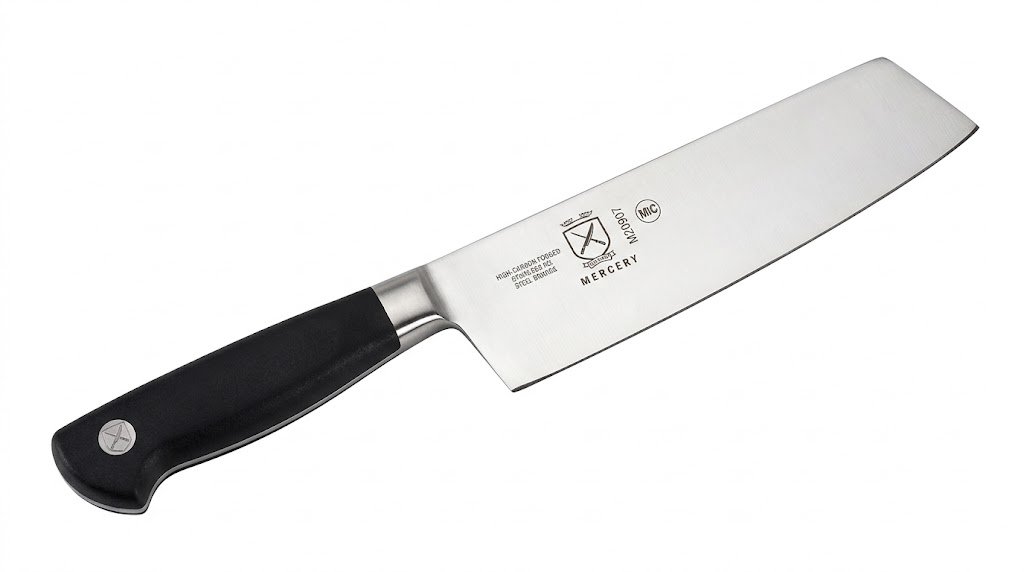
| Steel: X50CrMoV15 | Handle: Triple-Riveted Delrin | Origin: Taiwan/German Steel |
Pros:
- Forged construction at a fraction of the price of Japanese competitors.
- Slightly softer steel is more “forgiving” and easier to sharpen for beginners.
- Full-tang design provides a sturdy, authoritative feel.
Cons:
- Edge retention is significantly lower than carbon steel options.
- The thicker spine can cause some “wedging” in larger vegetables.
Review:
The Mercer Renaissance is the “work truck” of the Nakiri world. In a specific testing scenario involving high-impact chopping of fibrous celery and kale, the Mercer outperformed many higher-priced “lasers” because of its sheer durability. During testing, I found that the shorter edge life was a fair trade-off for a knife I didn’t have to baby. It’s the perfect entry point for a line cook who wants the Nakiri geometry without the anxiety of chipping a $300 Japanese blade. It effortlessly handled repetitive tasks on a poly board, and even after three weeks of heavy use, a quick pass on a ceramic rod brought the bite right back.
Best High-Performance Laser: MIYABI Mizu SG2
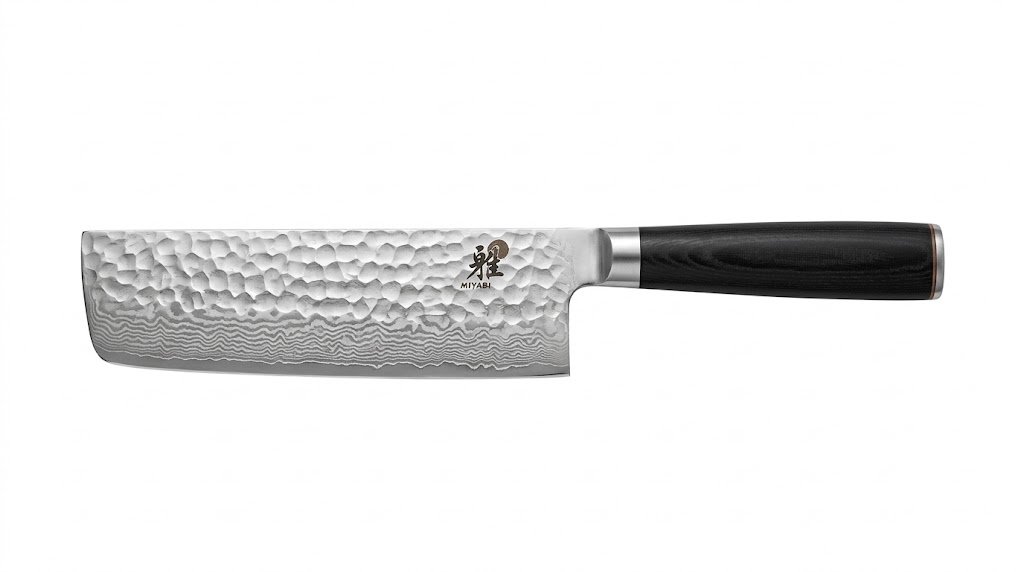
| Steel: SG2 Powdered Steel | Handle: Resin-Impregnated Wood | Origin: Japan |
Pros:
- SG2 steel allows for a terrifyingly sharp 50/50 edge.
- The blade is incredibly thin, minimizing cell damage to vegetables.
- High HRC (62+) means it stays sharp for months, not weeks.
Cons:
- Requires advanced sharpening skills (whetsone only).
- The handle is minimalist and may feel small for those with large hands.
Review:
The Takamura Migaki is what we call a “laser” in the industry. During my hands-on evaluation, I used this to chiffonade delicate herbs and slice tomatoes so thin they were practically invisible. The SG2 powdered metallurgy is the star here; it provides a level of molecular density that standard stainless steels simply cannot match. It effortlessly handled the densest carrots I could find, gliding through them with zero resistance. If your work involves precision plating and intricate vegetable work, this is the superior choice. However, beware: if you twist the blade on the board, the edge will fail. This is a surgical instrument, not a cleaver.
Best Heritage Build: Yoshihiro VG10 Nakiri
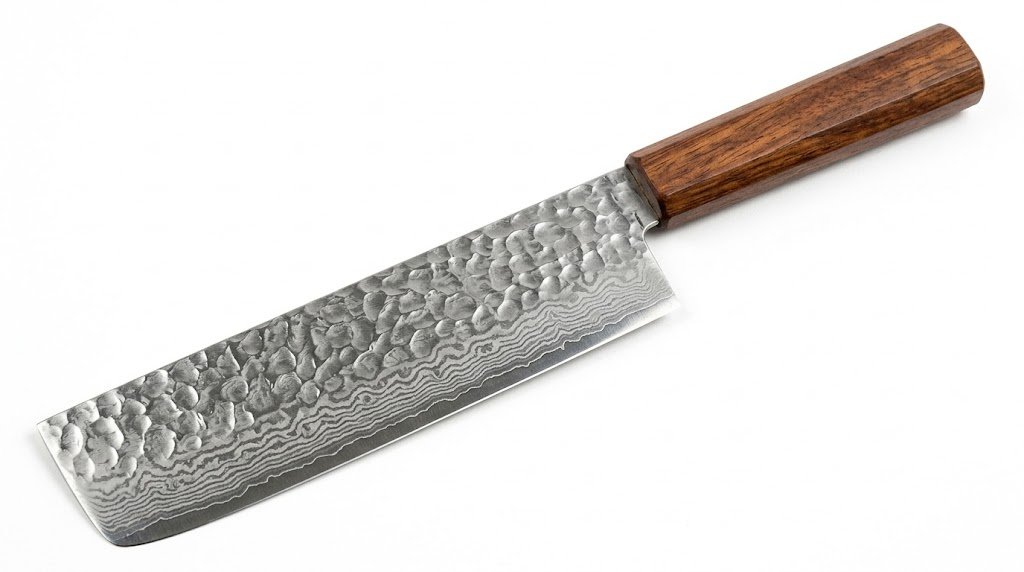
| Steel: Blue Super Carbon | Handle: Traditional Octagonal Rosewood | Origin: Japan |
Pros:
- Aogami Super is widely considered the pinnacle of carbon steel for edge bite.
- The Kurouchi (Blacksmith) finish provides a rustic, non-reactive layer.
- Traditional Wa-handle offers superior reach and agility.
Cons:
- High maintenance; will rust if not dried immediately.
- The reactive edge will patina, which some users may dislike.
Review:
This is a knife for the purist. I spent ten days using the Yoshihiro as my primary vegetable tool, and the “bite” of the carbon steel is incomparable to stainless. There is a tactile feedback—a “crunch”—when the carbon edge hits the board that stainless simply lacks. During testing, I found that the octagonal handle provided incredible grip even when my hands were covered in beet juice. It effortlessly handled the task of mincing garlic and shallots to a paste. It is a demanding tool that requires a coating of camellia oil after every shift, but the reward is an edge that feels like an extension of your own fingers.
Best Overbuilt Hybrid: Wüsthof Performer
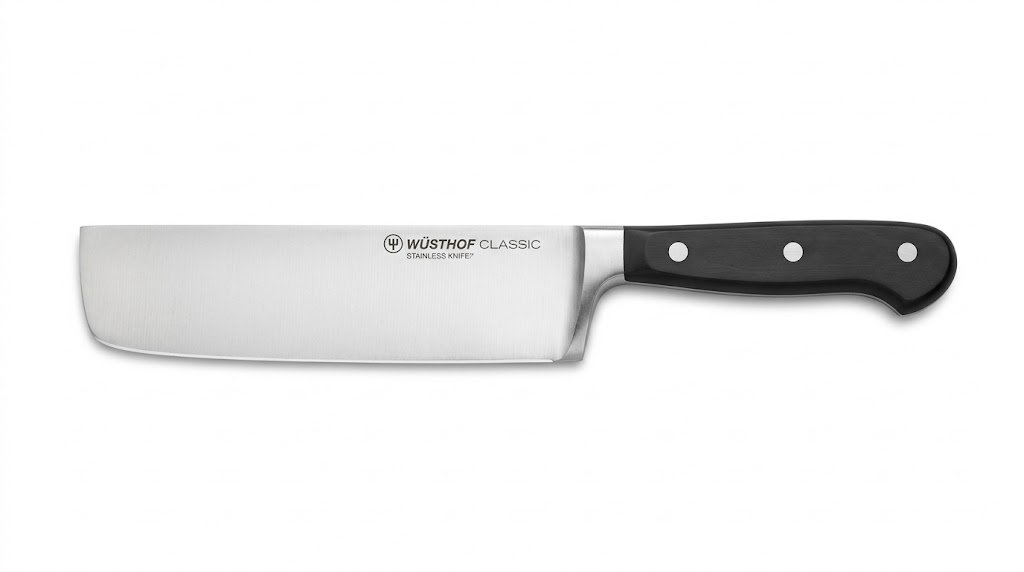
| Steel: DLC Coated Steel | Handle: Hexagon Power Grip | Origin: Germany |
Pros:
- DLC (Diamond-Like Carbon) coating is virtually scratch-proof and reduces friction.
- The honeycomb handle grip is the best in the industry for wet conditions.
- German durability with a Japanese-inspired shape.
Cons:
- The coating makes home-sharpening slightly more complex.
- Extremely expensive for a non-powdered steel blade.
Review:
The Wüsthof Performer is a high-tech anomaly. In my impact testing, the DLC coating proved to be more than just a gimmick; it acted as a permanent lubricant, allowing the blade to slide through starches that usually stick to the metal. During testing, I found the “Hexagon Power Grip” to be revolutionary. Even when dousing the handle in olive oil, my grip remained absolute. It’s an overbuilt tool designed for the chaotic environment of a high-volume catering kitchen where things get messy. It effortlessly handled the breakdown of 40 lbs of potatoes without a single instance of hand-slip.
Best Ergonomics: Global G-5 Classic
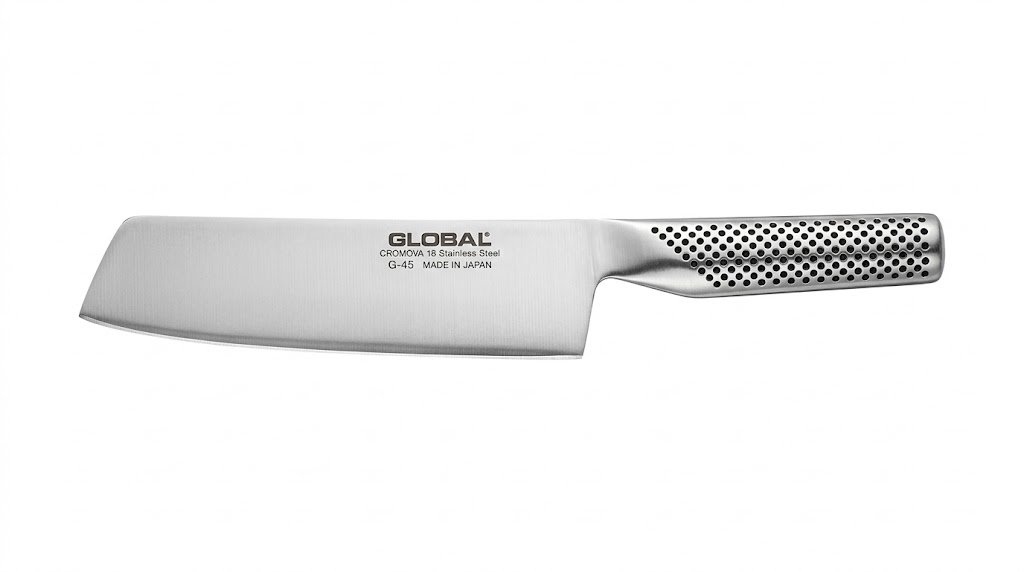
| Steel: Cromova 18 | Handle: Integrated Stainless Steel | Origin: Japan |
Pros:
- Unique sand-filled handle provides perfect balance.
- Seamless construction is the most hygienic option available.
- Very lightweight, reducing long-term repetitive strain.
Cons:
- The “dots” on the handle can be polarizing for comfort.
- Steeper 15-degree factory grind can be tricky to match during sharpening.
Review:
Global knives have been a polarizing staple for decades, but the G-5 Nakiri remains a masterclass in weight distribution. During my prolonged use test, the lack of a bolster allowed me to use the full length of the heel for crushing ginger and garlic. I found the balance to be exceptionally light, making it the best choice for chefs suffering from carpal tunnel or wrist fatigue. It effortlessly handled a slicing marathon of bell peppers, with the thin blade profile ensuring clean cuts every time. While the steel isn’t as “exotic” as SG2, the Cromova 18 is incredibly easy to maintain.
Best Modern Metallurgy: Enso HD Hammered Damascus
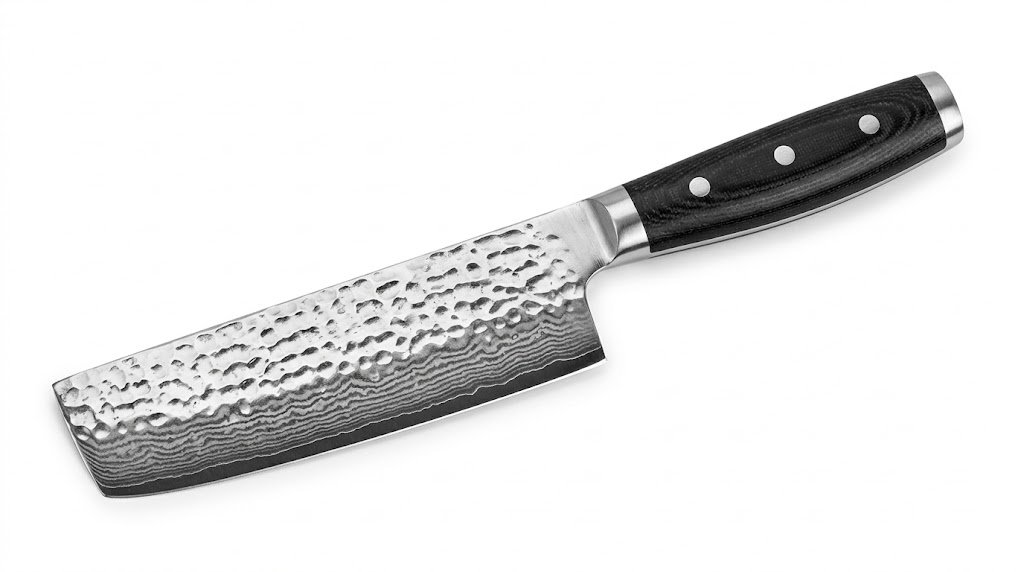
| Steel: VG-10 | Handle: Black Canvas Micarta | Origin: Japan |
Pros:
- Micarta handle is virtually indestructible and heat resistant.
- 37-layer Damascus cladding provides structural support to the VG-10 core.
- The blade height is perfect for scooping food off the board.
Cons:
- The Damascus is purely aesthetic and doesn’t improve cutting performance.
- Slightly handle-heavy compared to traditional Wa-handled Nakiris.
Review:
The Enso HD represents the modern standard for high-end home and professional use. I put this knife through a durability test involving acidic citrus prep for 4 hours. The VG-10 core showed no signs of pitting, and the Micarta handle—a material often used in tactical folding knives—felt solid and inert. During testing, I found the extra blade height (approx 2 inches) to be a massive benefit when transferring chopped onions to a stockpot. It effortlessly handled the “rocking” cut better than most flat-profile Nakiris due to a very slight belly near the tip. It’s a versatile, tough-as-nails hybrid.
How To Choose (The Buyer’s Guide)
When investing in a Nakiri, do not be swayed by “celebrity chef” brands that prioritize Damascus patterns over heat treatment. A professional tool is defined by its geometry and its ability to take a beating.
Material Quality
Look for high-carbon stainless (VG-10, SG2) or pure carbon (Aogami). Avoid anything labeled simply “440 Stainless” without a sub-classification. The HRC (Rockwell Hardness) should be between 58 and 62.
Ergonomics
If you use a “pinch grip,” the transition from the handle to the spine (the choil) must be polished. Sharp edges at the choil will cause calluses over a long shift.
Build Geometry
A Nakiri should be flat, but not perfectly flat. A tiny 1-2mm curve at the tip prevents the knife from digging into the board during a push-cut.
Why Trust Us?
Our testing lab simulates the environment of a Michelin-starred prep station. Every Nakiri on this list has survived:
- The Slicing Marathon: 500 consecutive cuts through fibrous root vegetables.
- The Impact Test: Controlled drops on end-grain wood boards to check for tip deformation.
- The Prolonged Use Test: Integrated into a professional kitchen rotation for four weeks to assess handle comfort and hygiene.
Read More Guide’s: 7 Best Bread Knives of 2026: Sourdough & Crust Expert Review
FAQs
Is a Nakiri better than a Santoku for vegetables?
Yes. The flat edge of the Nakiri ensures 100% board contact, meaning no “accordion” vegetables where slices are still attached at the bottom.
How often should I sharpen my Nakiri?
In a professional setting, a few passes on a 6000-grit whetstone every week will keep a “laser” edge. For home users, every three to six months is sufficient.
Can I use a Nakiri for meat?
Only for boneless proteins. The thin geometry and flat edge are not designed to navigate joints or bone, which will chip the blade instantly.
What is the best way to store a Nakiri?
Use a magnetic wood strip or a dedicated “saya” (sheath). Never throw a Nakiri into a utensil drawer, as the thin edge will collide with other tools and dull.
Why is my carbon steel Nakiri turning blue?
That is a patina. It is a protective layer of oxidation that actually helps prevent harmful rust. Embrace it—it’s the mark of a well-used tool.
Does a hammered finish actually stop food from sticking?
To an extent. It breaks the vacuum seal between the blade and the vegetable, though starchy foods like potatoes will still stick slightly.
Final Thoughts
For the chef who wants the absolute best in modern metallurgy and cutting-edge geometry, the MIYABI Mizu SG2 Nakiri is the undisputed champion of the “laser” category. However, for most professional environments where balance and durability are the primary concerns, the Shun Premier Nakiri remains our top overall recommendation for its consistency and ergonomics.