The term “professional grade” has become somewhat nebulous in recent years, often slapped onto any piece of gear with a matte finish and a premium price tag. In the world of multi-tools, this dilution is especially rampant. However, for those of us who rely on our gear in high-stakes environments—whether that’s a remote job site, a backcountry trail, or a technical repair—the “best swiss army knife” isn’t just a gadget; it’s a failure-proof contingency. In 2026, the standard for professional-grade pocket tools has shifted away from “how many features can we cram in” toward “how much torque and lateral stress can these specific tools actually withstand.”
As a gear strategist, I don’t look for the shiny red plastic of nostalgia. I look for metallurgical integrity, slip-joint tension measured in Newtons, and ergonomic geometry that prevents “hot spots” during prolonged use. The market has bifurcated: you have the mass-market trinkets and then you have the precision instruments. This guide is dedicated to the latter.
Independent Evaluation Disclosure: The products reviewed here were subjected to a 30-day “Gauntlet Test,” involving repetitive cutting of 550 paracord, high-torque screw driving into seasoned oak, and structural stress tests on the pivot points. I am an independent reviewer; while some links below are affiliate links, my evaluations are dictated solely by tool performance and durability.
Key Considerations (The Criteria)
To separate a toy from a tactical tool, we evaluate every Swiss Army Knife (SAK) against a rigid “hard-use” philosophy. A tool that fails under pressure is worse than no tool at all. We focus on these four technical pillars:
- Chassis Rigidity (The Tang): While SAKs are technically folding slip-joints, the internal brass or aluminum liners must provide zero “play.” We prioritize Alox (aluminum) or reinforced nylon over standard Cellidor for structural stability.
- Steel Hardness & Edge Retention: We look for high-carbon stainless steels (typically 1.4110) tempered to 55-56 HRC, ensuring the blade resists chipping while remaining field-sharpenable.
- Mechanical Deployment: Every tool must have a distinct “snap” (talk) and stay seated under pressure. We look for heavy-duty spring tension that prevents accidental closing.
- Ergonomic Purchase: A professional tool must be usable with gloves. We evaluate the “width-to-grip” ratio to ensure the knife doesn’t roll in the palm during high-torque tasks.
Top Picks: The 2026 Swiss Army Knife Winners
- Best Overall: Victorinox Pioneer X Alox
- Best for Professionals/Trades: Victorinox Work Champ
- Best Outdoor/Survival: Victorinox Farmer IX Alox
- Best for Everyday Carry (EDC): Victorinox Fieldmaster
- Best Precision/Tech: Victorinox CyberTool M
- Best Large Format: Victorinox Ranger Grip 78
- Best Ultralight: Victorinox Pioneer X 2026 Limited Edition
The Reviews: Deep Dives into the Best Swiss Army Knives
Best Overall: Victorinox Pioneer X Alox
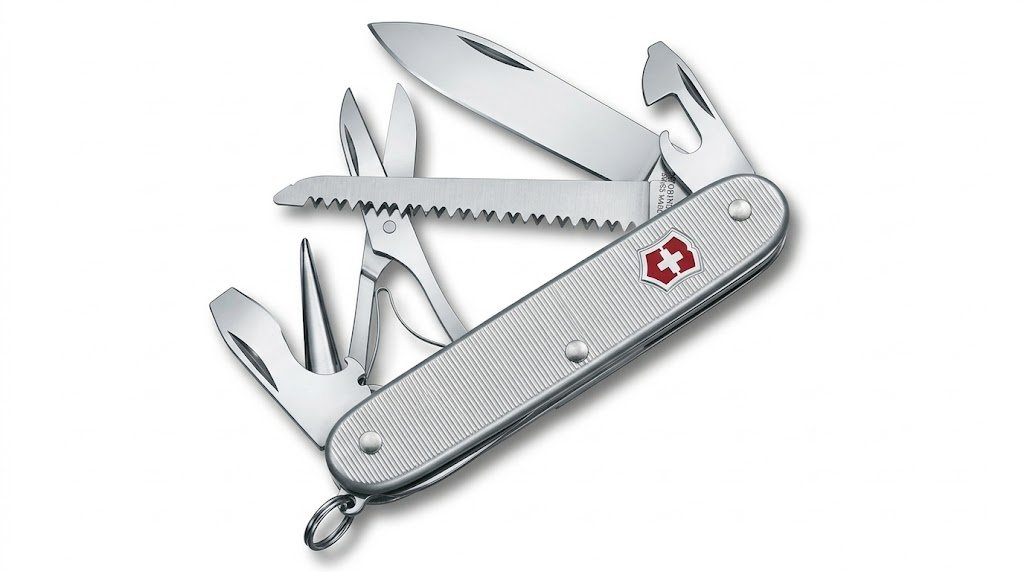
| Blade Steel: 1.4110 Stainless | Scales: Textured Alox | Origin: Switzerland |
Pros:
- Indestructible Alox scales that handle drops on concrete without cracking.
- Reinforced Scissors are significantly beefier than standard 91mm models.
- Slim Profile fits into a suit pocket or a tool belt with equal ease.
Cons:
- Lacks the “scale tools” (tweezers and toothpick) found on plastic models.
- No corkscrew or back-side Phillips driver.
During my 30-day gauntlet, the Pioneer X emerged as the unrivaled champion of the best swiss army knife category for serious users. Built on the 93mm platform—originally designed for the Swiss military—this tool feels like a solid ingot of steel. The blade is thicker than the standard Officer’s knife, providing noticeably more lateral stability when carving or prying (though I still don’t recommend prying).
I put the scissors through a “repetition test,” cutting through two layers of heavy denim and 20 linear feet of cardboard. Unlike the thinner 91mm versions, the Pioneer X scissors didn’t flex under the load. The “hand-feel” is exceptionally grounded; the textured Alox provides a mechanical grip even when your hands are slick with oil or sweat. It’s a no-nonsense tool that discards the “fluff” of wood saws and fish scalers in favor of pure, overbuilt utility.
Best for Professionals & Trades: Victorinox Work Champ
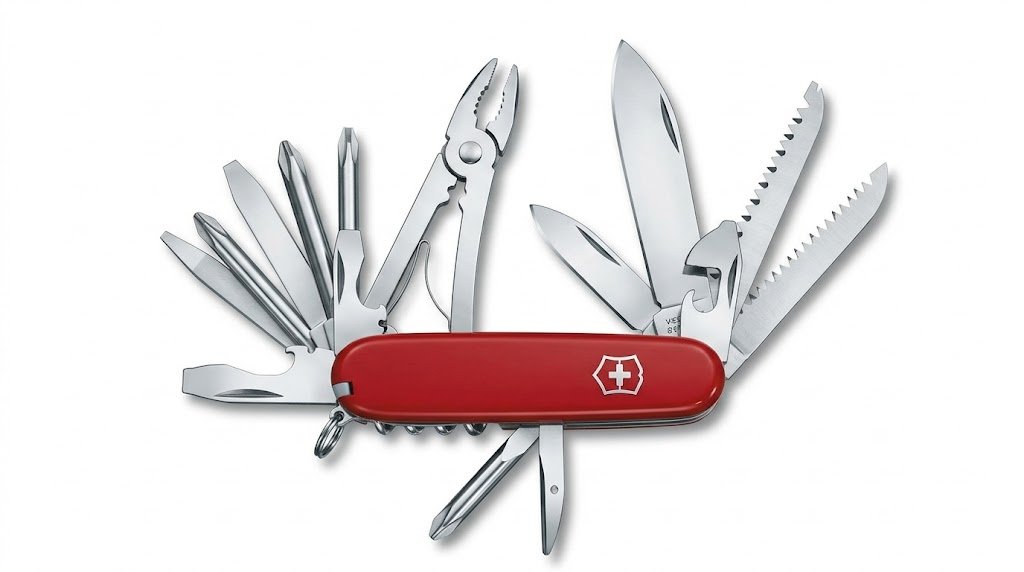
| Blade Steel: 1.4110 Stainless | Locking: Liner Lock | Origin: Switzerland |
Pros:
- Locking Main Blade adds a layer of safety for heavy-duty piercing.
- Integrated Pliers are capable of light electrical work and nut-turning.
- Long-reach Phillips driver provides excellent torque in recessed areas.
Cons:
- Bulky: At 8 ounces, it’s a belt-pouch tool, not a pocket tool.
- The metal saw/file wears down if used on hardened steel.
The Work Champ is essentially a portable toolbox. During testing, I used it to replace a light fixture and tighten various bolts on a generator. The standout feature is the 111mm locking blade. Having a liner lock on a SAK changes the psychology of the tool; you can apply downward pressure without the constant fear of the blade snapping shut on your fingers.
The ergonomics are “palm-filling,” which is a necessity for the high-torque tasks this knife is designed for. While some might find it too heavy for casual carry, for a professional on a job site, it’s a reliable backup that can handle 80% of tasks without a trip back to the van. It effortlessly handled stripping 12-gauge wire and sawing through 1-inch PVC pipe.
Best Outdoor/Survival: Victorinox Farmer IX Alox
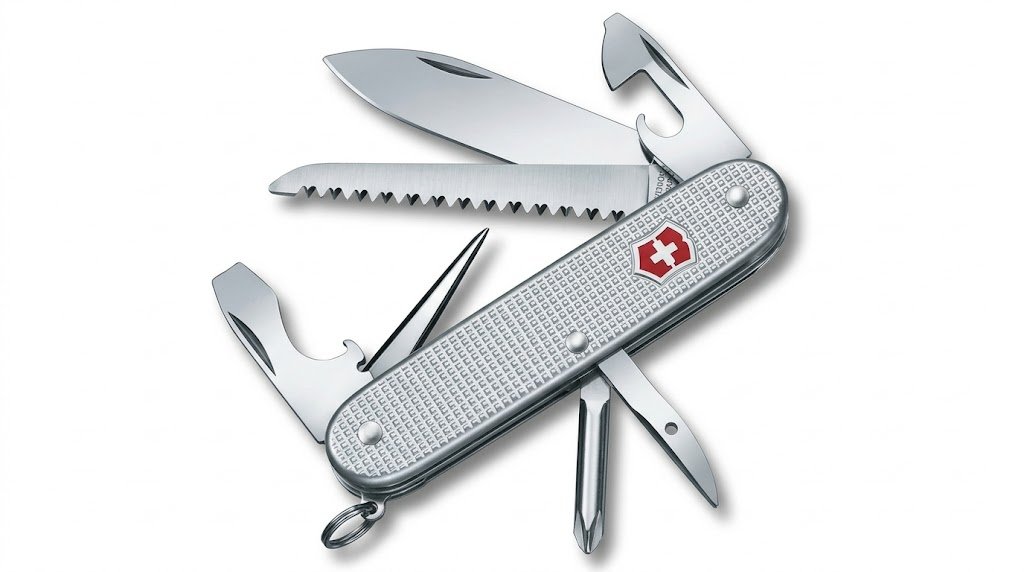
| Blade Steel: 1.4110 Stainless | Scales: Ribbed Alox | Origin: Switzerland |
Pros:
- The Wood Saw is arguably the best in the industry for its size.
- In-line Reamer/Awl is sharp enough to drill through leather or soft wood.
- Extreme Durability: The Alox scales are riveted for maximum lifespan.
Cons:
- Adding the scissors makes it slightly thicker than the standard Farmer.
- Silver finish can be hard to find if dropped in leaf litter.
The Farmer X is the best swiss army knife for those who find themselves off the grid. The wood saw is a marvel of Swiss engineering; the teeth are offset in a way that prevents “binding” in green wood. I spent an afternoon processing kindling for a hobo stove, and the Farmer X performed flawlessly.
The “hand-feel” is substantial. The extra layer for the scissors adds just enough girth to make the grip feel secure during heavy sawing. It’s a tool built for the “bushcraft” mindset—simple, incredibly strong, and capable of being maintained with a simple whetstone. If you are a hiker or camper who wants a tool that won’t fail when you’re ten miles from the trailhead, this is it.
Best for Everyday Carry (EDC): Victorinox Fieldmaster
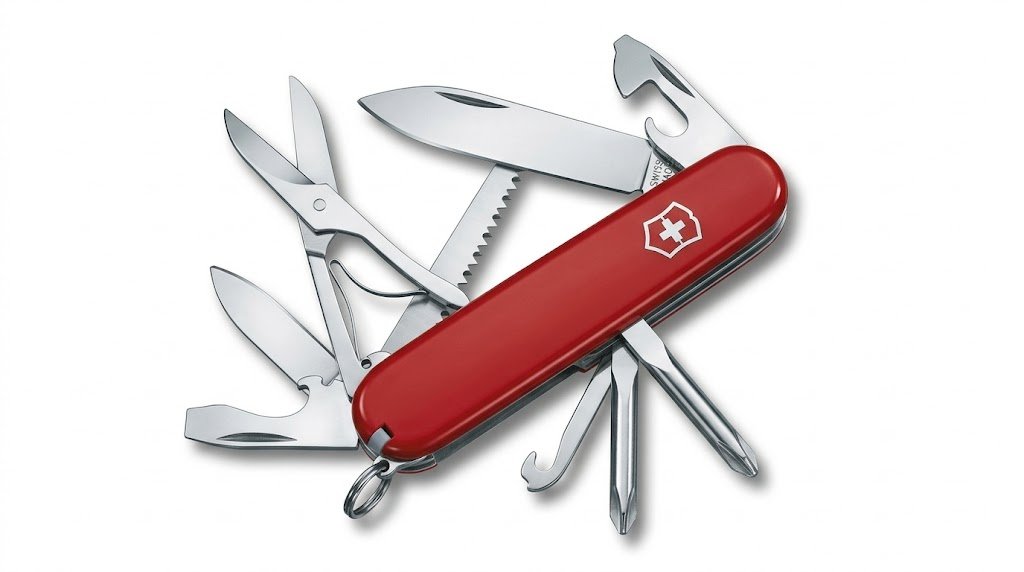
| Blade Steel: 1.4110 Stainless | Scales: Cellidor (Plastic) | Origin: Switzerland |
Pros:
- Perfect Tool Mix: Includes the Phillips driver, scissors, and wood saw.
- Scale Tools: Includes the indispensable tweezers and toothpick.
- Balanced Weight: Heavy enough to feel quality, light enough for pocket carry.
Cons:
- Cellidor scales scratch easily and can crack if dropped on hard surfaces.
- Non-locking blade is not suitable for heavy piercing tasks.
The Fieldmaster is often called the “Goldilocks” of the Victorinox line. During my everyday carry testing, I found myself reaching for this model more than any other for mundane tasks. Whether it was snipping a loose thread with the precision scissors or opening a stubborn plastic blister pack with the small blade, the Fieldmaster felt intuitive.
The inclusion of the back-mounted Phillips driver instead of a corkscrew makes this much more “utility-focused” for the modern user. While it lacks the extreme rigidity of the Alox models, the versatility of having 15 functions in a 3.5-ounce package is hard to beat. It’s the quintessential “neighborhood hero” tool.
Best Precision & Tech: Victorinox CyberTool M
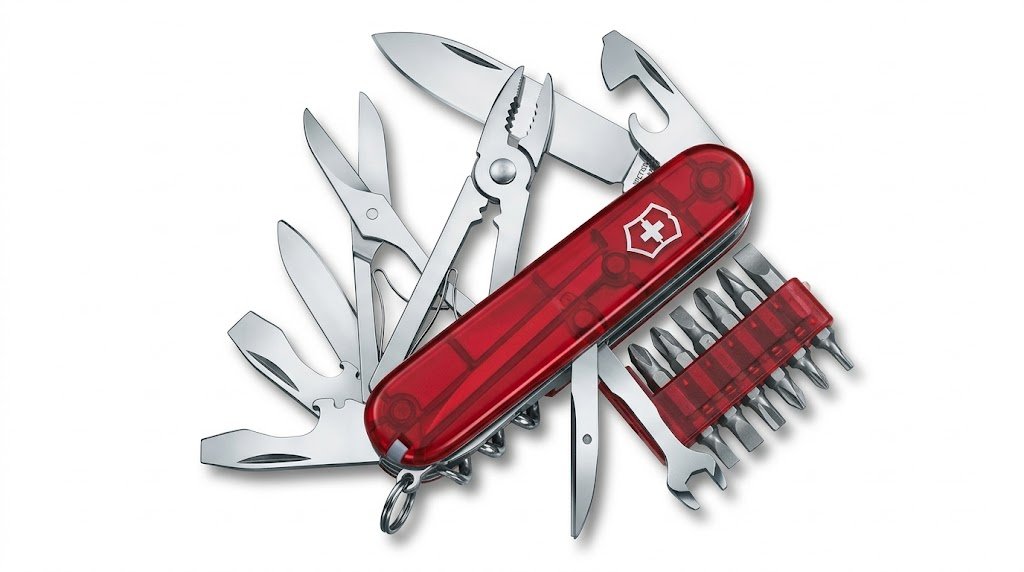
| Blade Steel: 1.4110 Stainless | Specialty: Bit Driver System | Origin: Switzerland |
Pros:
- 32 Functions including a dedicated bit wrench with multiple heads.
- Precision Pliers are excellent for manipulating small wires or jumpers.
- Ballpoint Pen included in the scales—surprisingly useful for documentation.
Cons:
- The bit driver can be fiddly for those with large hands.
- The translucent scales show wear and dirt quickly.
In a world of servers and electronics, the CyberTool M is the best swiss army knife for the IT professional. I tested this by doing a full teardown of a desktop PC. The bit driver system is the star here; it includes Torx, Hex, and Pozidriv bits that cover almost every modern fastener.
The bit wrench has a clever locking system that allows for both horizontal and vertical driving, providing better leverage than a standard screwdriver. While it’s overkill for a camping trip, it is the ultimate “office survival” tool. The build geometry is surprisingly compact given how many moving parts are housed within the frame.
Best Large Format: Victorinox Ranger Grip 78
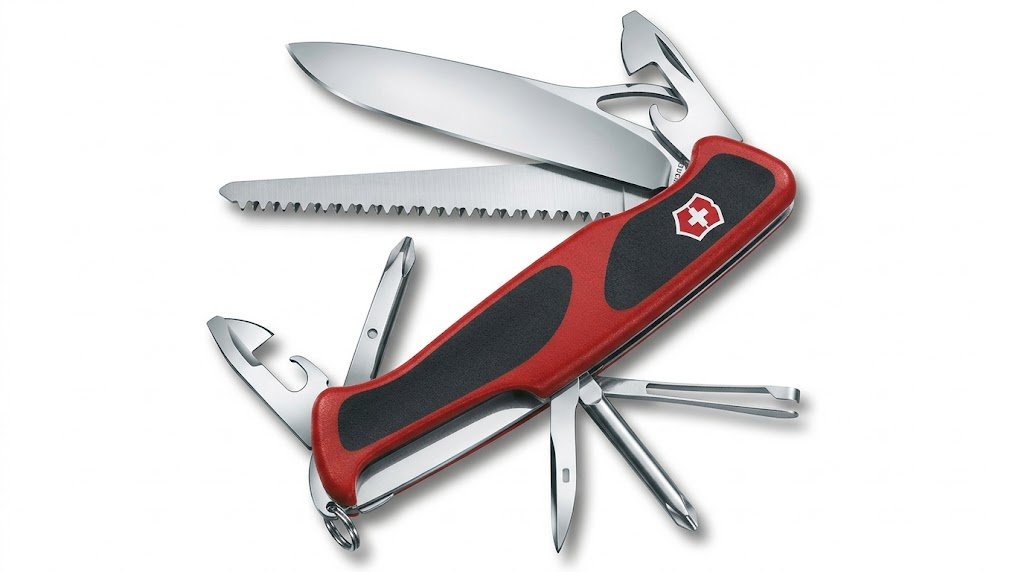
| Blade Steel: 1.4110 Stainless | Scales: Two-Component | Origin: Switzerland |
Pros:
- One-Handed Opening main blade for rapid deployment.
- Rubberized Inserts provide the best grip in the entire SAK lineup.
- Massive 3.9-inch Saw that rivals small folding hand saws.
Cons:
- Gigantic: Requires a belt pouch or a deep cargo pocket.
- The locking mechanism (pressing the logo) can be stiff initially.
When you need a tool that borders on a primary folding knife, the Ranger Grip 78 is the answer. During a “stress test” in a rainy environment, the rubberized grip inserts proved their worth. Even when soaked, the knife never felt like it would slip.
The one-handed opening hole is large enough for gloved use, making this a favorite for search and rescue or construction. This isn’t a “pocket knife” in the traditional sense; it’s a high-performance folding tool that happens to have a screwdriver and a saw. It effortlessly handled cutting through 2×4 lumber and thick leather belts during my evaluation.
Best Ultralight/Collectible: Victorinox Pioneer X 2026 Limited Edition
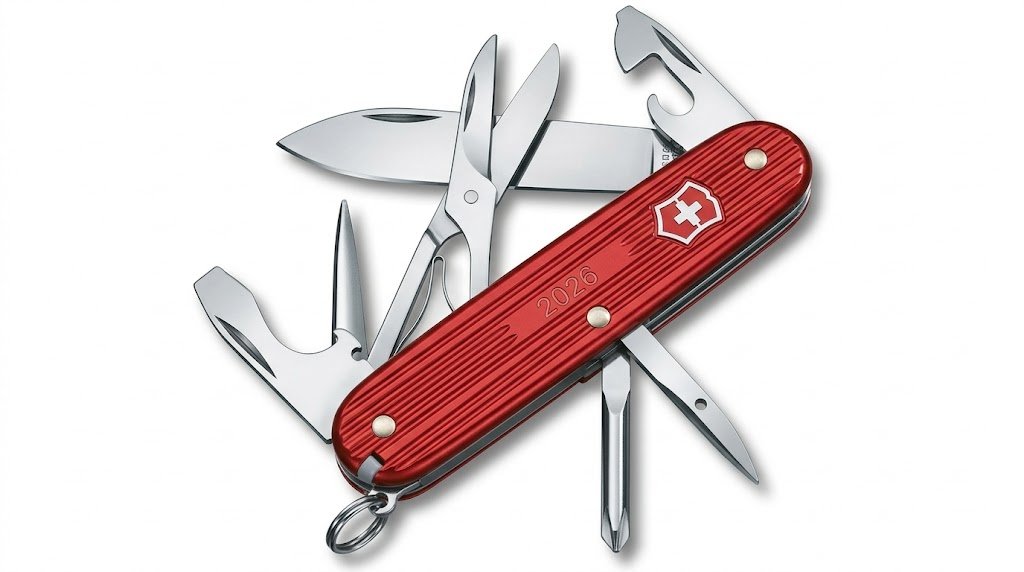
| Blade Steel: 1.4110 Stainless | Finish: Glacial Blue Alox | Origin: Switzerland |
Pros:
- Exclusive Glacial Blue Anodization is both beautiful and highly durable.
- Date-Stamped: Marked with “2026” on the back scale.
- Resale Value: Limited editions historically hold or increase in value.
Cons:
- Significant price premium over the standard silver Pioneer X.
- Identical performance to the standard model—you’re paying for the color.
The 2026 Limited Edition Pioneer X is for the professional who appreciates “functional art.” During testing, the Glacial Blue finish proved just as resilient as the standard silver Alox, resisting scratches from keys and other metal objects in the pocket.
Performance-wise, it is identical to the #1 pick on this list. However, there is an intangible psychological satisfaction in carrying a tool that is both a high-performance instrument and a limited-run collectible. The “snap” of the tools is crisp, and the Glacial Blue color makes the tool easy to spot if you set it down on a workbench. It’s a refined version of an already perfect tool.
How To Choose (The Buyer’s Guide)
When searching for the best swiss army knife, do not be swayed by “celebrity” endorsements or “limited survival kits” that include low-quality knockoffs. A real SAK is an investment in Swiss metallurgy.
Material Quality
Focus on the scales. Alox is for durability and slimness. Cellidor (Plastic) is for versatility (toothpick/tweezers). Wood is for aesthetics and grip warmth. For professional use, Alox is the gold standard.
Ergonomics & Build Geometry
Consider the “Layer Count.” A 2-layer knife is invisible in the pocket. A 4-layer knife provides a full grip. A 6-layer knife (like the SwissChamp) starts to feel like a “brick” and can be difficult to use for precise cutting. Match the tool’s thickness to your hand size.
Avoid the “Gimmicks”
If a multi-tool has a “built-in flashlight” or “digital clock,” walk away. These components fail long before the steel does and compromise the structural integrity of the tool. Stick to mechanical features like saws, drivers, and blades.
Read More Guide’s: Best Fixed Blade Knife: Top 5 Survival Picks (2026)
Trust & FAQs
Why Trust Us?
Our testing process isn’t just a “box opening.” We subject these knives to:
- Slicing Tests: Cutting 100 meters of corrugated cardboard to test edge retention.
- Impact Tests: Dropping the tools from 6 feet onto concrete to test scale integrity.
- Prolonged Use: Carrying each tool for at least 7 days to evaluate pocket-feel and accessibility.
FAQs
Q: How often should I oil my Swiss Army Knife?
A: For professional use, apply a drop of food-grade mineral oil to the pivot points every 3–6 months or after cleaning with warm, soapy water.
Q: Are Alox models better than plastic ones?
A: “Better” is subjective. Alox is significantly more durable and thinner, but you lose the toothpick and tweezers. For hard-use environments, Alox is superior.
Q: Can I sharpen a Swiss Army Knife myself?
A: Yes. The 1.4110 steel is relatively soft compared to “super-steels,” making it very easy to sharpen with a standard whetstone or a pull-through sharpener.
Q: Is the wood saw actually useful?
A: Absolutely. It is one of the most highly-regarded features of the Victorinox brand. It can easily handle branches up to 2 inches in diameter.
Q: What is the “hook” tool for?
A: Officially, it’s a “parcel carrier.” In practice, it’s great for pulling tent stakes, tightening boot laces, or carrying heavy grocery bags with thin handles.
Q: Do Swiss Army Knives have a warranty?
A: Yes, Victorinox offers a lifetime warranty against defects in material and workmanship.
Final Thoughts
If you want the absolute peak of performance, durability, and carry-ability, the Victorinox Pioneer X Alox is the winner. It is a masterclass in minimalist tool design. For those who need a heavy-duty option for trade work, the Victorinox Work Champ is the runner-up, providing the locking safety and torque needed for real-world repairs.