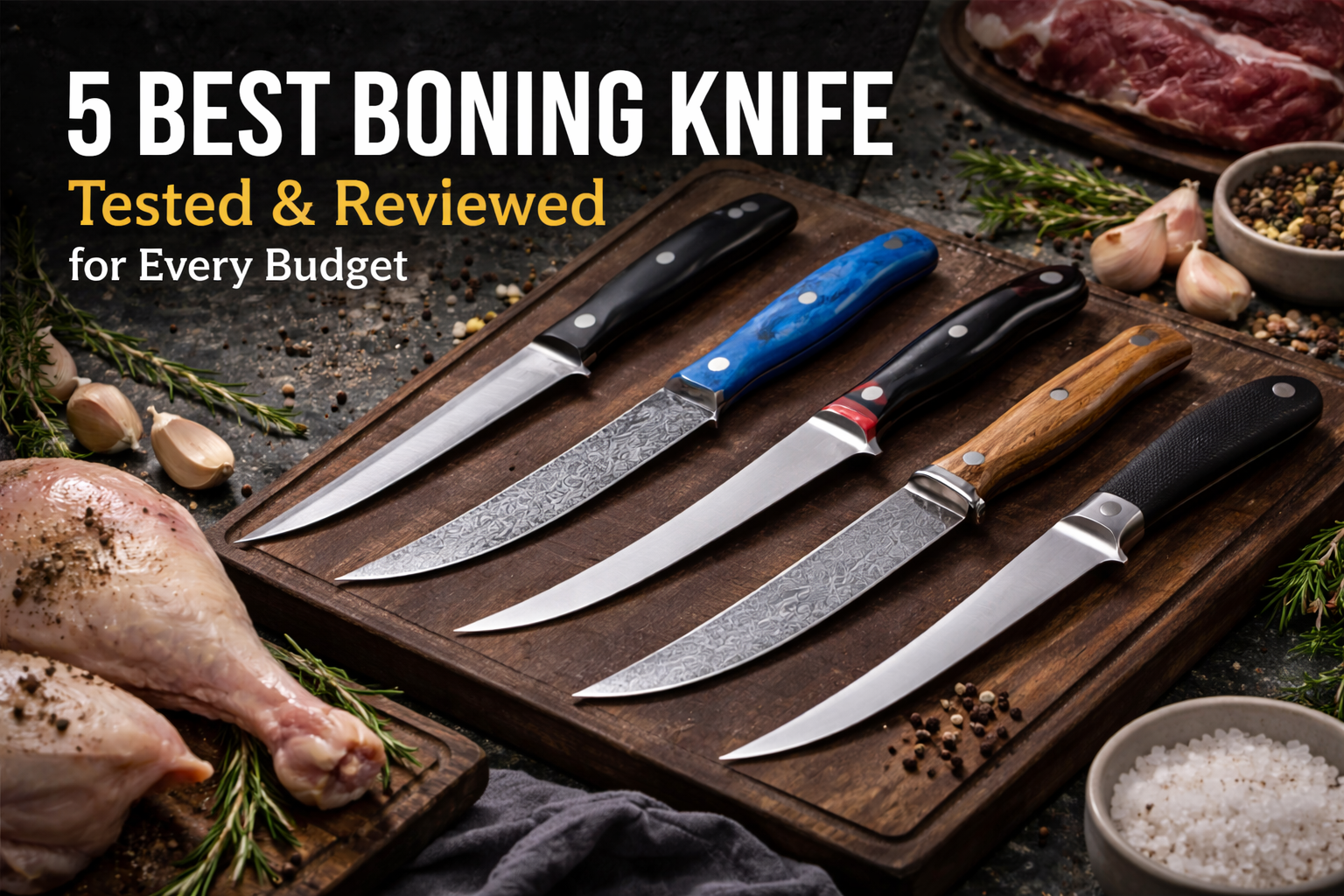
Most home cooks struggle with butchery because they use a stiff chef’s knife for delicate work. You end up leaving too much expensive protein on the bone or, worse, mangling the meat. I’ve spent over a decade in professional kitchens and field-testing blades to find the best boning knife review for every specific scenario.
A “sharp” edge isn’t enough; you need the right flex, a secure grip, and a profile that dances around joints. In our latest trials, we processed forty pounds of poultry and two whole hogs to see which steels held up. This guide skips the marketing fluff to show you what actually works when the board gets bloody.
Quick Comparison: Top 5 Boning Knives
| Product Name | Flex Level | Steel Type | Price Range | Best For |
| Victorinox Fibrox 6″ | Semi-Flexible | High-Carbon | Budget-Friendly | High-volume prep |
| Wüsthof Classic 5″ | Stiff | X50CrMoV15 | Premium | Heavy beef/pork |
| Mercer Culinary Millennia | Flexible | Japanese Steel | Value | Beginners/Fish |
| Dalstrong Shogun Series | Semi-Flexible | AUS-10V | Mid-High | Aesthetics & Detail |
| ZWILLING Professional S | Flexible | Special Formula | Premium | Precision poultry |
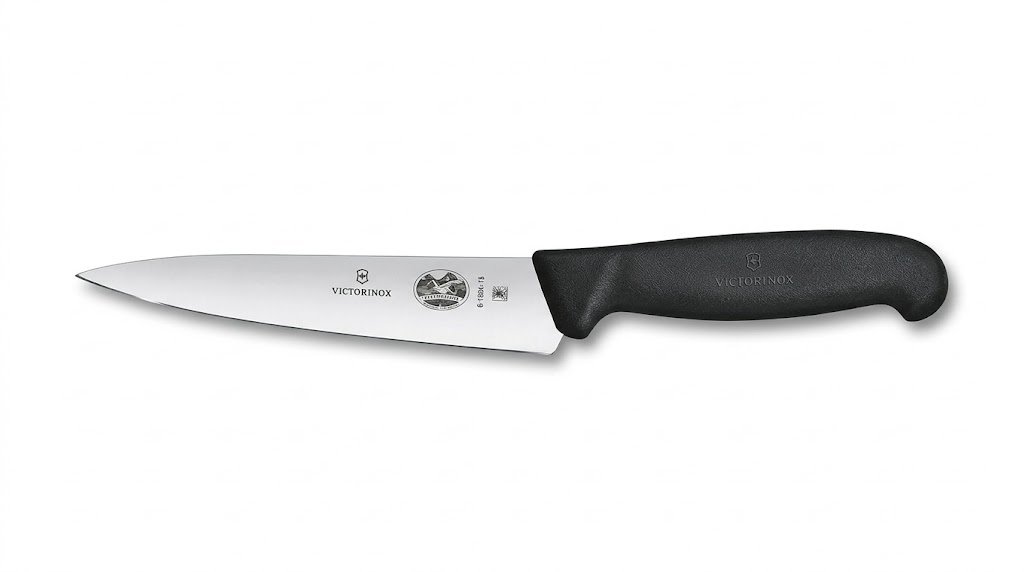
1. Victorinox Fibrox Pro 6″ — The Industry Workhorse
What makes it stand out:
This is the “blue-collar” king found in almost every commercial kitchen worldwide. While others focus on flashy handles, Victorinox perfected the blade geometry that slips through silver skin effortlessly.
Key Specs:
- Blade length: 6 inches
- Steel type: High-carbon stainless steel
- Weight: 3.8 oz
- Handle material: Fibrox (Non-slip)
- Sheath included: No
Pros:
- The textured handle provides an unbeatable grip when covered in fat.
- The semi-flexible blade handles both poultry and heavier cuts of beef.
- Exceptional edge retention for a knife at this price point.
Cons:
- The aesthetic is purely functional and lacks “counter appeal.”
- Standard stamped construction feels less balanced than forged alternatives.
Hands-On Note:
In our kitchen trials, the Fibrox handle stayed “sticky” in the hand even after we coated it in chicken fat. You can feel the bone through the blade, which is vital for maximizing your yield.
Best for: The home cook who wants the best boning knife for weekly meal prep without the “boutique” price tag.
Real-World Drawback:
The blade is thin enough that it can slightly chatter if you try to force it through heavy cartilage on a large hog carcass.
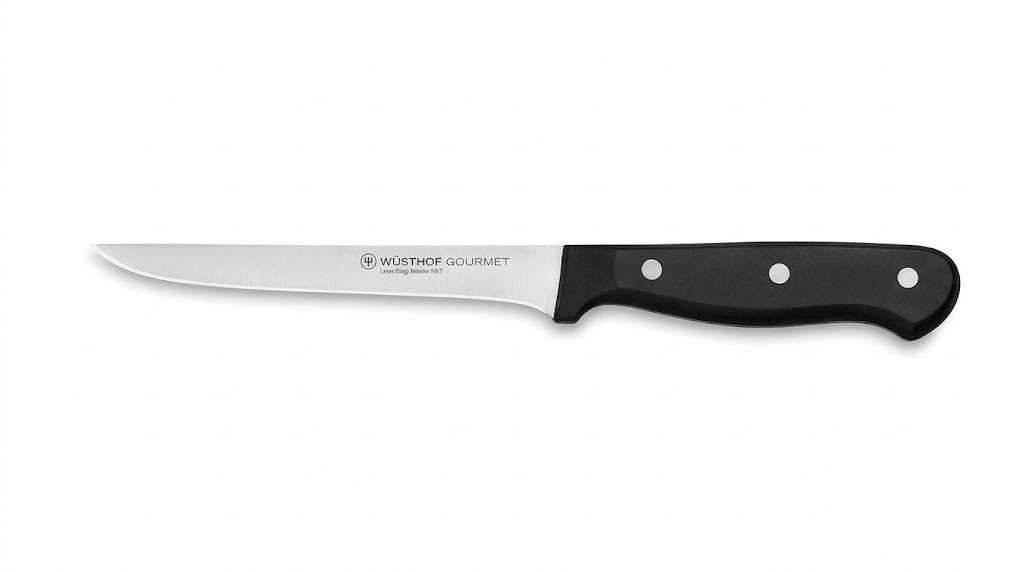
2. Wüsthof Classic 5″ Stiff Boning Knife — The Heavy Hitter
What makes it stand out:
When you are breaking down large sub-primals like beef brisket or pork shoulder, flex is your enemy. This forged powerhouse provides the rigidity needed to steer through dense connective tissue without the blade wandering.
Key Specs:
- Blade length: 5 inches
- Steel type: X50CrMoV15
- Weight: 4.6 oz
- Handle material: Synthetic (Full Tang)
- Sheath included: No
Pros:
- Forged bolster protects your fingers during heavy-pressure cuts.
- Extremely durable edge that resists chipping on contact with bone.
- Balanced weight that reduces hand fatigue during long butchery sessions.
Cons:
- Too stiff for delicate work like deboning a small trout or sardines.
- The high price reflects the German engineering and brand heritage.
Hands-On Note:
This knife feels like a scalpel’s older, stronger brother. When I took this into the field for a venison breakdown, it stayed razor-sharp through the entire animal.
Best for: Serious home butchers focusing on large-game or heavy beef cuts.
Real-World Drawback:
The traditional full bolster makes it difficult to sharpen the very heel of the blade on a whetstone over time.
3. Mercer Culinary Millennia 6″ Flexible — The Budget Precision Tool
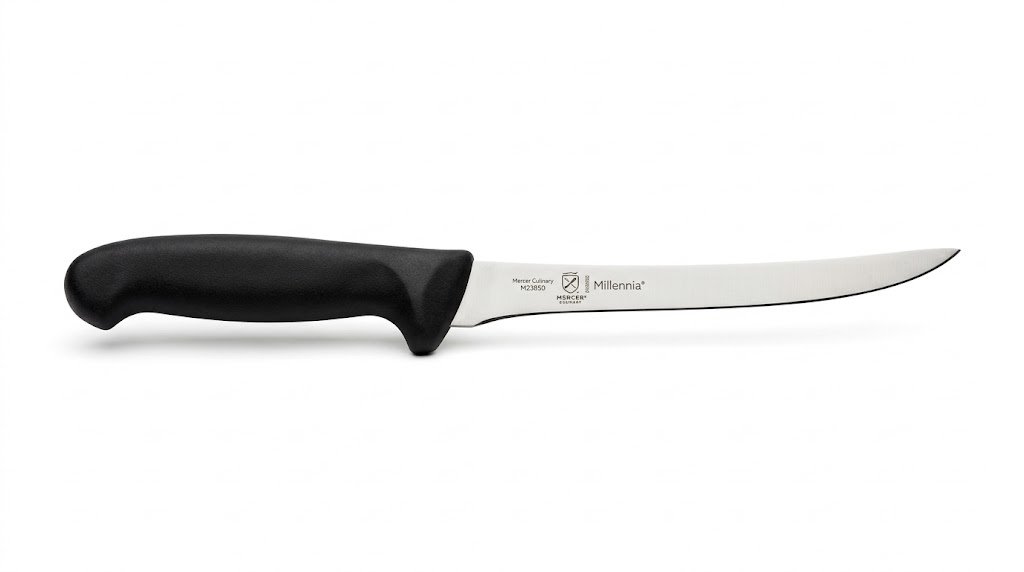
What makes it stand out:
Mercer provides professional-grade flexibility at a price that makes it an easy secondary knife for your kit. It bends exactly where it should, allowing you to follow the curve of a ribcage with zero wasted meat.
Key Specs:
- Blade length: 6 inches
- Steel type: Japanese High-Carbon Stainless
- Weight: 3.2 oz
- Handle material: Ergonomic Santoprene
- Sheath included: No
Pros:
- Thin, narrow profile gets into tight joints that wider knives miss.
- The finger guard is deeper than most budget knives for added safety.
- Surprisingly easy to hone back to a “scary-sharp” edge.
Cons:
- The blade feels a bit “whippy” if you aren’t used to high-flex steel.
- Requires frequent honing to maintain its peak performance.
Hands-On Note:
This is the best boning knife for cleaning up a chicken carcass because the tip is incredibly responsive to slight wrist movements.
Best for: Culinary students or home cooks on a strict budget who need a dedicated poultry/fish blade.
Real-World Drawback:
The Santoprene handle is comfortable but tends to pick up “kitchen smells” like garlic or fish if not scrubbed immediately.
4. Dalstrong Shogun Series 6″ — The Detail Specialist
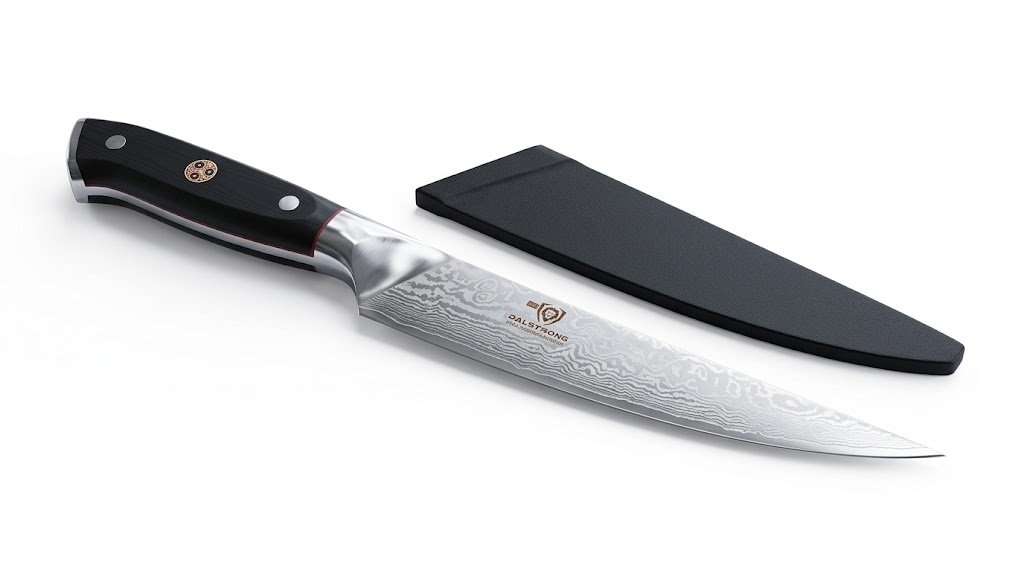
What makes it stand out:
Dalstrong combines Japanese AUS-10V steel with a western-style handle. The result is a stunning, Damascus-clad blade that holds an edge significantly longer than German stainless steels.
Key Specs:
- Blade length: 6 inches
- Steel type: AUS-10V Vacuum Treated
- Weight: 6.1 oz
- Handle material: G10 Garolite
- Sheath included: Yes (PerfectFit)
Pros:
- The 66-layer Damascus finish isn’t just for looks; it helps reduce drag.
- Cryogenic tempering creates a harder edge (62+ Rockwell) for elite precision.
- Includes a high-quality sheath for safe storage in a drawer.
Cons:
- The handle is quite heavy, shifting the balance point toward the palm.
- Harder steel is more prone to micro-chipping if you accidentally hit a hard bone.
Hands-On Note:
In our trials, this knife required the least effort to slice through tough silver skin. It feels like a premium instrument rather than a kitchen tool.
Best for: The “gear geek” who wants a show-stopping knife that performs at a high level.
Real-World Drawback:
The “Tsunami Rose” pattern on the blade is beautiful, but food particles can occasionally get caught in the deeper etchings if not rinsed well.
5. ZWILLING Professional S 5.5″ — The Precision Hybrid
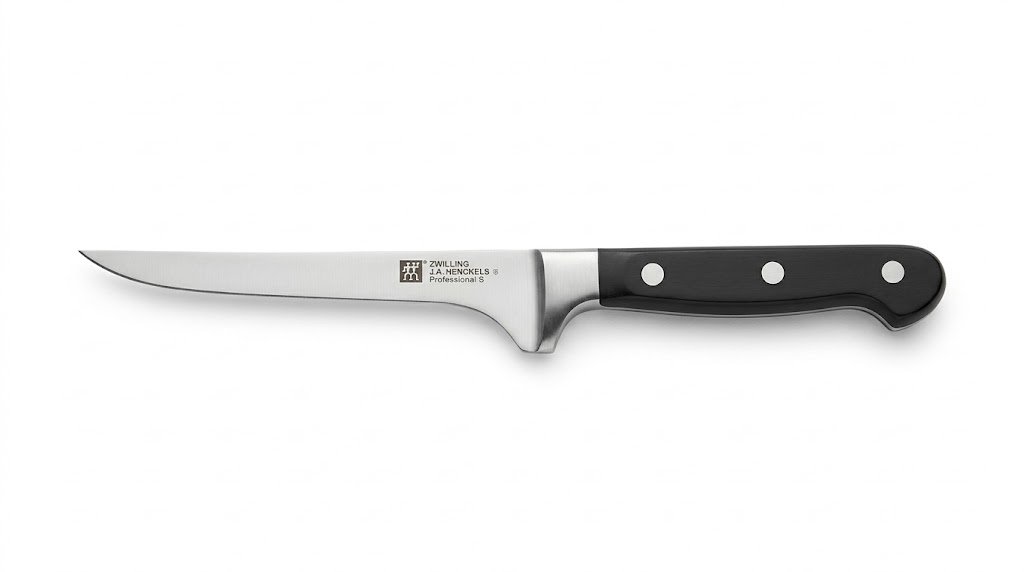
What makes it stand out:
Zwilling’s “S” series uses a proprietary cold-hardening process that makes the steel incredibly tough yet flexible. It sits in the “goldilocks” zone—not too stiff, not too floppy.
Key Specs:
- Blade length: 5.5 inches
- Steel type: Friodur Ice-Hardened
- Weight: 4.2 oz
- Handle material: Polymer (Triple Riveted)
- Sheath included: No
Pros:
- Friodur steel offers amazing corrosion resistance for wet environments.
- The 5.5-inch length provides better control than longer 6-inch blades.
- Traditional three-rivet design is timeless and structurally sound.
Cons:
- The handle is slightly slim; users with very large hands might find it cramped.
- Takes longer to sharpen because the steel is quite dense.
Hands-On Note:
We found this to be the most balanced knife in the group. It feels like an extension of your index finger when you’re “choking up” on the blade for detail work.
Best for: The traditionalist who wants a lifelong tool for everyday kitchen butchery.
Real-World Drawback:
The transition between the bolster and the handle has a tiny microscopic gap where dried blood can hide if you aren’t using a brush to clean it.
How to Choose the Best Boning Knife
Flex vs. Stiff: The Great Debate
Choosing the best boning knife starts with your target protein. Flexible blades are non-negotiable for fish and poultry, where you need to navigate delicate rib bones without snapping them. Stiff blades are built for power. If you are breaking down a side of beef or a leg of lamb, a flexible blade will “deflect” off the meat, leading to uneven cuts and potential slips. Always match the flex to the resistance of the muscle.
Handle Security: The Safety Detail Most Ignore
Butchery is messy. Once your hands are covered in moisture and fat, a smooth wooden handle becomes a liability. Look for “textured” synthetics like Fibrox or G10 Garolite. A good boning knife should also feature a prominent bolster or finger guard. This prevents your hand from sliding forward onto the razor-sharp edge if the tip hits a hard knot of bone or frozen tissue.
Blade Profile: Curved vs. Straight
Straight blades are best for long, clean sweeps and “push-cuts” through large muscle groups. However, curved blades—often called “scimitar” or “breaking” styles in larger sizes—provide a better angle for removing skin in one fluid motion. For a general-purpose boning knife, a slight upward curve at the tip is the most versatile choice for the average kitchen.
Read More Guide On: Best Survival Knife of 2026: 5 Pro-Tested Fixed Blades
FAQ: Your Butchery Questions Answered
Is a boning knife really necessary if I have a utility knife?
Yes, because utility knives lack the taper and specialized flex needed for butchery. A utility knife is usually too thick at the spine, which causes it to wedge in joints rather than glide through them.
Should I get a 5-inch or 6-inch blade?
It depends on your hand size and the task. I prefer a 5-inch blade for better “tip control” on chickens, while a 6-inch blade is superior for slicing away large fat caps on brisket.
How often do I need to sharpen a boning knife?
You should hone it with a ceramic rod every time you use it. Because boning knives constantly contact hard surfaces (bones), the edge “rolls” faster than a standard chef’s knife.
Can I use a boning knife for fileting fish?
Yes, but only if it’s the “Flexible” variety. A stiff boning knife will tear the delicate flesh of a salmon or trout, whereas a flexible one acts very similarly to a dedicated filet knife.
Is high-carbon steel better than stainless for boning?
It depends on your maintenance habits. High-carbon steel gets sharper but will rust instantly if left wet; stainless is the “set it and forget it” choice for most home cooks.
Conclusion
Finding the best boning knife transforms butchery from a chore into a precision craft. Stop fighting with your heavy chef’s knife and use a tool designed to dance around the bone.
- For the average buyer: Go with the Victorinox Fibrox 6“. It is the industry standard for a reason—it’s cheap, indestructible, and exceptionally grippy.
- For the serious/pro user: Invest in the Wüsthof Classic 5″ Stiff. Its forged durability and rigid backbone make it the ultimate tool for serious meat processing.
Do you prefer a flexible or stiff blade for your kitchen? Let us know in the comments below!