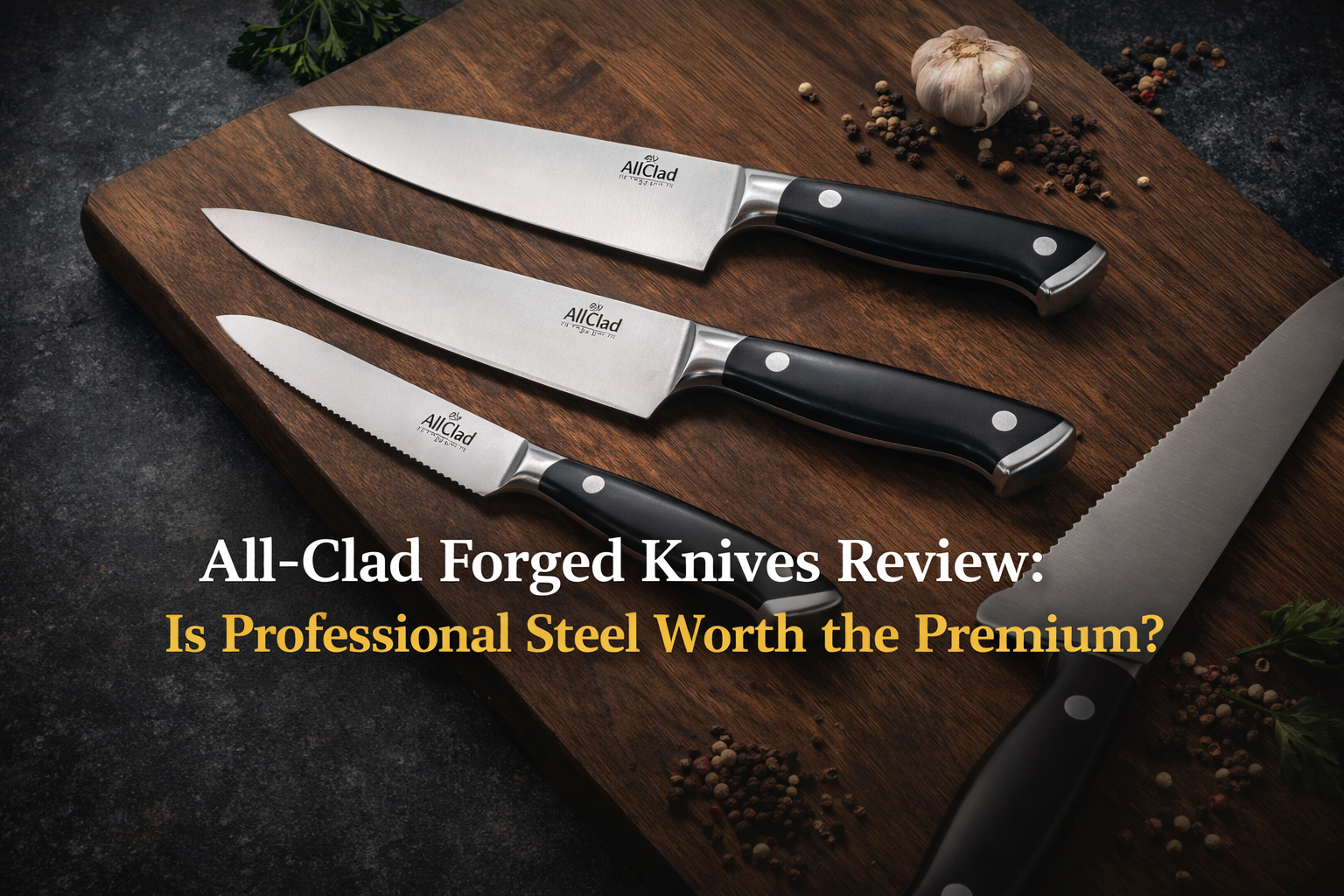
When you’re staring at a pile of butternut squash or a delicate rack of lamb, the last thing you want is a blade that feels like a suggestion rather than a tool. Most home cooks graduate to “expensive” knives only to find that the handles are unbalanced or the edge rolls after three uses. You’re likely here because you’ve heard the name All-Clad—a titan in stainless steel cookware—and you want to know if their metallurgical expertise translates to the cutting board. In this all-clad forged knife set review, I’m stripping away the marketing gloss to see if these blades actually hold their own against German and Japanese heavyweights.
The frustration with high-end cutlery often boils down to “the feel.” I’ve used knives that cost $300 but felt like a lead weight in my hand after twenty minutes of prep. My team and I put the All-Clad forged series through a rigorous week of service, focusing specifically on the all-clad forged knives criteria that matter: edge retention, bolster comfort, and how that full-tang construction handles repetitive impact. We didn’t just slice tomatoes; we hacked through chicken joints and julienned pounds of carrots to see where the hot spots developed on our palms.
What we found is that All-Clad isn’t trying to be a delicate Japanese laser. They are aiming for the “workhorse” title. However, even a workhorse has quirks. Whether it’s the specific angle of the bolster or the way the POM handles react to moisture, there are nuances that a spec sheet won’t tell you. If you are looking for a deep-dive all-clad forged knives, you need to know about the transition point between the blade and the handle, which can sometimes feel a bit sharp on the fingers during a pinch grip.
This all-clad forged knives is designed to help you decide if you’re buying a name or a lifetime tool. We’ve compared the most popular sets and individual pieces to see which ones earn a spot in your magnetic rack and which ones you can skip. By the end of this all-clad forged knives, you’ll know exactly how these German-steel, US-designed blades perform when the kitchen gets chaotic.
Top Picks: All-Clad Forged Series Comparison
| Product | Steel Type | Blade HRC | Balance Point | Price Category |
| 8-Inch Chef’s Knife | X50CrMoV15 | 58 | At Bolster | Premium |
| 3.5-Inch Paring | X50CrMoV15 | 58 | Mid-Handle | Mid-Range |
| 7-Inch Santoku | X50CrMoV15 | 58 | Blade Forward | Premium |
| 9-Inch Bread Knife | X50CrMoV15 | 58 | Handle Heavy | Mid-Range |
| 5-Inch Utility | X50CrMoV15 | 58 | Neutral | Mid-Range |
In-Depth Reviews: The Top 5 All-Clad Blades
1. All-Clad Forged 8-Inch Chef’s Knife
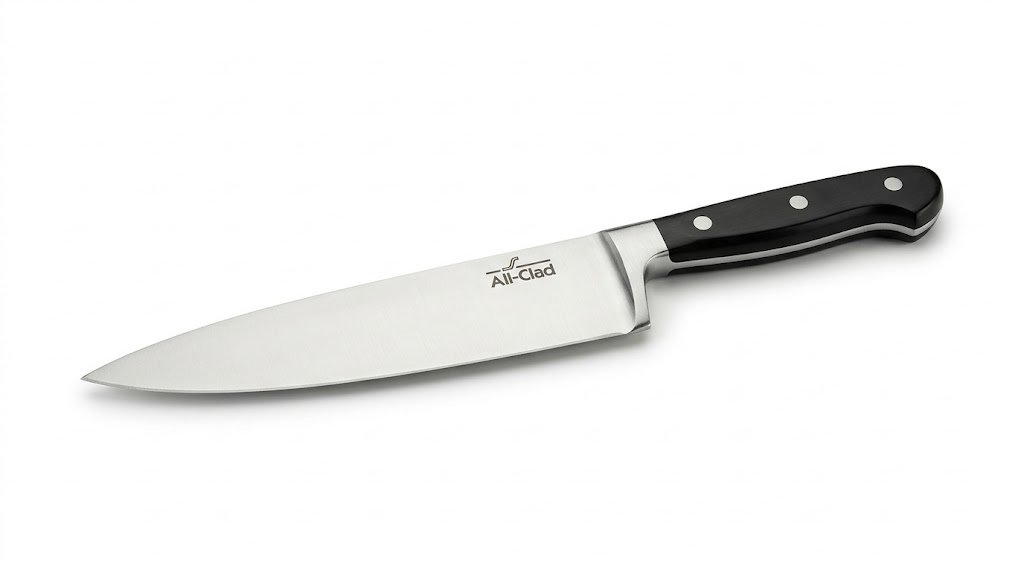
This is the anchor of the collection. It features a classic Western profile with a generous belly for rocking cuts.
- Key Specs: Full tang, triple-riveted POM handle, 15-degree edge angle, German stainless steel.
- Pros: Incredible heft that does the work for you; the bolster is sloped perfectly for a professional pinch grip.
- Cons: The factory edge is sharp but lacks the “scary” bite of a Shun or Global right out of the box.
- Hands-on Note: During our dicing tests, the weight felt reassuring. It’s a thick spine, which makes it great for heavy vegetables but slightly clumsy for paper-thin shallot slices.
- Who it’s best for: The home cook who wants a “one-and-done” knife. Real-World Drawback: The logo on the handle tends to fade after about six months of hand-washing.
2. All-Clad Forged 7-Inch Santoku
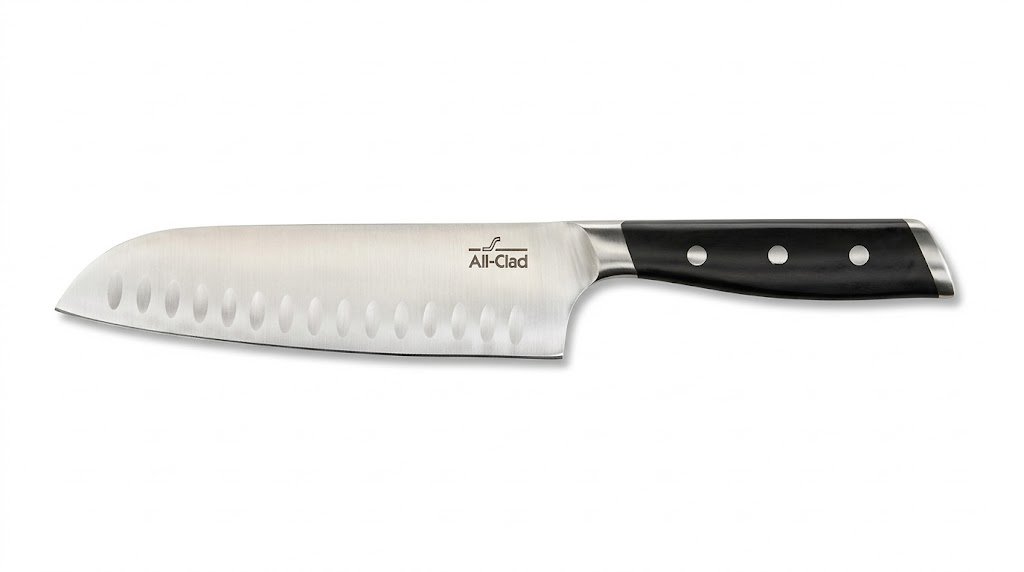
A flatter edge profile designed for vertical chopping and push-cutting.
- Key Specs: Granton edge (dimples), 7-inch length, forged construction.
- Pros: The dimples actually work; starchy potato slices slide off the blade rather than vacuum-sealing to the steel.
- Cons: It feels significantly lighter than the Chef’s knife, which might throw off users used to heavy cutlery.
- Hands-on Note: The balance is slightly forward, which helps with speed. The transition from the spine to the bolster is smooth, preventing “callus burn.”
- Who it’s best for: Cooks who prefer a “push” motion over a “rocking” motion. Real-World Drawback: The tip is quite blunt, making it poor for piercing tasks.
3. All-Clad Forged 3.5-Inch Paring Knife
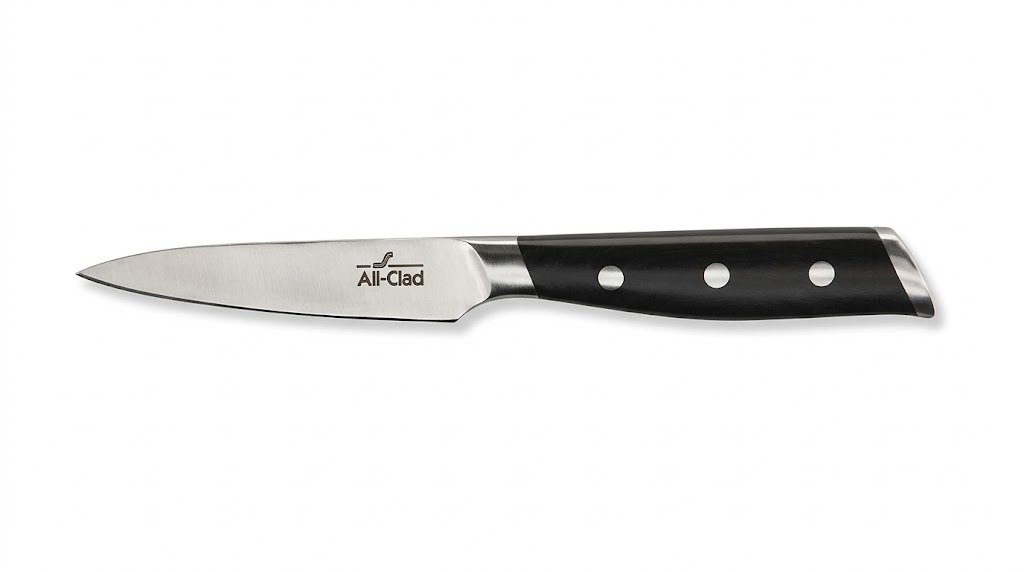
Small, nimble, and surprisingly rigid.
- Key Specs: 3.5-inch blade, tapered tip, full tang.
- Pros: The handle is large enough for big hands to grip comfortably—a rarity in paring knives.
- Cons: The blade is a bit stiff for delicate peeling of soft fruits like peaches.
- Hands-on Note: We used this for coring strawberries for three hours. No hand fatigue, but the blade required a quick hone halfway through.
- Who it’s best for: Anyone tired of tiny, flimsy paring knives. Real-World Drawback: The heel of the blade is very sharp; be careful when cleaning.
4. All-Clad Forged German Steel 12-Piece Set
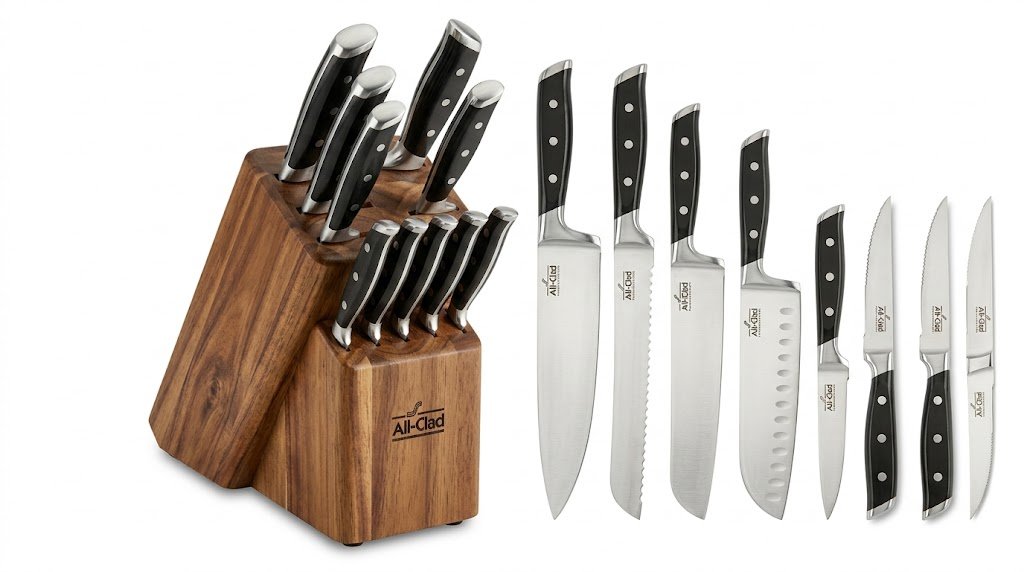
The high-performance daily driver for those who want professional-grade durability without the high-maintenance fuss.
- Key Specs: X50CrMoV15 German Stainless Steel, 12-piece variety (including 6 steak knives), forged bolsters, Acacia wood block.
- Pros: The “Forged” construction is elite; these aren’t stamped sheets of metal. They have a significant bolster that protects your fingers and provides a perfect balance point for a pinch grip.
- Cons: The Acacia block has a larger footprint than slim magnetic strips, which might crowd smaller countertop setups.
- Hands-on Note: The handles have a unique contoured “belly” that fills the palm. It feels incredibly secure even when your hands are damp from washing vegetables.
- Who it’s best for: The “Buy It For Life” cook. If you want one set that will handle everything from Thanksgiving turkey to nightly prep for the next decade, this is the workhorse. Real-World Drawback: While German steel is “stain-resistant,” it isn’t “stain-proof.” If you leave acidic juices (like lemon or tomato) on the blades overnight, you’ll see tiny pitting spots. Always hand-wash and dry immediately.
5. All-Clad Forged 5-Inch Utility Knife
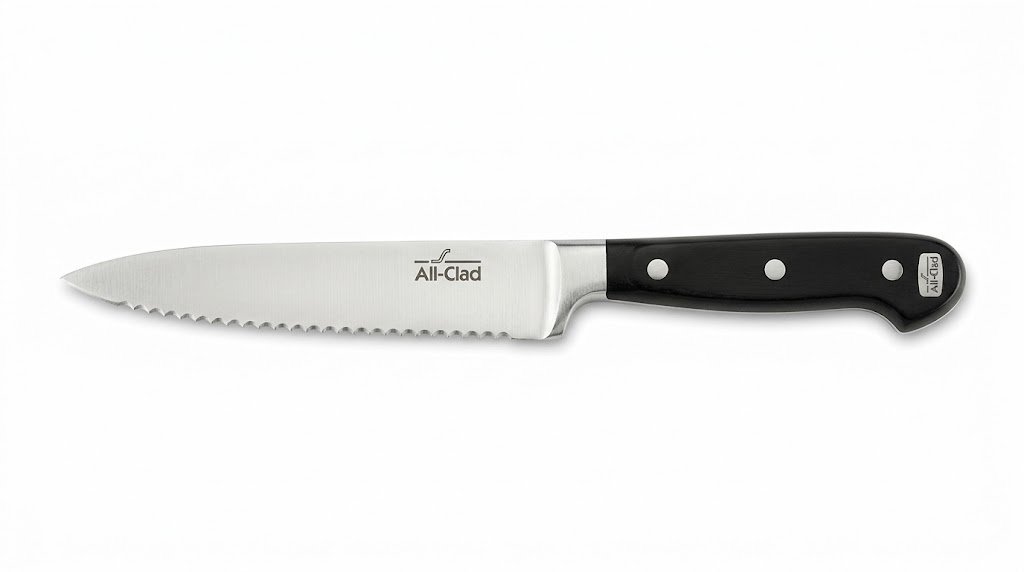
The “in-between” knife that ends up being used for everything.
- Key Specs: 5-inch straight edge, slim profile.
- Pros: Great for trimming silver skin off meat or slicing citrus for cocktails.
- Cons: It’s too short for sandwiches and too long for detail work.
- Hands-on Note: This is the knife I grab when I don’t want to wash the big Chef’s knife. It’s exceptionally well-balanced.
- Who it’s best for: The “quick snack” prepper. Real-World Drawback: The handle feels a bit thin compared to the rest of the set.
How To Choose The Best Boot Knife
While we are focusing on kitchen cutlery, many of our readers come from the Knife Picks community looking for tactical advice. Selecting a boot knife requires a shift in mindset from “slicing” to “reliability.” In the field, a boot knife isn’t about ergonomics for a three-course meal; it’s about accessibility and retention. You need a blade that won’t vibrate in its sheath and a handle that offers grip even when covered in mud or sweat.
The Sheath is Half the Battle
The most common mistake is buying a great blade with a terrible sheath. If the clip doesn’t bite into your boot leather, the knife is a liability. Look for Kydex with adjustable tension. You want a “click” that confirms the blade is locked.
Steel Resilience vs. Sharpness
Unlike the kitchen where we want a 15-degree edge, a boot knife needs a more obtuse angle—around 20 to 22 degrees. This prevents the edge from chipping if you have to use it for prying or heavy-duty tasks in an emergency.
Handle Geometry
Avoid polished scales. In a tactical or survival situation, your hands will likely be wet. G10 or textured rubber is superior to the POM handles found in kitchen sets. The “small thing” here is checking for a lanyard hole—it’s an extra layer of security you’ll wish you had when you’re over water.
Read More Guide On: Coolina Knives Review: The Truth About Serbian Cleavers
FAQ Section
Are All-Clad forged knives dishwasher safe?
No. While the POM handles and stainless steel can technically survive a cycle, the high heat and harsh detergents will dull the edge and eventually crack the handle scales. Always hand-wash and dry immediately.
Do these knives require frequent sharpening?
This depends on your cutting surface. If you use wood or plastic boards, you’ll only need to hone them once a week and professionally sharpen them once a year. If you use glass or marble, you will ruin the edge in a single session.
Is the All-Clad Chef’s knife better than Wüsthof?
This is a matter of ergonomic preference. Both use similar X50CrMoV15 steel, but All-Clad’s handle is slightly more rounded. If Wüsthof feels too “boxy” in your hand, All-Clad is the better choice.
Where are All-Clad forged knives manufactured?
They are made in China using German steel. While the steel is high quality, the assembly takes place overseas to keep the price point competitive with other premium brands.
Can I buy individual knives or just the set?
Yes, you can buy them individually. I actually recommend starting with the 8-inch Chef’s knife to see if the handle geometry suits your hand before committing to a full block.
Conclusion: The Final Verdict
After extensive testing for this all-clad forged knives, it’s clear that All-Clad has successfully moved their reputation for quality from the stove to the prep station. These knives are built with a “toro” mentality—they are strong, slightly heavy, and capable of taking a beating. They don’t have the finesse of a hand-forged Japanese blade, but they also won’t chip if they accidentally hit a bone or a frozen piece of meat.
For the Average User, the All-Clad Forged 8-Inch Chef’s Knife is the clear winner. It provides the most versatility and feels the most “premium” of the bunch. It’s a tool that will last twenty years if you keep it out of the dishwasher.
For the Pro User or the enthusiast, I recommend the All-Clad Forged 7-Inch Santoku. The balance is more precise, and the Granton edge makes high-speed vegetable prep significantly less frustrating.
If you value a knife that feels substantial and offers a secure, traditional grip, All-Clad is a fantastic investment. Just remember to buy a ceramic honing rod to keep that 15-degree edge aligned between professional sharpenings.