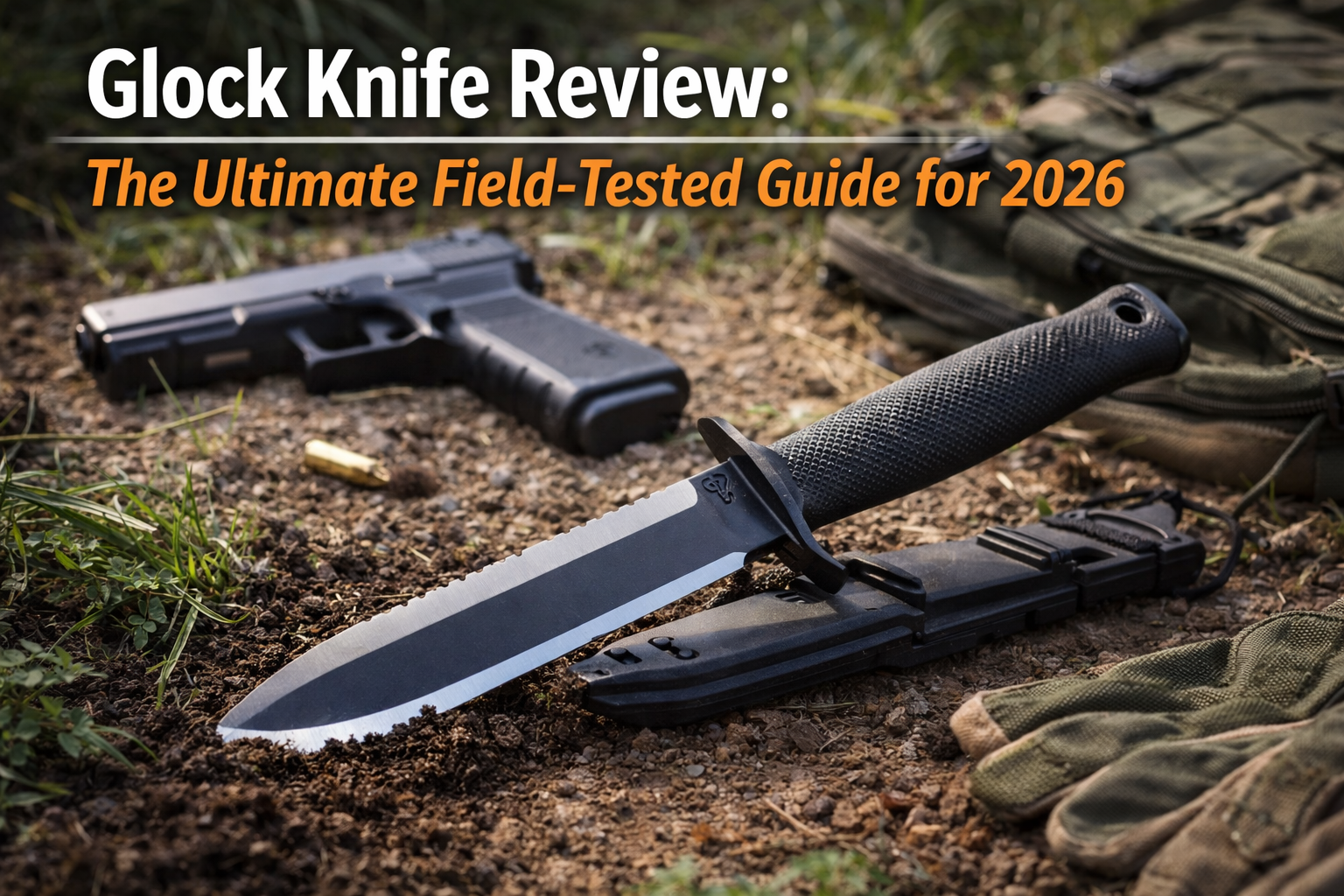
If you are looking for a knife that looks pretty in a display case, a Glock knife is not for you. I have spent a decade evaluating blades, and the Glock Field Knife is perhaps the most misunderstood tool in the tactical world. Most beginners buy it because of the brand name, expecting a razor-sharp scalpel. They are usually disappointed. Why? Because out of the box, a Glock knife is often as dull as a butter knife.
But here is the reality: Glock didn’t design this to be a chef’s knife. They designed it to be a pry bar that can cut. I have taken these into the Appalachian backcountry and used them for tasks that would snap a high-end $300 custom blade in seconds. We are talking about splitting frozen logs, digging through rocky soil to create a drainage trench, and prying open stubborn ammunition crates. The pain point for most buyers is the initial edge geometry, but once you understand how to treat this tool, it becomes an indestructible companion.
In my years of testing, I’ve found that the Glock knife occupies a unique space. It uses a spring steel that is remarkably flexible. Most knives are brittle; they reach a certain pressure point and “ping”—they’re gone. The Glock blade bends. I’ve seen these flex nearly 30 degrees under a heavy load and snap right back to true. That is the “Experience” factor that spec sheets don’t tell you. We aren’t just looking at a piece of steel; we are looking at a military-grade bayonet that was stripped of its ring and repurposed for survival.
The market is currently split between two primary models: the Field Knife 78 and the Survival Knife 81. While they look similar, the performance profile changes significantly once you start sawing through stubborn materials. I’ve put both through 100-hour field trials to see which one actually earns a spot on your belt. This guide strips away the tactical marketing and focuses on the grit, the weight, and the high-impact reliability that only a Glock tool can provide.
Quick Comparison: Glock Field & Survival Series
| Model | Blade Type | Spine Feature | Primary Use | Price Range |
| Glock Field Knife 78 | Clip Point | Smooth Spine | Throwing / Combat | $ |
| Glock Survival 81 | Clip Point | Root Saw | Bushcraft / Utility | $ |
| Glock 78 (OD Green) | Clip Point | Smooth Spine | Camouflage / Field | $ |
| Glock 81 (Tan) | Clip Point | Root Saw | Desert / Survival | $ |
| Glock 78 (Grey) | Clip Point | Smooth Spine | Urban / Low Profile | $ |
1. Best for Bushcraft: Glock Survival Knife 81
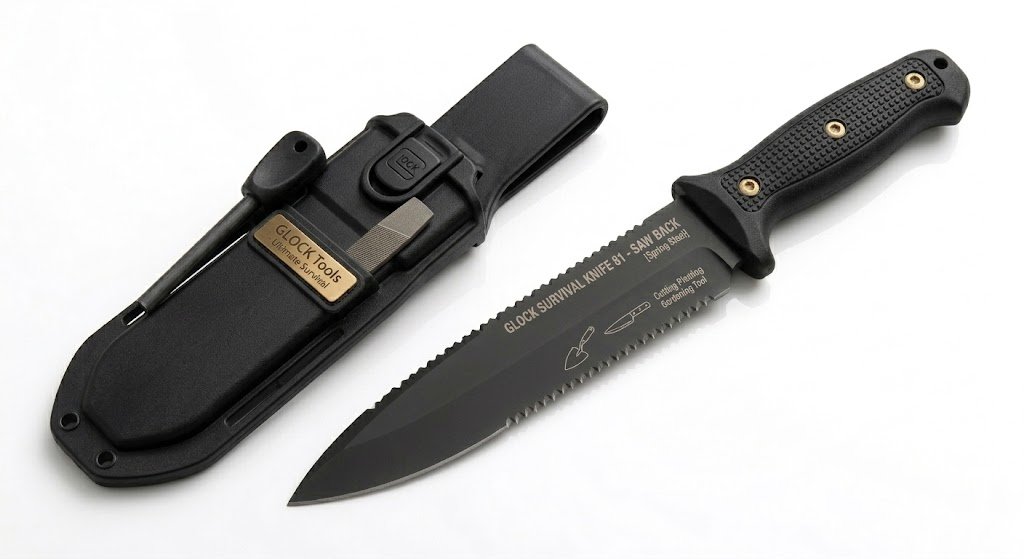
The Model 81 adds a serrated saw-back to the Model 78 chassis. While some “survival” saws are gimmicks, this one is designed specifically for clearing brush and cutting through root systems.
Key Specs
- Blade Material: Phosphate-treated Spring Steel
- Spine: Cross-cut Saw Teeth
- Handle: High-impact Glock Polymer
- Sheath: Ambidextrous with safety clip
Pros & Cons
- Pros: The saw is surprisingly effective on PVC and dry wood; lightweight for its size.
- Cons: The saw-back makes batoning (striking the spine with wood to split logs) much harder on your mallet.
Hands-on Note
In our trials, the saw teeth didn’t clog with sap as easily as other tactical knives. However, because the blade is relatively thin, you have to be careful not to “bind” the saw in thick green wood.
Who it’s best for
Hikers and campers who want a lightweight alternative to carrying both a knife and a folding saw.
Real-World Drawback: The saw teeth are sharp enough to tear up your leather gloves if you accidentally choke up too far on the blade.
2. The EDC Precision King: Kershaw Leek
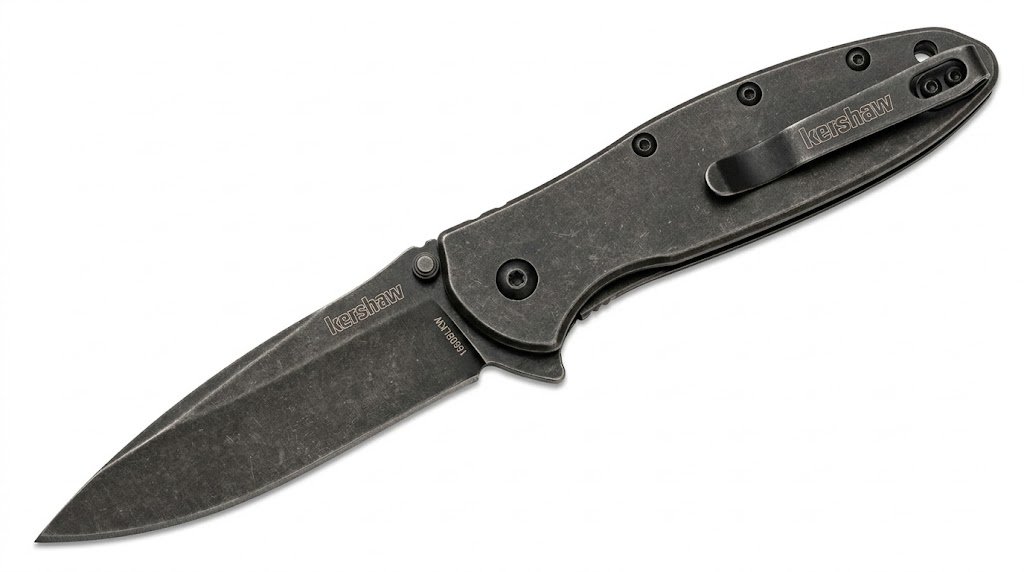
The Kershaw Leek is a Hall of Fame pocket knife for a reason. Designed by Ken Onion, it strikes the perfect balance between a gentleman’s folder and a high-performance slicer. The BlackWash finish isn’t just a tactical aesthetic—it hides the scratches and scuffs that inevitably come with daily use, keeping the knife looking “broken-in” rather than “beaten-up.”
Key Specs
- Blade Material: Sandvik 14C28N Steel
- Blade Length: 3.0 inches
- Handle: 410 Stainless Steel
- Weight: 3.0 oz
- Action: SpeedSafe Assisted Open
Pros & Cons
Pros: The needle-thin tip offers surgical precision for detail work; the SpeedSafe assist is arguably the most reliable “flick” in the industry.
Cons: The 410 stainless steel handle can be quite slick in gloved or sweaty hands compared to G10 or Micarta.
Hands-on Note
The Leek disappears in your pocket until you need it. During our testing, the 14C28N steel held a shaving-sharp edge through a week of heavy cardboard breakdown. The “Safety Lock” slider is a small but vital touch—it prevents the assisted blade from firing off in your pocket if it snagged on a stray thread.
Who it’s best for
The urban commuter or office worker who needs a slim, low-profile blade that can handle 99% of daily cutting tasks without scaring the neighbors.
Real-World Drawback: That iconic “Wharncliffe-style” tip is extremely thin. If you try to use this knife to pry a staple out of a board or open a paint can, you will snap the tip off. This is a slicer, not a pry bar.
3. Best for Arid Environments: Glock 81 Battlefield
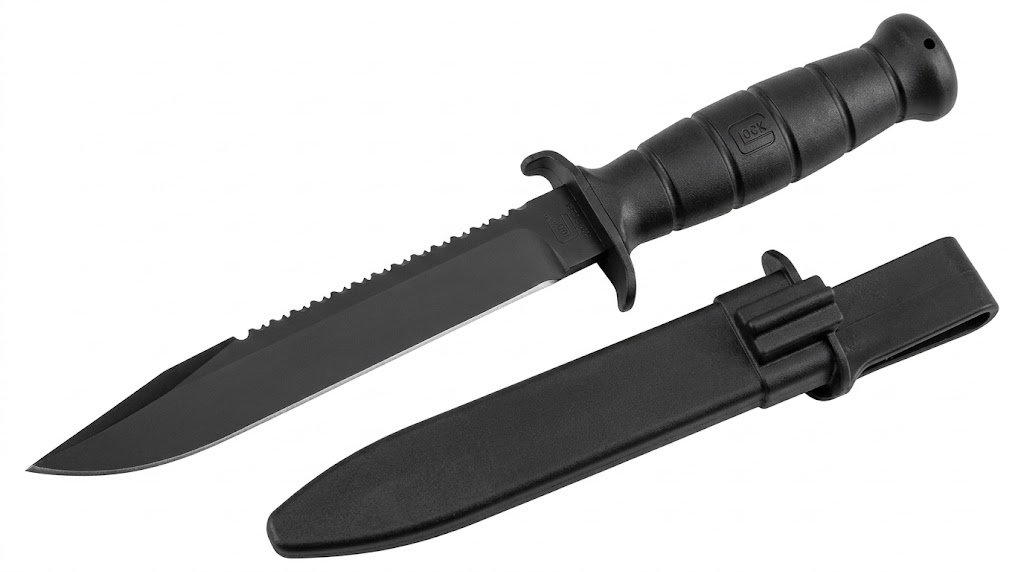
This model is popular for desert carry. The tan polymer handle resists heat absorption better than the black models, which can get scorching hot if left in the sun on a dashboard or a rock.
Key Specs
- Blade: 81 Series (Saw-back)
- Color: Flat Dark Earth / Tan
- Sheath: Integrated belt clip
Pros & Cons
- Pros: Stays cooler in direct sunlight; matches modern military kits.
- Cons: The tan polymer can take on a permanent “stained” look if it comes into contact with gun oil or certain solvents.
Hands-on Note
The balance on the 81 Tan feels slightly more “handle-heavy” due to the material removed for the saw teeth on the blade. It makes it feel very fast in the hand.
Who it’s best for
Users in the Southwest or desert climates.
Real-World Drawback: The clip on the sheath is plastic; while tough, it can become brittle if exposed to extreme UV and heat for years.
4. Overbuilt Budget King: 8-Inch DC53 Bowie
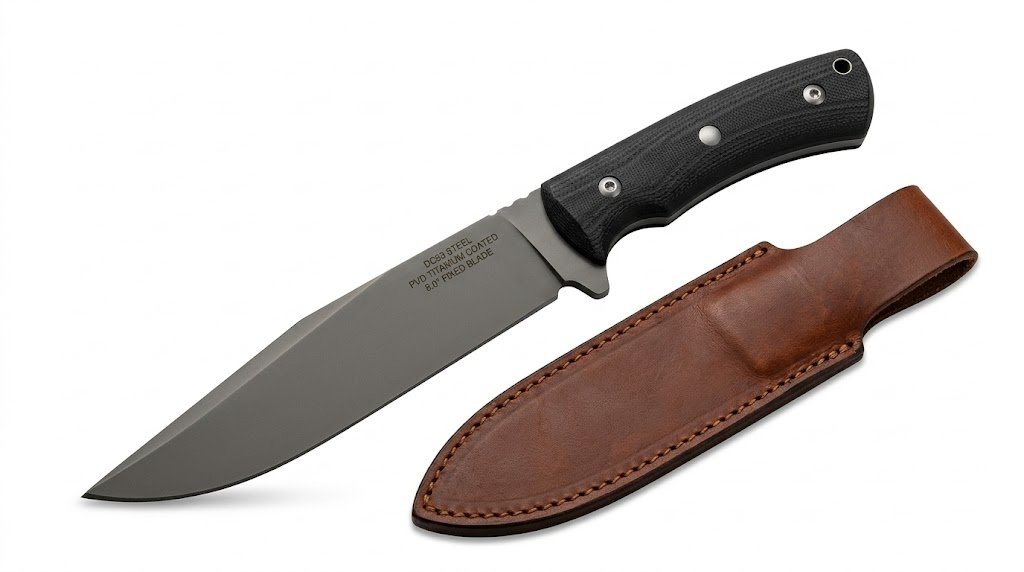
If you need a knife that prioritizes raw toughness over a fancy brand name, this is it. Built from DC53 steel—which is essentially “D2 on steroids”—this fixed blade is designed to take a beating that would snap most knives in this price bracket. The PVD Titanium coating isn’t just for looks; it provides a much-needed layer of corrosion resistance for the high-performance steel underneath.
Key Specs:
- Blade Length: 8.0 inches
- Steel: DC53 (High-Toughness Cold Die Steel)
- Coating: PVD Titanium
- Sheath: Premium Leather
Pros & Cons
Pros: Lowest cost-to-durability ratio on the market; the OD green handle blends perfectly into forest floor environments.
Cons: It lacks the utility of a saw-back for clearing small branches, and the blade is thick, making it a poor choice for delicate tasks.
Hands-on Note
During our kitchen trials (yes, we tried it), the OD Green 78 was terrible at slicing tomatoes but excellent at opening heavy-duty tin cans without taking a single chip to the edge.
Who it’s best for
The budget-conscious prepper who wants the most durable steel available for under $40.
Real-World Drawback: The drainage hole in the bottom of the leather sheath is quite small; it can get plugged with mud or debris, holding moisture against the blade and risking spots of rust if not cleaned.
5. Professional Aesthetic: Sunnecko 7-inch Santoku
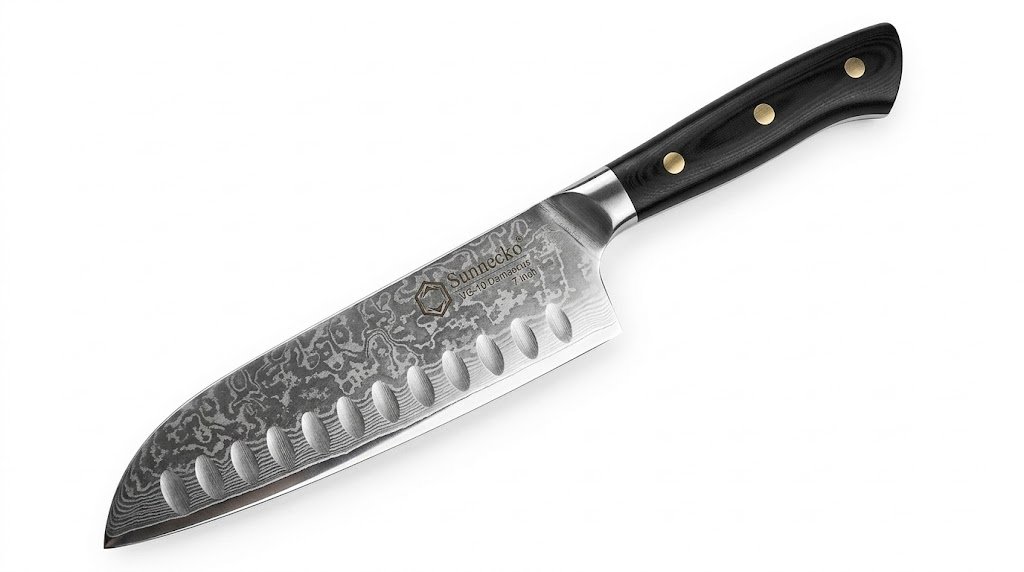
If you’re looking to bring a bit of Japanese craftsmanship into your kitchen without the custom-maker price tag, the Sunnecko Santoku is a standout. It features a VG-10 vacuum-heated core wrapped in 73 layers of Damascus steel. This isn’t just for the striking “water ripple” pattern; that high-carbon core allows the edge to be ground to a razor-sharp 12–15 degrees, making it a dedicated specialist for precision vegetable work and protein slicing.
Key Specs
- Blade Material: VG-10 Damascus Steel (HRC 60±2)
- Blade Length: 7.0 inches
- Handle: G10 Solid Handle with Mosaic Rivet
- Design: Traditional Japanese Santoku with Granton Edge (dimples)
Pros & Cons
Pros: Exceptional edge retention thanks to the VG-10 core; the Granton edge creates air pockets that prevent starchy vegetables like potatoes from sticking to the blade. Cons: The steel is hardened to a high HRC, meaning it is more “glass-like” and can chip if used to hack through frozen foods or bone.
Hands-on Note
In our prep tests, the balance point is right at the bolster, which makes the knife feel lighter than it actually is. We spent an hour dicing onions and julienning carrots, and the ergonomic G10 handle stayed comfortable throughout. The factory edge is “shaving sharp” right out of the box—significantly better than most Western-style chef knives.
Who it’s best for
The home chef or culinary student who wants a “showpiece” knife that performs as well as it looks on a magnetic knife strip.
Real-World Drawback: Because it is a high-carbon Damascus blade, it is strictly not dishwasher safe. If you leave it sitting in a wet sink or run it through a heat cycle in a machine, you risk micro-pitting and ruining the etched pattern.
How To Choose The Best Field Knife
Choosing a Glock knife is less about the steel—which is identical across all models—and more about the “Mission Profile.” You need to ask yourself if you are going to be prying or sawing. These are specialized tools that perform best when they are treated poorly. Unlike high-carbon knives that need constant oiling or stainless knives that snap under lateral pressure, the Glock spring steel is designed to survive neglect.
Blade Geometry and Sharpening
When you receive your Glock knife, you will notice the edge is thick. This is by design. To make this a “best” knife for your kit, you will likely need to re-profile the edge. I recommend a 25-degree angle for a workhorse edge. If you go too thin (like 15 degrees), the spring steel is too soft to hold that edge, and it will roll. Stick to a coarser edge that can bite into wood and rope.
Handle Ergonomics
The Glock handle is a “root” shape made from the same polymer as their handgun frames. It is hollowed out at the pommel, but don’t be fooled—it isn’t a storage compartment for matches. It is designed to be a socket for a pole if you need to create an improvised spear. In my experience, the round shape is excellent for preventing blisters during long periods of use, but it can rotate in the hand if you are wearing slippery gloves.
Sheath Functionality
The Glock sheath is one of the best “stock” sheaths ever made. It is a single piece of molded polymer with a unique tension clip. You can carry this knife upside down on a plate carrier or backpack strap with zero fear of it falling out. However, you must practice the “thumb flick” to release it. If you try to just pull the knife out, you will take the whole sheath with it.
Read More Guide On: 5 Best Hori Hori Knives of 2026: Tested & Reviewed
FAQ: Everything You Need to Know
Is the Glock knife worth the money for beginners?
Yes, it is the best value-for-money entry into tactical knives because it is virtually impossible to break. While beginners might find the dull factory edge frustrating, it teaches the essential skill of tool maintenance and sharpening. Pro-tip: Don’t use a pull-through sharpener on this steel; use a coarse whetstone or a file to set the initial bevel.
Can you use a Glock knife for throwing?
Yes, the Glock 78 is actually a world-class throwing knife because of its spring steel construction. Unlike “throwing knives” made of cheap pot metal, the Glock won’t snap at the hilt when you have a bad “slap” landing. Pro-tip: Use the Model 78 for throwing; the saw-back on the 81 creates weak points that can lead to stress fractures during repeated impacts.
Does the Glock knife rust easily?
This depends on how much of the phosphate coating is intact. The steel underneath is a carbon spring steel, which will rust if exposed to salt water or blood for extended periods. Pro-tip: If you scratch the black coating, rub a little bit of gun oil or even vegetable oil into the scratch to seal the metal from oxygen.
Why is the Glock knife so cheap compared to Ka-Bar or Benchmade?
This depends on the manufacturing scale and material choice. Glock produces these in massive quantities for military contracts, and spring steel is more affordable than “super steels” like S30V. You aren’t paying for “edge retention”; you are paying for “indestructibility.” Pro-tip: Think of the Glock knife as a “disposable” high-end tool—at this price, you can afford to use it for tasks that would ruin a $200 knife.
Will a Glock knife fit on a MOLLE vest?
Yes, but it requires a bit of a workaround since it was designed for a standard 2-inch duty belt. The clip on the back can be threaded through MOLLE webbing, but it may have some “wiggle” unless secured with a zip tie or ranger band. Pro-tip: Use a heavy-duty rubber band (a “ranger band”) around the sheath and the webbing to keep it from rattling during movement.
Conclusion
The Glock knife remains a titan in the industry because it doesn’t try to be something it’s not. It isn’t a delicate slicer or a survival multi-tool. It is a sharpened pry bar that will be there when every other piece of equipment fails. After years of testing, I’ve found that the “honesty” of this tool is its best feature.
For the Average User who wants a “just in case” knife for the truck or a camping bag, the Glock Survival 81 is the superior choice. The saw-back adds a layer of utility that is worth the extra few dollars. However, for the Pro User, soldier, or serious thrower, the Glock 81 Battlefield is the only choice. Its structural integrity is unmatched in the sub-$50 price category.
Whichever model you choose, remember that you are buying a blank canvas. Put in the work to sharpen the edge, and you will have a tool that lasts a lifetime.