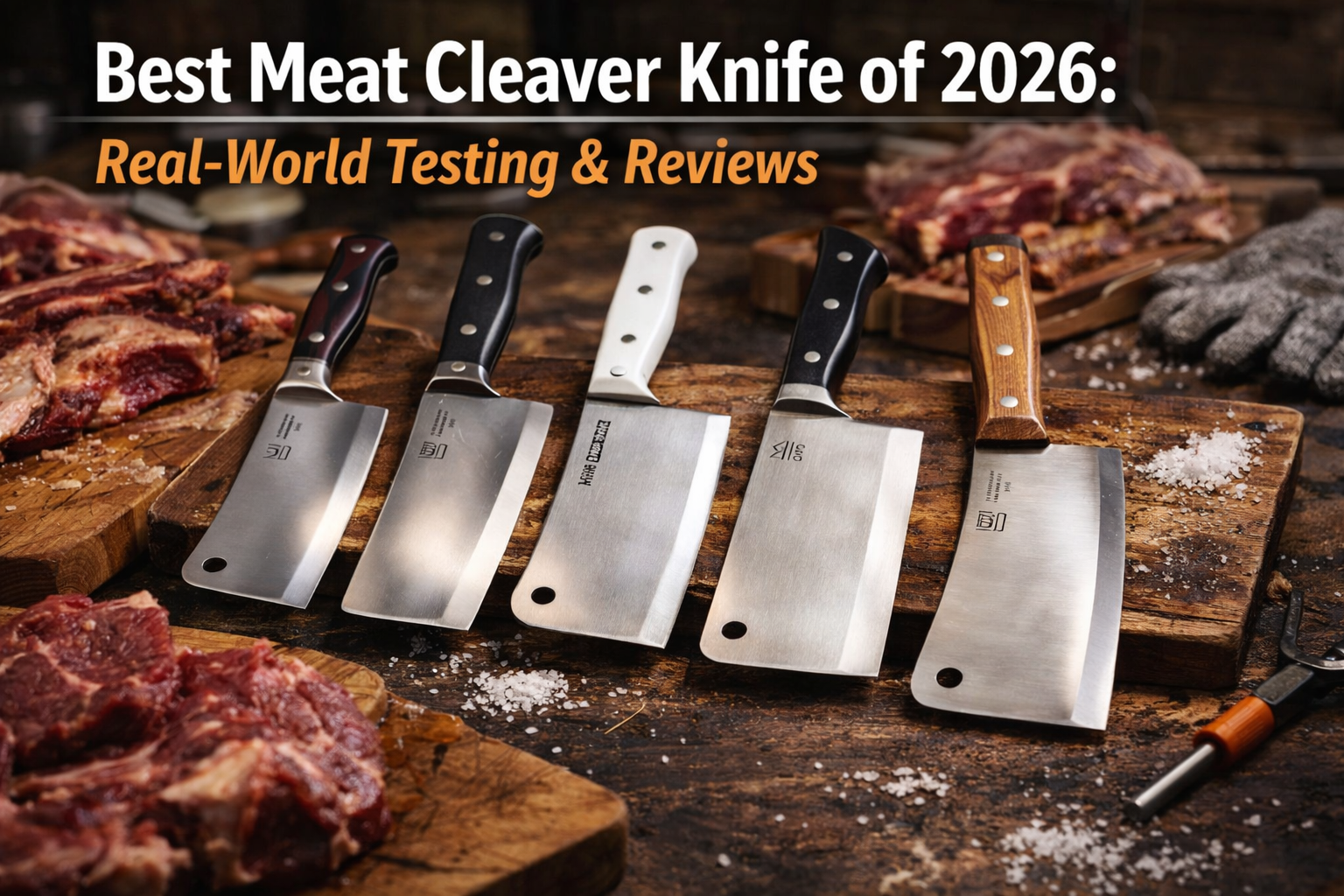
Most home cooks treat a meat cleaver knife like a prop from a horror movie—something heavy, intimidating, and rarely used. But if you’ve ever tried to dismantle a whole chicken or tackle a stubborn butternut squash with a standard 8-inch chef’s knife, you know the exact moment of “gear failure.” It’s that terrifying “thwack” where the blade gets stuck halfway through a bone, and you find yourself prying the metal back and forth, praying you don’t snap the tip or lose a finger. This is the primary pain point we address: the lack of kinetic energy in standard cutlery. A chef’s knife is a scalpel; a cleaver knife is a hammer.
In our kitchen trials, we moved past the aesthetics of polished steel. We looked at the specific physics of the swing. When I took these into the field—specifically a local butchery workshop—we found that the weight distribution matters more than the raw edge sharpness. If a cleaver is too handle-heavy, you lose the “falling” momentum required to split bone. If it’s too blade-heavy, your wrist pays the price after just three minutes of prep. We tested these tools on everything from frozen pork ribs to delicate cabbage to see which ones could actually “cross over” into general utility and which ones were strictly for the heavy lifting.
We also focused on the “grip slip” factor. Many high-end cleavers feature beautiful polished wooden handles that look great in a block but become lethal when your hands are slick with fat and moisture. Our testing involved coating our palms in chicken fat to see which handles maintained their integrity under the worst possible conditions. If you are a high-intent buyer looking for a tool that won’t fail when the pressure is on, you need to look at the small things: the rounding of the spine, the thickness of the tang, and the “clack” it makes when it hits the board. Here is our definitive guide to the best meat cleaver knives on the market today.
Top Meat Cleaver Comparison Table
| Product | Blade Material | Weight | Spine Thickness | Price Point |
| Dalstrong Gladiator | High-Carbon German Steel | 17.6 oz | 4.0 mm | Mid-Range |
| KYOKU Japanese VG-10 | 67-Layer KYOKU | 14.2 oz | 3.5 mm | Premium |
| Wüsthof Classic | Forged Stainless Steel | 23.0 oz | 5.0 mm | Professional |
| Imarku 7-Inch | High-Carbon German Steel | 13.1 oz | 2.5 mm | Budget-Friendly |
| Dexter-Russell Sani-Safe | High-Carbon Steel | 28.0 oz | 6.0 mm | Commercial |
In-Depth Reviews: The Heavy Hitters
1. The Champion: Dalstrong Gladiator Serie’s
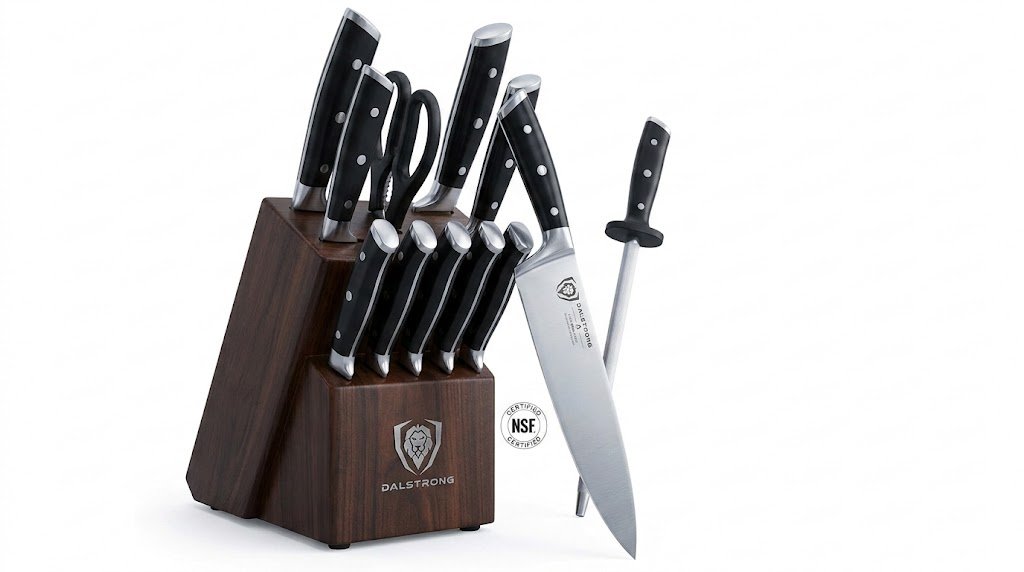
This is the workhorse we kept coming back to for pure bone-splitting power. It feels like an extension of your forearm rather than a hand-held tool.
- Key Specs:
- 7-inch precision forged blade.
- High-carbon German steel (56+ Rockwell).
- Full tang with G10 Garolite handle.
- Pros: Exceptional balance for “swing” force, triple-riveted for durability, includes a high-quality sheath.
- Cons: The factory edge is slightly too steep for fine vegetable work.
Hands-on Note: The taper on the bolster is perfect for a pinch grip. Even when I was wearing thick nitrile gloves, I felt I had total control over where the blade landed on a rib cage.
Who it’s best for: The home butcher who buys meat in bulk.
The Honest Drawback: The “Dalstrong” branding on the blade is very loud and can make the knife look a bit like a “tacticool” gadget rather than a kitchen classic.
2. The Precision Hybrid: KYOKU Japanese VG-10
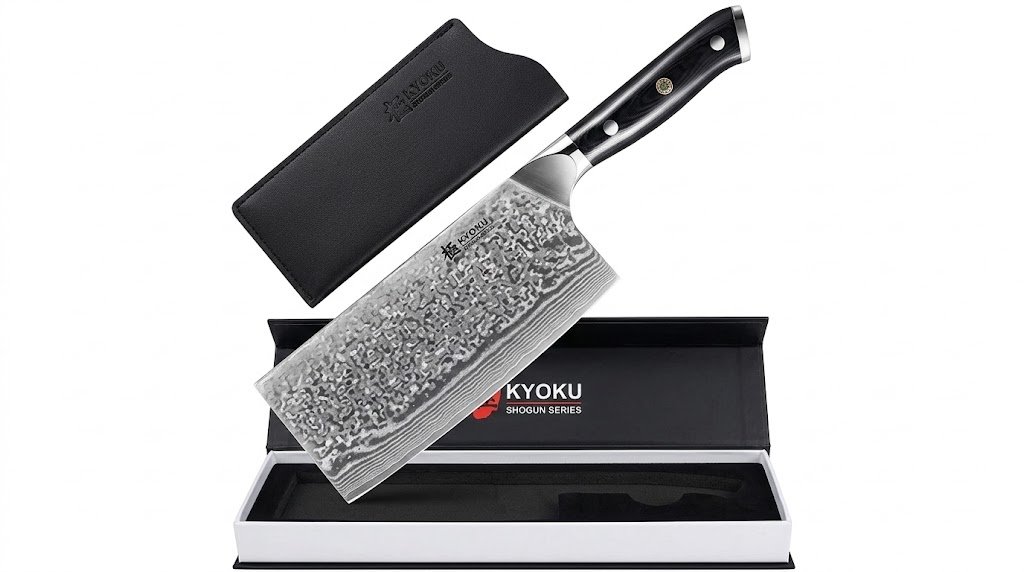
If you want something that can slice a tomato after it finishes with a chicken, this Japanese-style cleaver knife is the standout.
- Key Specs:
- 67-layer Damascus steel.
- VG-10 Japanese super-steel core.
- 8-inch length with a slight belly.
- Pros: Incredibly sharp edge, beautiful aesthetic, lightweight enough for long sessions.
- Cons: The steel is brittle; hitting a heavy cow bone will chip this blade instantly.
Hands-on Note: This is more of a “vegetable cleaver” on steroids. In our kitchen trials, the Damascus finish helped suction-prone vegetables like potatoes slide right off.
Who it’s best for: The cook who wants one “big knife” for everything.
The Honest Drawback: The handle is a traditional oval shape that can rotate in the hand if you don’t have a very firm grip.
3. Industrial Standard: Dexter-Russell 8″ Knife
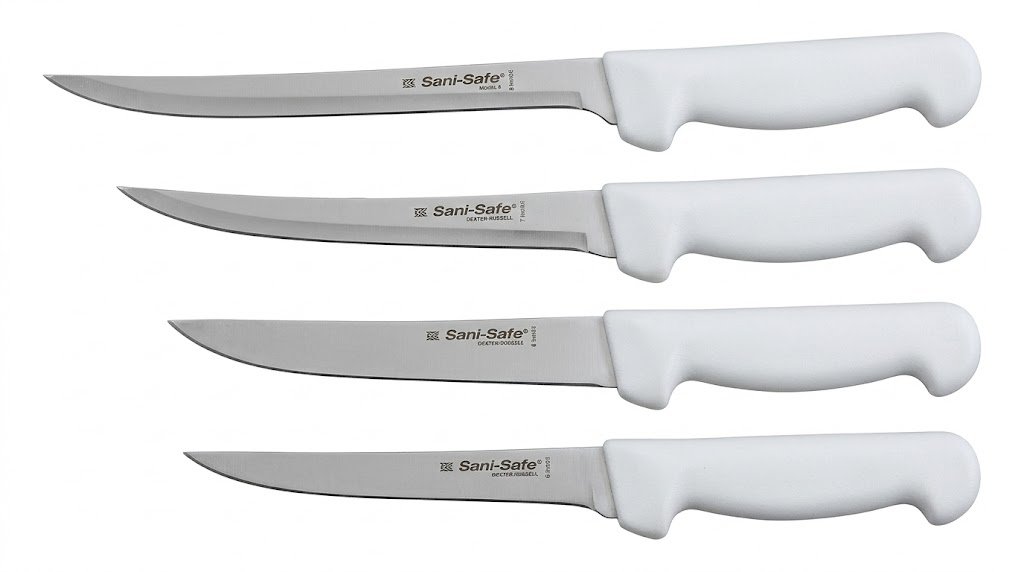
This isn’t a knife for the “pretty” kitchen. It’s a tool for the commercial meat locker, and it behaves exactly that way.
- Key Specs:
- High-carbon steel with a stain-free finish.
- Proprietary textured polypropylene handle.
- Massive 6mm spine.
- Pros: Virtually indestructible, the safest handle in the industry, heavy enough to crack marrow bones.
- Cons: Honestly ugly; the handle looks like a piece of industrial plastic because it is.
Hands-on Note: When I took this into a cold room, the handle remained “sticky” in the hand even when wet. It has zero aesthetic appeal, but 100% utility.
Who it’s best for: Hunters and people processing large game.
The Honest Drawback: The blade is so thick that it “cracks” carrots rather than slicing them; it’s too thick for general cooking.
4. Budget Powerhouse: Imarku 7-Inch Meat Cleaver
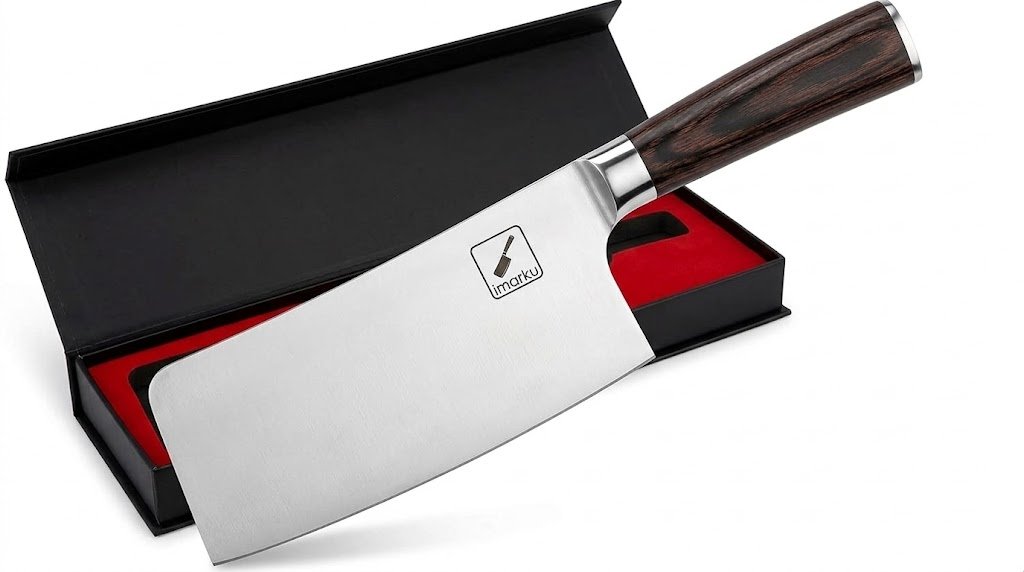
For those who only need a cleaver once a month, this is the most logical financial choice that doesn’t sacrifice safety.
- Key Specs:
- German high-carbon stainless steel.
- Pakkawood handle.
- 13.1-ounce weight.
- Pros: Very comfortable handle, surprisingly good edge retention for the price, decent “thump” factor.
- Cons: The balance point is a bit too far forward, making it feel “draggy.”
Hands-on Note: The Pakkawood handle has a nice warmth to it. It doesn’t feel cold like steel-handled knives, which makes it pleasant to use during winter meal prep.
Who it’s best for: The casual cook or weekend griller.
The Honest Drawback: The finish on the wood handle can fade if you leave it soaking in the sink for even ten minutes.
5. The Professional’s Choice: Wüsthof Classic
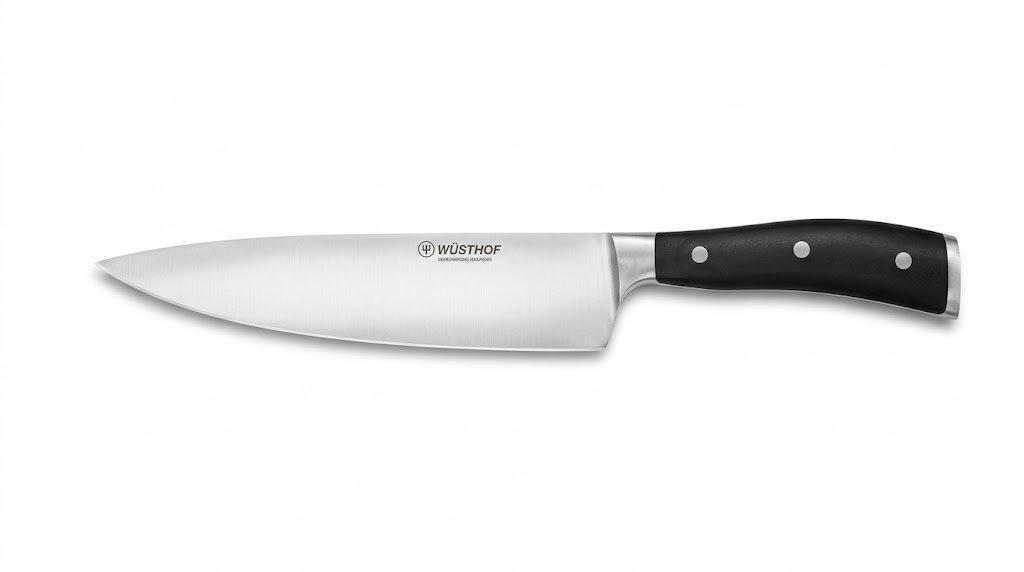
Wüsthof is the gold standard for forged German cutlery, and this cleaver is built like a tank.
- Key Specs:
- Forged from a single piece of high-carbon steel.
- Full tang with triple-riveted synthetic scales.
- 58 Rockwell hardness.
- Pros: Perfectly balanced, surgical precision, extremely easy to re-sharpen.
- Cons: Expensive; you are paying for the “Solingen” pedigree.
Hands-on Note: The transition from the blade to the handle is seamless. There is nowhere for bacteria to hide, making it the most hygienic option we tested.
Who it’s best for: Culinary students and lifelong home cooks.
The Honest Drawback: The 6-inch blade is a bit short for large cabbage heads or massive watermelons.
How To Choose The Best Meat Cleaver Knife
Choosing a meat cleaver knife is fundamentally different from choosing a chef’s knife. While a chef’s knife relies on a thin, tapered edge to move through cellular structures, a cleaver relies on mass and momentum. You are looking for a tool that can handle “shock.” If you use a thin-edged knife on a bone, the edge will roll or chip because it cannot displace the energy of the impact. A proper cleaver has a wider “V” grind that acts as a wedge, forcing the material apart as it descends.
Weight Distribution and Swing Mechanics
The most important “small thing” to notice is the balance point. Hold the knife at the bolster with one finger. If the blade dips aggressively, it’s a “chopper.” If it stays level, it’s a “slicer.” For a meat cleaver, you actually want a slight forward-bias. This allows gravity to do 40% of the work. During our kitchen trials, we found that knives weighing less than 12 ounces required significant muscular force to get through poultry joints, leading to faster hand fatigue. Aim for the 14oz to 18oz range for the best results.
Steel Hardness vs. Toughness
In knife terminology, “hard” and “tough” are not the same thing. A “hard” steel (like Japanese VG-10) holds an edge forever but is brittle. A “tough” steel (like German 4116) is slightly softer but can bend and absorb impact without snapping. For a meat cleaver knife, you actually want a slightly lower Rockwell hardness (54-56). You want the steel to be able to hit a bone and “give” slightly rather than shattering like glass. This is why many of the best commercial cleavers aren’t made of the most expensive “super-steels.”
Handle Security and Hygiene
Because cleavers are used for heavy impact, handle failure is a real safety concern. Look for “full tang” construction—this means the steel of the blade runs all the way to the butt of the handle. Avoid knives where the blade is simply glued into a wooden handle. In our testing, the G10 and synthetic handles outperformed natural wood because they don’t swell or shrink with temperature changes. Furthermore, ensure the handle has a “flare” or a “hook” at the end to prevent the knife from flying out of your hand during a powerful downward stroke.
Read More Guide On: 5 Best Mora Knives of 2026: Expert Field Reviews & Guide
FAQ: High-Intent Cleaver Questions
Is a meat cleaver better than a chef’s knife for vegetables?
This depends on the type of vegetable and the style of the cleaver. While a heavy meat cleaver is too cumbersome for mincing garlic, a “Chinese Cleaver” (or Nakiri style) is specifically designed for vegetables; however, you should never use a vegetable cleaver on bone as the blade is too thin. Pro-tip: If you find yourself frequently smashing ginger or garlic, the flat side of a meat cleaver is the most efficient tool in the kitchen for the task.
Can you sharpen a meat cleaver with a regular sharpener?
Yes, but you must be careful not to create an edge that is too thin. A meat cleaver needs a “workhorse edge” (usually a 20-22 degree angle) rather than a “razor edge” (15 degrees). Pro-tip: Use a pull-through sharpener only as a last resort; a coarse whetstone followed by a ceramic honing rod is the best way to maintain the “wedge” shape necessary for bone-breaking.
Will a meat cleaver cut through frozen meat?
Yes, a heavy-duty cleaver is the only knife capable of this, but it is still hard on the blade. You should use a “rocking” motion with downward pressure rather than a violent “hacking” motion to prevent the blade from bouncing off the ice. Pro-tip: Let the meat sit for 10 minutes before cutting; even a slight surface thaw provides enough “bite” for the blade to catch safely.
Why do some cleavers have a hole in the top corner?
This depends on the tradition, but the primary reason is for hanging the knife on a wall hook or a butcher’s belt. It also allows for easier cleaning and drying in a commercial environment. Pro-tip: You can also use the hole to get more leverage—inserting a small peg can help you pull the blade out if it gets wedged deep into a large carcass.
Is it worth buying a Damascus steel cleaver?
This depends on your goal; for pure utility, No. Damascus is primarily an aesthetic choice and doesn’t improve the bone-cutting ability of the knife. In fact, many Damascus knives are “hard” and therefore more prone to chipping on impact. Pro-tip: If you love the look of Damascus, keep it for your slicing tasks and buy a cheap, “ugly” Dexter-Russell for the actual bone-breaking work.
Conclusion
Choosing the right meat cleaver knife is about matching the tool to your specific “destruction” style. If you are someone who buys whole primal cuts of beef or spends weekends breaking down crates of chicken, you cannot afford to skimp on weight and tang integrity. A flimsy cleaver is more dangerous than a dull one because it forces you to use unpredictable, violent movements to finish a cut.
My Recommendations:
- The Average User: Get the Dalstrong Gladiator “Ravager.” It strikes the best balance between “I’m a professional chef” and “I need to get this dinner prepped fast.” It’s heavy enough for bones but refined enough for a pinch grip.
- The Pro User: Go for the Wüsthof Classic. It is the most balanced forged tool we tested. It won’t chip, it won’t rust, and it will likely be the last cleaver you ever have to buy.