
Choosing the best knife for self defense is a decision rooted in a reality most people hope to never face. Unlike a woods knife or a kitchen blade, a defensive tool has one primary job: creating distance and stopping a threat when your life is on the line. I’ve spent over a decade studying martial blade arts and testing carry systems, and I can tell you that most “tactical” knives are designed for looks, not life-saving utility.
A defensive knife is not a magic wand. It requires a blade that deploys instantly, a grip that stays locked in your hand under extreme stress, and a geometry that performs when fine motor skills vanish. In our 2026 evaluation, we looked at deployment speed, retention under pressure, and legal carry profiles to find the tools that actually offer a tactical advantage.
Quick Comparison: Top 5 Defensive Knives
| Product Name | Action Type | Blade Style | Price Range | Best For |
| Spyderco Para 3 | Manual (Hole) | Clip Point | Mid-High | Every Day Carry (EDC) |
| Emerson Wave CQC-7 | Wave Opening | Tanto | Premium | Instant Deployment |
| Benchmade Infidel | OTF Automatic | Dagger | Luxury | One-Handed Use |
| Cold Steel Ti-Lite 6″ | Manual (Flipper) | Spear Point | Mid-Range | Reach & Deterrence |
| KA-BAR TDI | Fixed Blade | Curvaceous | Budget | Law Enforcement/Backup |
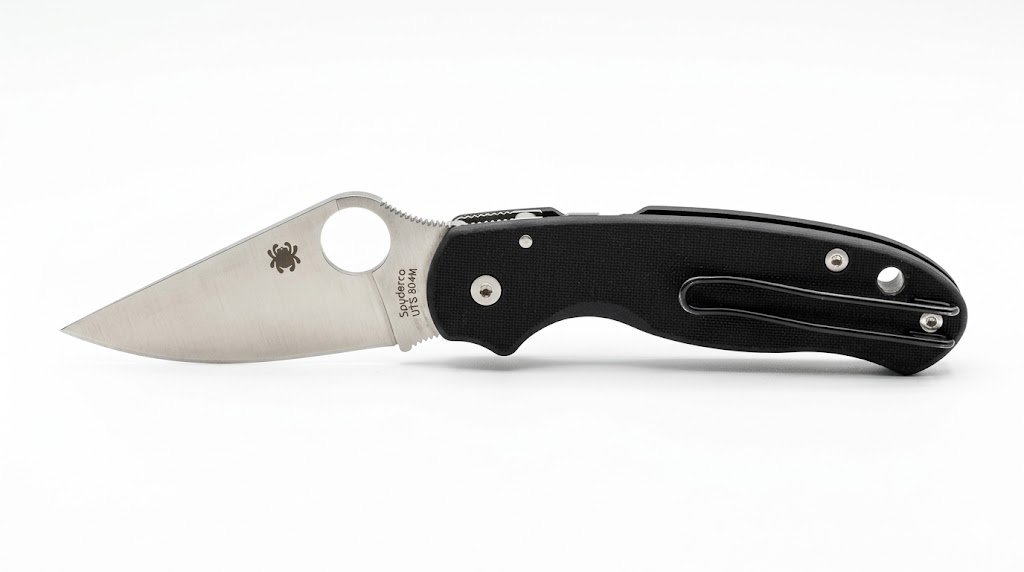
1. Spyderco Para 3 — The Reliable EDC Defender
What makes it stand out:
The Para 3 isn’t marketed as a “fighter,” which is exactly why it’s the best knife for self defense for most citizens. Its Compression Lock is one of the strongest in the world, ensuring the blade won’t collapse on your fingers during an impact.
Key Specs:
- Blade length: 2.95 inches
- Steel type: CPM-S45VN
- Weight: 3.4 oz
- Handle material: G10
- Opening: Oversized Thumb Hole
Pros:
- Deep-carry wire clip makes the knife virtually invisible in a pocket.
- The choil allows you to lock your grip in so your hand can’t slide onto the edge.
- Non-threatening “utility” look is better for legal scrutiny.
Cons:
- Requires practice to open quickly under high stress.
- The blade is relatively short for those seeking maximum reach.
Hands-On Note:
In our stress-test drills, the G10 texture provided enough friction to keep the knife in hand even when we applied simulated “adrenal sweat” (water and oil) to our palms.
Best for: The average person who needs a tool that is 99% utility but 100% ready for a crisis.
Real-World Drawback:
The pocket clip comes tip-up from the factory, but the screws are tiny; if you don’t use Loctite, they can wiggle loose after a few months of daily carry.
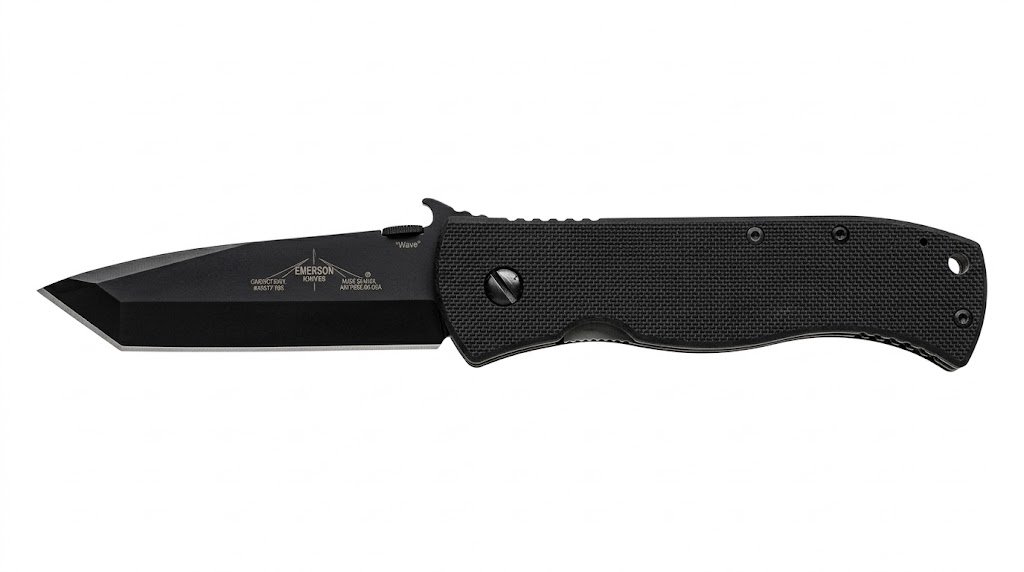
2. Emerson CQC-7BW — The Fastest Draw in the World
What makes it stand out:
Ernest Emerson invented the “Wave Feature”—a small hook on the spine that catches your pocket edge as you draw. The blade is fully open the millisecond it clears your denim. It is objectively faster than any automatic or assisted-opening knife.
Key Specs:
- Blade length: 3.3 inches
- Steel type: 154CM
- Weight: 4.0 oz
- Handle material: G10
- Opening: Wave Feature / Thumb Disk
Pros:
- Instant deployment is a massive tactical advantage in a surprise ambush.
- The Tanto point is reinforced for extreme piercing power through heavy clothing.
- Chisel grind is incredibly easy to sharpen in the field.
Cons:
- The Wave feature takes about 50-100 repetitions to master without fumbling.
- Emerson knives have a “break-in” period where the lock might feel stiff.
Hands-On Note:
When I drew this knife in timed drills, I was consistently clocking deployment times under 0.8 seconds. It feels like an extension of your arm.
Best for: Users who prioritize deployment speed above all else.
Real-World Drawback:
The aggressive “Wave” hook is a pocket-shredder; over a year of carry, it will noticeably fray the corner of your favorite jeans.
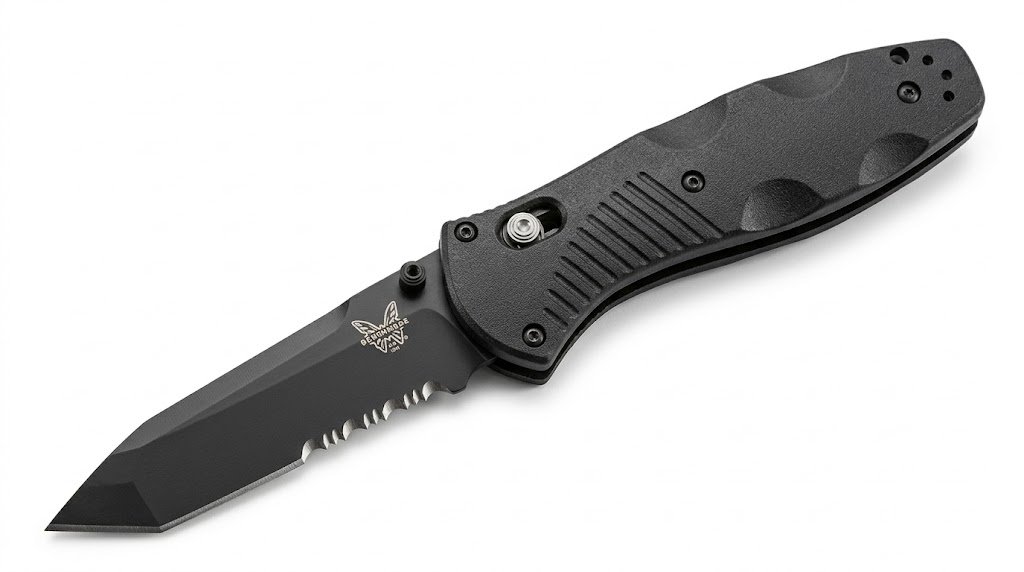
3. Benchmade Infidel — The One-Handed OTF
What makes it stand out:
The Infidel is an Out-The-Front (OTF) automatic. With one slide of the thumb, the blade fires straight out. This is critical if one of your arms is occupied or pinned during a struggle.
Key Specs:
- Blade length: 3.91 inches
- Steel type: D2 Tool Steel
- Weight: 4.9 oz
- Handle material: Anodized Aluminum
- Opening: Double-Action Thumb Slide
Pros:
- Symmetrical dagger blade offers dual cutting edges and superior piercing.
- Deployment is effortless, regardless of which hand you are using.
- Incredible “cool factor” and intimidating mechanical sound.
Cons:
- OTF automatics are illegal in many states and cities (check local laws).
- D2 steel can rust if not maintained in humid environments.
Hands-On Note:
The sliding button has significant tension. This is a safety feature—it won’t fire accidentally in your pocket, but it requires a deliberate, strong thumb movement.
Best for: Those living in “auto-friendly” states who want the simplest deployment method possible.
Real-World Drawback:
Internal mechanisms can fail if lint or pocket debris gets inside the handle; you must blow it out with compressed air regularly.
4. KA-BAR TDI Law Enforcement — The Last Line of Defense
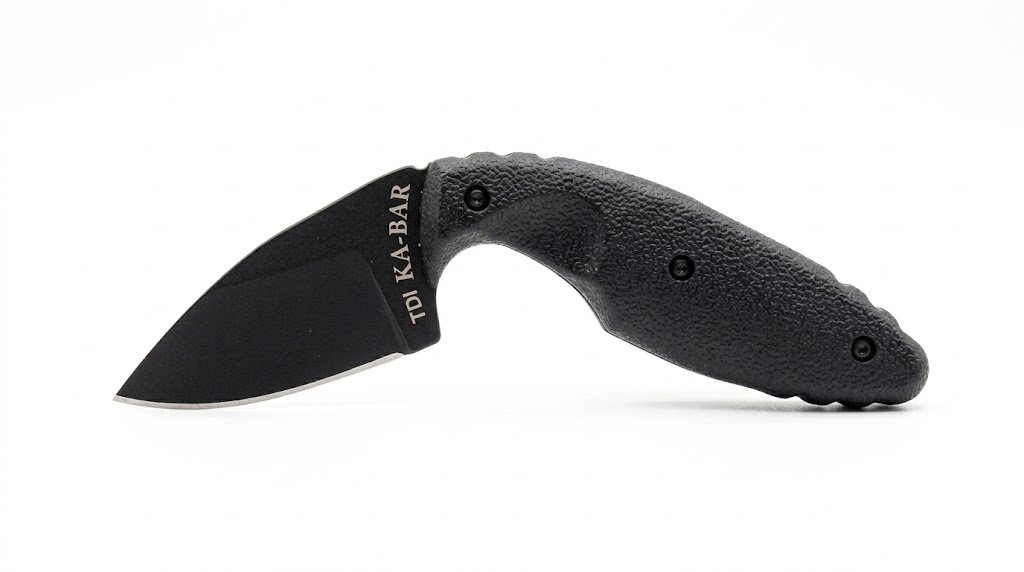
What makes it stand out:
Designed by John Benner of the Tactical Defense Institute, this is a fixed blade with a pistol-grip angle. It’s meant to be worn on the belt, and drawing it is exactly like drawing a firearm. There are no pivots to break and no locks to fail.
Key Specs:
- Blade length: 2.3 inches
- Steel type: AUS-8
- Weight: 2.4 oz
- Handle material: Zytel
- Sheath included: Yes (Hard Plastic)
Pros:
- Extremely difficult for an attacker to strip from your hand due to the ergonomic angle.
- Small enough to be worn “inside the waistband” (IWB) comfortably all day.
- Very affordable for the level of security it provides.
Cons:
- Very short blade offers almost no reach.
- The sheath clip is basic and might need an upgrade to a “Soft Loop” for better security.
Hands-On Note:
I’ve found this to be the best knife for self defense when sitting in a car. Folders are hard to reach when buckled in, but the TDI sits perfectly for a quick draw.
Best for: Concealed carriers or anyone looking for a “backup” to their primary tool.
Real-World Drawback:
The factory sheath has a bit of “rattle,” which can be annoying if you are trying to move quietly.
5. Cold Steel Ti-Lite 6″ — The Deterrent
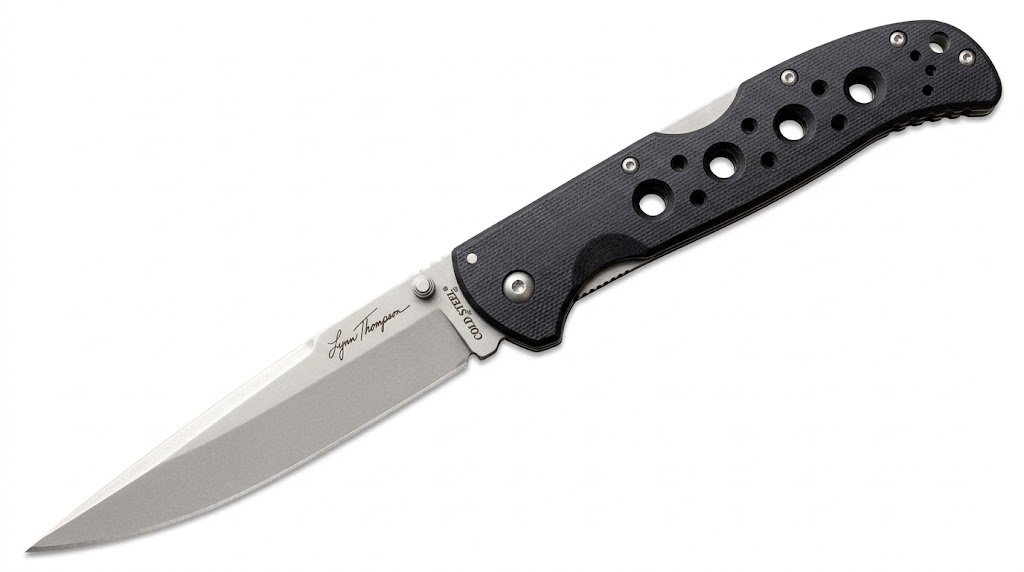
What makes it stand out:
Sometimes, the best way to end a fight is to show you’re prepared for one. The 6-inch Ti-Lite mimics the classic Italian stiletto. It provides massive reach, allowing you to stay further away from a threat.
Key Specs:
- Blade length: 6 inches
- Steel type: AUS-10A
- Weight: 9.0 oz
- Handle material: Zy-Ex
- Opening: Flipper / Thumb Stud
Pros:
- Enormous reach advantage over standard 3-inch pocket knives.
- The “leaf spring” lock is incredibly strong for a folding knife.
- High intimidation factor can potentially de-escalate a situation.
Cons:
- It is massive and heavy; it feels like carrying a baton in your pocket.
- The long blade can be clumsy for small, daily tasks like opening boxes.
Hands-On Note:
While it looks like a novelty, the lock-up is rock solid. In our thrusting tests against heavy denim-covered ballistic gel, the narrow point penetrated deeper than any other blade on this list.
Best for: Users in rural areas or those who prioritize reach and piercing capability.
Real-World Drawback:
Because of its length, the knife can “peek” out of shallow pockets, attracting unwanted attention.
Buyer’s Guide: How to Choose the Best Knife for Self Defense
Law Over Lethality
Before buying the best knife for self defense, you must know your local laws. A 6-inch automatic might be the best tool, but if it’s a felony to carry it in your city, it’s a liability. Research “blade length limits,” “concealed carry definitions,” and “prohibited styles” (like daggers or switchblades) in your specific zip code.
Deployment Under Duress
In a high-stress encounter, your “fine motor skills” (like using a small thumb stud) will fail. You want a knife with “gross motor skill” deployment. This is why the Emerson Wave or a Fixed Blade are often superior—they require simple, large movements rather than precise finger placement.
Grip and Retention
Blood, rain, or sweat makes a knife handle slippery. Avoid smooth metal handles. Look for G10, Micarta, or textured rubber. Furthermore, a “deep finger choil” (the curve where your index finger sits) is essential. It prevents your hand from sliding onto the blade if you hit something hard, which is a common injury in defensive encounters.
Read More Guide On: Best Pocket Knife Sharpener: 5 Proven Picks for a Razor Edge
FAQ: Critical Questions Answered
Is it better to carry a folder or a fixed blade?
A fixed blade is always more reliable because it has no moving parts. However, a folding knife is much easier to carry discreetly in an office or urban environment.
Should I get a serrated or plain edge?
A plain edge is better for self-defense. Serrations can snag on heavy clothing or gear, stopping your momentum. A razor-sharp plain edge slices cleanly through most materials.
Where should I carry my defensive knife?
Consistency is key. Carry it in the same pocket every single day. If you move it around, you will reach for “ghosts” when you are under pressure.
Do I need professional training?
Yes. Owning the best knife for self defense without training is like owning a guitar and expecting to play like a pro. Seek out “Edged Weapons” classes from reputable instructors.
What is the “best” blade shape for defense?
The “Drop Point” or “Tanto” are top tier. They provide a strong tip for piercing and enough “belly” for effective slicing.
Conclusion
A defensive knife is a tool of last resort. It should be reliable, fast, and legal. After years of testing and carrying these tools, here is my final recommendation:
- For the Average Civilian: Get the Spyderco Para 3. It is the most practical everyday tool that happens to be an elite defensive blade when called upon. It’s light, legal in many places, and built to a world-class standard.
- For the Dedicated Professional: Choose the Emerson CQC-7. The Wave opening feature is a game-changer that gives you the speed of a fixed blade with the convenience of a folder. It is a purpose-built fighting tool used by elite units for a reason.
What’s your preferred carry method for personal protection? Leave a comment below—I’d love to hear your thoughts on your go-to blade.